Event submissions
Published
 10.3390/CPPC2021-10226 (registering DOI)
 This submission belongs to the session E. Peptide and Protein Applications in Cosmetic, Agricultural and High-tech Products of the event First Canadian Peptide and Protein Community Virtual Symposium
Published date
27 May, 2021
Citation
Miguel Rebollo-Hernanz, Silvia Cañas, Maria Angeles Martin-Cabrejas, Yolanda Aguilera, In Silico Identification of Bioactive Proteins and Peptides in Insects for Human Consumption, in Proceedings of First Canadian Peptide and Protein Community Virtual Symposium, 27 May–28 May 2021, MDPI: Basel, Switzerland, doi: 10.3390/CPPC2021-10226
Share
Email
Facebook
Twitter
LinkedIn
In Silico Identification of Bioactive Proteins and Peptides in Insects for Human Consumption

Miguel Rebollo-Hernanz 1,2

Silvia Cañas 1,2

Maria Angeles Martin-Cabrejas 1,2

Yolanda Aguilera 1,2
1. Department of Agricultural Chemistry and Food Science, Universidad Autónoma de Madrid
2. Institute of Food Science Research (CIAL, UAM-CSIC)
Abstract
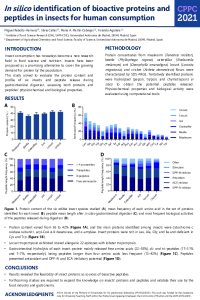
Insect consumption has nowadays become a new research field in food science and nutrition. Insects have been proposed as a promising alternative to cover the growing demand for protein by the population. This study aimed to evaluate the protein content and profile of six insects and peptide release during gastrointestinal digestion, assessing both proteins and peptides' physicochemical and biological properties. Protein concentrates from mealworm (Tenebrio molitor), beetle (Phyllophaga rugosa), caterpillar (Nudaurelia melanops), ant (Oecophylla smaradigna), locust (Locusta migratoria), and cricket (Acheta domesticus) flours were characterized by SDS-PAGE. identified proteins were hydrolyzed (pepsin, trypsin, and chymotrypsin) in silico to obtain the potential peptides released. Physicochemical properties and biological activity were evaluated using . Protein content varied from 36 to 42%, and the main proteins identified among insects were cytochrome c oxidase subunit I, acyl-CoA Δ-9 desaturase, and α-amylase. Insect proteins were rich in Leu, Ala, Gly, and Ile and deficient in Cys and Trp. Locust tropomyosin exhibited shared allergenic 22 epitopes with lobster tropomyosin. Gastrointestinal hydrolysis of each insect protein mainly released free amino acids (22–55%), di- and tri-peptides (22–55% and 17–31%, respectively) being peptides longer than four amino acids less (12–42%). Peptides presented antioxidant and DPP-IV and ECA inhibitory potential. Results revealed the feasibility of insect proteins as sources of bioactive peptides. Forthcoming studies are required to expand the knowledge on insects' proteins and peptides and validate their use by the food industry and gastronomy.
Keywords
insects
mealworm
beetle
caterpillar
ant
locust
cricket
food ingredient
antioxidant
antidiabetic
antihypertensive
hydrolysis
bioinformatic
computational
Manuscript
sciforum-045418.pdf
Poster
045418.pdf
Exploring Anti-Leishmanial Almiramide Structure-aActivity Relationships
Learning Structure-Activity Relationship (GE-SAR) of the Wittig Reaction from Genetically-Encoded substrates