Event submissions
Published
 10.3390/CPPC2021-10227 (registering DOI)
 This submission belongs to the session A. Chemical-Biology and Medicinal Chemistry of the event First Canadian Peptide and Protein Community Virtual Symposium
Published date
27 May, 2021
Citation
Kejia Yan, Vivian Triana, Kwami Aku-Dominguez, Alex Brown, Ratmir Derda, Learning Structure-Activity Relationship (GE-SAR) of the Wittig Reaction from Genetically-Encoded substrates, in Proceedings of First Canadian Peptide and Protein Community Virtual Symposium, 27 May–28 May 2021, MDPI: Basel, Switzerland, doi: 10.3390/CPPC2021-10227
Share
Email
Facebook
Twitter
LinkedIn
Learning Structure-Activity Relationship (GE-SAR) of the Wittig Reaction from Genetically-Encoded substrates
'%3e%3cpath%20d='M12.6647%2010.9104C12.4176%2010.325%2012.0589%209.7933%2011.6088%209.34485C11.16%208.89511%2010.6283%208.53653%2010.0432%208.28891C10.038%208.28629%2010.0327%208.28498%2010.0275%208.28236C10.8437%207.69282%2011.3743%206.73252%2011.3743%205.64907C11.3743%203.85423%209.92005%202.40002%208.12522%202.40002C6.33038%202.40002%204.87618%203.85423%204.87618%205.64907C4.87618%206.73252%205.40677%207.69282%206.22296%208.28367C6.21772%208.28629%206.21248%208.2876%206.20724%208.29022C5.62031%208.53783%205.09365%208.89287%204.64167%209.34616C4.19192%209.79496%203.83334%2010.3266%203.58573%2010.9117C3.34247%2011.4846%203.21128%2012.0987%203.19925%2012.721C3.1989%2012.735%203.20135%2012.7489%203.20646%2012.7619C3.21157%2012.7749%203.21924%2012.7868%203.22901%2012.7968C3.23877%2012.8068%203.25045%2012.8148%203.26334%2012.8202C3.27623%2012.8256%203.29007%2012.8284%203.30406%2012.8284H4.09012C4.14776%2012.8284%204.19362%2012.7825%204.19493%2012.7262C4.22113%2011.7148%204.62726%2010.7676%205.34519%2010.0497C6.08802%209.30686%207.07452%208.89811%208.12522%208.89811C9.17592%208.89811%2010.1624%209.30686%2010.9052%2010.0497C11.6232%2010.7676%2012.0293%2011.7148%2012.0555%2012.7262C12.0568%2012.7839%2012.1027%2012.8284%2012.1603%2012.8284H12.9464C12.9604%2012.8284%2012.9742%2012.8256%2012.9871%2012.8202C13%2012.8148%2013.0117%2012.8068%2013.0214%2012.7968C13.0312%2012.7868%2013.0389%2012.7749%2013.044%2012.7619C13.0491%2012.7489%2013.0515%2012.735%2013.0512%2012.721C13.0381%2012.0947%2012.9084%2011.4856%2012.6647%2010.9104ZM8.12522%207.90243C7.52388%207.90243%206.95792%207.66793%206.53214%207.24215C6.10636%206.81636%205.87185%206.2504%205.87185%205.64907C5.87185%205.04773%206.10636%204.48177%206.53214%204.05599C6.95792%203.63021%207.52388%203.3957%208.12522%203.3957C8.72655%203.3957%209.29252%203.63021%209.7183%204.05599C10.1441%204.48177%2010.3786%205.04773%2010.3786%205.64907C10.3786%206.2504%2010.1441%206.81636%209.7183%207.24215C9.29252%207.66793%208.72655%207.90243%208.12522%207.90243Z'%20fill='%235D1EE1'/%3e%3c/g%3e%3c/svg%3e)
Kejia Yan 1
Vivian Triana 1
Kwami Aku-Dominguez 1
Alex Brown 1
Ratmir Derda 1
1. Department of Chemistry, University of Alberta
Abstract
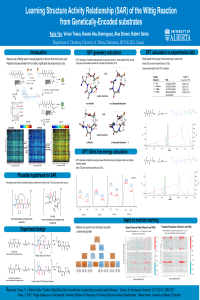
The Wittig reaction can be used for late stage functionalization of proteins and peptides to ligate glycans, pharmacophores, and other natural or unnatural functionalities do not present in polypeptides made of 20 natural amino acids. It is not obvious how peptide sequence influences the rate and outcome of Wittig ligation. Our group has previously employed the Wittig reaction to modify N-terminal aldehydes in Genetically-Encoded (GE) peptide libraries. It was found that the reaction rate strongly depends on the nature of the two N-terminal amino acids: specifically peptides with penultimate Pro-Pro exhibit a significantly decreased reaction rate. A plausible mechanistic hypothesis is that the hydrogen bonds inside the peptide backbone stabilize the transition state (TS) of the Wittig reaction and accelerate this reaction. I synthesized two model isoteric peptide substrates—CHO-Ala-Ala and CHO-Sarcosine-Sarcosine—with and without primary amides. The DFT calculation of the geometry of transition states in model peptide CHO-Ala-Ala indeed detected a contribution of hydrogen bond between backbone N-H and the betaine in the late TS while CHO-Sarcosine-Sarcosine does not have this characteristic. I measured reaction rates with model ylide and compare the observed results to the energy and geometry of the Wittig reaction TSs for CHO-Ala-Ala and CHO-Sarcosine-Sarcosine obtained in DFT calculation.
Keywords
phage
SAR
Wittig reaction
DFT calculation
Manuscript
sciforum-045876.pdf
Poster
sciforum_045876_manuscript_KY_2021CPPC.pdf
In Silico Identification of Bioactive Proteins and Peptides in Insects for Human Consumption
Peptides Derived from Palindromic Sequence RWQWRWQWR Exert an Additive Effect with Fluconazole in A Drug-Resistant C. albicans Strain