Event submissions
Published
 10.3390/CPPC2021-10228 (registering DOI)
 This submission belongs to the session A. Chemical-Biology and Medicinal Chemistry of the event First Canadian Peptide and Protein Community Virtual Symposium
Published date
27 May, 2021
Citation
Karen Johanna Cárdenas-Martínez, Yerly Vargas-Casanova, Laura Bonilla-Velásquez, Claudia Marcela Parra-Giraldo, Zuly Jenny Rivera- Monroy, Javier García-Castañeda, Peptides Derived from Palindromic Sequence RWQWRWQWR Exert an Additive Effect with Fluconazole in A Drug-Resistant C. albicans Strain, in Proceedings of First Canadian Peptide and Protein Community Virtual Symposium, 27 May–28 May 2021, MDPI: Basel, Switzerland, doi: 10.3390/CPPC2021-10228
Share
Email
Facebook
Twitter
LinkedIn
Peptides Derived from Palindromic Sequence RWQWRWQWR Exert an Additive Effect with Fluconazole in A Drug-Resistant C. albicans Strain
'%3e%3cpath%20d='M12.6647%2010.9104C12.4176%2010.325%2012.0589%209.7933%2011.6088%209.34485C11.16%208.89511%2010.6283%208.53653%2010.0432%208.28891C10.038%208.28629%2010.0327%208.28498%2010.0275%208.28236C10.8437%207.69282%2011.3743%206.73252%2011.3743%205.64907C11.3743%203.85423%209.92005%202.40002%208.12522%202.40002C6.33038%202.40002%204.87618%203.85423%204.87618%205.64907C4.87618%206.73252%205.40677%207.69282%206.22296%208.28367C6.21772%208.28629%206.21248%208.2876%206.20724%208.29022C5.62031%208.53783%205.09365%208.89287%204.64167%209.34616C4.19192%209.79496%203.83334%2010.3266%203.58573%2010.9117C3.34247%2011.4846%203.21128%2012.0987%203.19925%2012.721C3.1989%2012.735%203.20135%2012.7489%203.20646%2012.7619C3.21157%2012.7749%203.21924%2012.7868%203.22901%2012.7968C3.23877%2012.8068%203.25045%2012.8148%203.26334%2012.8202C3.27623%2012.8256%203.29007%2012.8284%203.30406%2012.8284H4.09012C4.14776%2012.8284%204.19362%2012.7825%204.19493%2012.7262C4.22113%2011.7148%204.62726%2010.7676%205.34519%2010.0497C6.08802%209.30686%207.07452%208.89811%208.12522%208.89811C9.17592%208.89811%2010.1624%209.30686%2010.9052%2010.0497C11.6232%2010.7676%2012.0293%2011.7148%2012.0555%2012.7262C12.0568%2012.7839%2012.1027%2012.8284%2012.1603%2012.8284H12.9464C12.9604%2012.8284%2012.9742%2012.8256%2012.9871%2012.8202C13%2012.8148%2013.0117%2012.8068%2013.0214%2012.7968C13.0312%2012.7868%2013.0389%2012.7749%2013.044%2012.7619C13.0491%2012.7489%2013.0515%2012.735%2013.0512%2012.721C13.0381%2012.0947%2012.9084%2011.4856%2012.6647%2010.9104ZM8.12522%207.90243C7.52388%207.90243%206.95792%207.66793%206.53214%207.24215C6.10636%206.81636%205.87185%206.2504%205.87185%205.64907C5.87185%205.04773%206.10636%204.48177%206.53214%204.05599C6.95792%203.63021%207.52388%203.3957%208.12522%203.3957C8.72655%203.3957%209.29252%203.63021%209.7183%204.05599C10.1441%204.48177%2010.3786%205.04773%2010.3786%205.64907C10.3786%206.2504%2010.1441%206.81636%209.7183%207.24215C9.29252%207.66793%208.72655%207.90243%208.12522%207.90243Z'%20fill='%235D1EE1'/%3e%3c/g%3e%3c/svg%3e)
Karen Johanna Cárdenas-Martínez 1

Yerly Vargas-Casanova 2
Laura Bonilla-Velásquez 3

Claudia Marcela Parra-Giraldo 2
Zuly Jenny Rivera- Monroy 4
Javier García-Castañeda 1
1. Department of Pharmacy, Universidad Nacional de Colombia
2. Department of Microbiology , Pontificia Universidad Javeriana
3. Biotechnology Institute, Universidad Nacional de Colombia
4. Department of Chemistry, Universidad Nacional de Colombia
Abstract
Antimicrobial resistance is a public health problem, requiring the development of new therapeutic agents. Antimicrobial peptides derived from Bovine Lactoferricin (LfcinB) have exhibited antibacterial and antifungal effects. Lipopeptides and peptides containing non-natural amino acids, derived from LfcinB (21-25) Pal: RWQWRWQWR, were synthesized by SPPS-Fmoc/tBu and characterized by RP-HPLC and MALDI-TOF mass spectrometry. The antimicrobial activity was tested against reference strains E. coli ATCC 11775 and 25922, S. aureus ATCC 25923, C. albicans SC 5314, C. auris 435 and 537, as well as against the clinical isolate of C. albicans 256 which is resistant to fluconazole. The peptides containing non-natural amino acids exhibited lower minimum inhibitory concentrations (MIC), and minimum fungicidal concentration (MFC) / minimum bactericidal concentration (MBC) values for most of the strains except C. auris. The lipopeptides did not show activity at the concentrations evaluated, however, molecules containing amino-isobutyric or lauric acid combined with fluconazole showed an additivity effect against the clinical isolate C. albicans (256), finding decreases of two to eight times in the MIC values compared with the MIC of the fluconazole only. The results suggest that these molecules could be candidates to develop combined therapies against strains resistant to fluconazole. All the molecules are synthetically viable and the functionalization with non-natural amino acids is a positive modification to enhance the antimicrobial activity.
Keywords
Lipopeptides
non-natural amino acids
antimicrobial resistance
fluconazole.
Manuscript
sciforum-045911.pdf
Poster
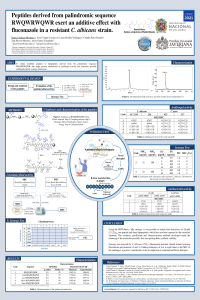
sciforum_045911_slides_Poster_CPPC_FINAL.pdf
Learning Structure-Activity Relationship (GE-SAR) of the Wittig Reaction from Genetically-Encoded substrates
FlICked ACE2 Mimics Inhibit SARS-CoV-2 Spike Protein-ACE2 Interaction