Event submissions
Published
 10.3390/CPPC2021-10230 (registering DOI)
 This submission belongs to the session E. Peptide and Protein Applications in Cosmetic, Agricultural and High-tech Products of the event First Canadian Peptide and Protein Community Virtual Symposium
Published date
27 May, 2021
Citation
Zeyneb Boucherit, Raouf Zehioua, Aicha Mechakra, Souad Ameddah, Economic Laccase Production from Halotolerant Fungi, in Proceedings of First Canadian Peptide and Protein Community Virtual Symposium, 27 May–28 May 2021, MDPI: Basel, Switzerland, doi: 10.3390/CPPC2021-10230
Share
Email
Facebook
Twitter
LinkedIn
Economic Laccase Production from Halotolerant Fungi
'%3e%3cpath%20d='M12.6647%2010.9104C12.4176%2010.325%2012.0589%209.7933%2011.6088%209.34485C11.16%208.89511%2010.6283%208.53653%2010.0432%208.28891C10.038%208.28629%2010.0327%208.28498%2010.0275%208.28236C10.8437%207.69282%2011.3743%206.73252%2011.3743%205.64907C11.3743%203.85423%209.92005%202.40002%208.12522%202.40002C6.33038%202.40002%204.87618%203.85423%204.87618%205.64907C4.87618%206.73252%205.40677%207.69282%206.22296%208.28367C6.21772%208.28629%206.21248%208.2876%206.20724%208.29022C5.62031%208.53783%205.09365%208.89287%204.64167%209.34616C4.19192%209.79496%203.83334%2010.3266%203.58573%2010.9117C3.34247%2011.4846%203.21128%2012.0987%203.19925%2012.721C3.1989%2012.735%203.20135%2012.7489%203.20646%2012.7619C3.21157%2012.7749%203.21924%2012.7868%203.22901%2012.7968C3.23877%2012.8068%203.25045%2012.8148%203.26334%2012.8202C3.27623%2012.8256%203.29007%2012.8284%203.30406%2012.8284H4.09012C4.14776%2012.8284%204.19362%2012.7825%204.19493%2012.7262C4.22113%2011.7148%204.62726%2010.7676%205.34519%2010.0497C6.08802%209.30686%207.07452%208.89811%208.12522%208.89811C9.17592%208.89811%2010.1624%209.30686%2010.9052%2010.0497C11.6232%2010.7676%2012.0293%2011.7148%2012.0555%2012.7262C12.0568%2012.7839%2012.1027%2012.8284%2012.1603%2012.8284H12.9464C12.9604%2012.8284%2012.9742%2012.8256%2012.9871%2012.8202C13%2012.8148%2013.0117%2012.8068%2013.0214%2012.7968C13.0312%2012.7868%2013.0389%2012.7749%2013.044%2012.7619C13.0491%2012.7489%2013.0515%2012.735%2013.0512%2012.721C13.0381%2012.0947%2012.9084%2011.4856%2012.6647%2010.9104ZM8.12522%207.90243C7.52388%207.90243%206.95792%207.66793%206.53214%207.24215C6.10636%206.81636%205.87185%206.2504%205.87185%205.64907C5.87185%205.04773%206.10636%204.48177%206.53214%204.05599C6.95792%203.63021%207.52388%203.3957%208.12522%203.3957C8.72655%203.3957%209.29252%203.63021%209.7183%204.05599C10.1441%204.48177%2010.3786%205.04773%2010.3786%205.64907C10.3786%206.2504%2010.1441%206.81636%209.7183%207.24215C9.29252%207.66793%208.72655%207.90243%208.12522%207.90243Z'%20fill='%235D1EE1'/%3e%3c/g%3e%3c/svg%3e)
Zeyneb Boucherit 1
Raouf Zehioua 2
Aicha Mechakra 3
Souad Ameddah 4
1. Laboratoire d’Obtention des Substances Thérapeutiques LOST, UFMC1, 25000, Constantine, Algeria
2. LABORATOIRE DE L'INGÉNIERIE DES PROCÉDÉS DE L'ENVIRONNEMENT, UC3SB, 25000, Constantine, Algeria
3. Laboratoire de Biologie et Environnement, UFMC1, 25000, Constantine, Algeria
4. Laboratoire de biologie et Environnement. UFMC1, 25000, Constantine, Algeria
Abstract
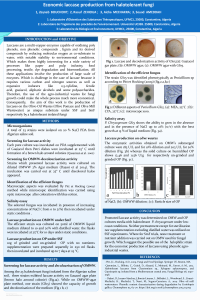
The main aim of this study was to assess the ability of producing extracellular laccases of fungi isolated from Algerian’s saline soil and use them for an eventual low coast laccase’s production using agro-industrial wastes as substrate. Three out of twenty-three isolates displayed laccase-producing ability as measured by selective agar plate assays and were all halotolerant. Among them, one strain grows and decolorizes the Olive oil wastewater agar medium. The efficient strain was identified as Penicillium chrysogenum. This latter was highly halotolerant fungus due to its ability to grow from 0 to 21% (w/v) of NaCl with optimal growth showed at 15 % NaCl of liquid medium. The enzyme production was carried out, in the dark, at 25° C on diluted olive oil wastewater under Submerged fermentation (SmF) static condition for ten days and on olive pomace under Solid Stat Fermentation (SSF) for seven days. Both of the olive-oil wastes were adequate for laccase activities with 183 and 203 U/L on respectively 10% and 20% unsupplemented olive mill wastewaters and 12,46 U/g and 11,56 U/g on the untreated grinded and ungrinded olive pomace correspondingly. These results might suggest the possible use of the strain Penicillium chrysogenum for the economic production of laccases using phenolic agro-industrial wastes.
Keywords
Laccase
Halotolerant fungi
Agro-industrial wastes.
Manuscript
sciforum-045428.pdf
Poster
045428.pdf
FlICked ACE2 Mimics Inhibit SARS-CoV-2 Spike Protein-ACE2 Interaction
Inhibition of Breast, Liver and Prostate Cancer Cell Proliferation by Cowpea Derived Peptide Fractions: An In Vitro Investigation