Event submissions
Published
 10.3390/CPPC2021-10232 (registering DOI)
 This submission belongs to the session E. Peptide and Protein Applications in Cosmetic, Agricultural and High-tech Products of the event First Canadian Peptide and Protein Community Virtual Symposium
Published date
27 May, 2021
Citation
Biane Oliveira Philadelpho, Mariana Barros de Cerqueira e Silva, Victória Guimarães Santiago, Lorena Moraes de Almeida, Victor Luis Soares Reis, Johnnie Elton Machado dos Santos, Dara Leite Fontes, Rone Aparecido De Grandis, Fernando Rogério Pavan, Ederlan de Souza Ferreira, Inhibition of Breast, Liver and Prostate Cancer Cell Proliferation by Cowpea Derived Peptide Fractions: An In Vitro Investigation, in Proceedings of First Canadian Peptide and Protein Community Virtual Symposium, 27 May–28 May 2021, MDPI: Basel, Switzerland, doi: 10.3390/CPPC2021-10232
Share
Email
Facebook
Twitter
LinkedIn
Inhibition of Breast, Liver and Prostate Cancer Cell Proliferation by Cowpea Derived Peptide Fractions: An In Vitro Investigation
'%3e%3cpath%20d='M12.6647%2010.9104C12.4176%2010.325%2012.0589%209.7933%2011.6088%209.34485C11.16%208.89511%2010.6283%208.53653%2010.0432%208.28891C10.038%208.28629%2010.0327%208.28498%2010.0275%208.28236C10.8437%207.69282%2011.3743%206.73252%2011.3743%205.64907C11.3743%203.85423%209.92005%202.40002%208.12522%202.40002C6.33038%202.40002%204.87618%203.85423%204.87618%205.64907C4.87618%206.73252%205.40677%207.69282%206.22296%208.28367C6.21772%208.28629%206.21248%208.2876%206.20724%208.29022C5.62031%208.53783%205.09365%208.89287%204.64167%209.34616C4.19192%209.79496%203.83334%2010.3266%203.58573%2010.9117C3.34247%2011.4846%203.21128%2012.0987%203.19925%2012.721C3.1989%2012.735%203.20135%2012.7489%203.20646%2012.7619C3.21157%2012.7749%203.21924%2012.7868%203.22901%2012.7968C3.23877%2012.8068%203.25045%2012.8148%203.26334%2012.8202C3.27623%2012.8256%203.29007%2012.8284%203.30406%2012.8284H4.09012C4.14776%2012.8284%204.19362%2012.7825%204.19493%2012.7262C4.22113%2011.7148%204.62726%2010.7676%205.34519%2010.0497C6.08802%209.30686%207.07452%208.89811%208.12522%208.89811C9.17592%208.89811%2010.1624%209.30686%2010.9052%2010.0497C11.6232%2010.7676%2012.0293%2011.7148%2012.0555%2012.7262C12.0568%2012.7839%2012.1027%2012.8284%2012.1603%2012.8284H12.9464C12.9604%2012.8284%2012.9742%2012.8256%2012.9871%2012.8202C13%2012.8148%2013.0117%2012.8068%2013.0214%2012.7968C13.0312%2012.7868%2013.0389%2012.7749%2013.044%2012.7619C13.0491%2012.7489%2013.0515%2012.735%2013.0512%2012.721C13.0381%2012.0947%2012.9084%2011.4856%2012.6647%2010.9104ZM8.12522%207.90243C7.52388%207.90243%206.95792%207.66793%206.53214%207.24215C6.10636%206.81636%205.87185%206.2504%205.87185%205.64907C5.87185%205.04773%206.10636%204.48177%206.53214%204.05599C6.95792%203.63021%207.52388%203.3957%208.12522%203.3957C8.72655%203.3957%209.29252%203.63021%209.7183%204.05599C10.1441%204.48177%2010.3786%205.04773%2010.3786%205.64907C10.3786%206.2504%2010.1441%206.81636%209.7183%207.24215C9.29252%207.66793%208.72655%207.90243%208.12522%207.90243Z'%20fill='%235D1EE1'/%3e%3c/g%3e%3c/svg%3e)
Biane Oliveira Philadelpho 1
Mariana Barros de Cerqueira e Silva 2
Victória Guimarães Santiago 1
Lorena Moraes de Almeida 3
Victor Luis Soares Reis 1
Johnnie Elton Machado dos Santos 1
Dara Leite Fontes 1
Rone Aparecido De Grandis 4

Fernando Rogério Pavan 4

Ederlan de Souza Ferreira 1
1. School of Pharmacy, Federal University of Bahia (UFBA), Barão de Jeremoabo street, 40170-115, Salvador, BA, Brazil
2. Institute of Chemistry, Sao Paulo State University (UNESP), Prof. Francisco Swgni street, 14800-0600, Araraquara, SP, Brazil.
3. School of Pharmacy, Federal University of Bahia (UFBA), Barão de Jeremoabo street, 40170-115, Salvador, BA, Brazil.
4. School of Pharmaceutical Sciences, São Paulo State University (UNESP), 14800-903, Araraquara, SP, Brazil
Abstract
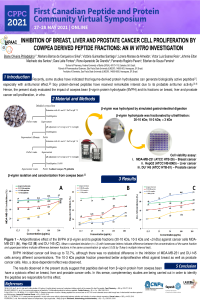
Recently, some studies have indicated that legume-derived protein hydrolysates can generate bioactive peptides with antitumoral effect. Hence, the present study evaluates the impact of cowpea β-vignin protein hydrolysate (BVPH) and its fractions on breast, liver and prostate cancer cell proliferation, in vitro. β-vignin was isolated, purified by size exclusion chromatographic process and analyzed by SDS-PAGE. The BVPH was produced by in vitro digestion of the protein using commercial pepsin and pancreatic enzymes under previously established conditions. BVPH was further separated by ultrafiltration into three peptide fractions (30-10, 10-3 and < 3 kDa) and tested on MDA-MB-231, Hep-G2 and DU-145 cells, in concentrations that ranged between 12.5–200 μg/ml. BVPH inhibited cancer cell lines up to 72.7%, although there was no statistical difference in the inhibition of MDA-MB-231 and DU-145 cells among different concentrations. The 10-3 kDa peptide fraction presented better antiproliferative effect against breast (IC50=0.33 μg/ml) as well as prostate cancer cells (IC50=4.37 μg/ml). However, in liver cells, the 30-10 kDa peptide fraction showed the greatest antiproliferative activity (IC50=231.79 μg/ml). Also, a dose-dependent effect was observed. The results observed in the present study suggest that peptides derived from β-vignin protein from cowpea bean have a cytotoxic effect on breast, liver and prostate cancer cells. In this sense, complementary studies are being carried out in order to identify the peptides are responsible for this effect.
Keywords
Vigna unguiculata (L.) Walp
protein hydrolysates
MDA-MB-231 cells
dose-response effect.
Manuscript
sciforum-045996.pdf
Poster
045996.pdf
Economic Laccase Production from Halotolerant Fungi
Ultrasound‐Assisted Extraction of Zein from Corn