Event submissions
Published
 10.3390/CPPC2021-10234 (registering DOI)
 This submission belongs to the session C. Structural Biology and Computational Methods of the event First Canadian Peptide and Protein Community Virtual Symposium
Published date
27 May, 2021
Citation
Spencer Smyth, Thomas Tsangaris, Alaji Bah, Julie D. Forman-Kay, Claudiu C. Gradinaru, Modelling The Multifarious Conformations of The Intrinsically Disordered Protein 4e-Bp2 With Sm-Fret, Saxs & Pre Restraints, in Proceedings of First Canadian Peptide and Protein Community Virtual Symposium, 27 May–28 May 2021, MDPI: Basel, Switzerland, doi: 10.3390/CPPC2021-10234
Share
Email
Facebook
Twitter
LinkedIn
Modelling The Multifarious Conformations of The Intrinsically Disordered Protein 4e-Bp2 With Sm-Fret, Saxs & Pre Restraints
'%3e%3cpath%20d='M12.6647%2010.9104C12.4176%2010.325%2012.0589%209.7933%2011.6088%209.34485C11.16%208.89511%2010.6283%208.53653%2010.0432%208.28891C10.038%208.28629%2010.0327%208.28498%2010.0275%208.28236C10.8437%207.69282%2011.3743%206.73252%2011.3743%205.64907C11.3743%203.85423%209.92005%202.40002%208.12522%202.40002C6.33038%202.40002%204.87618%203.85423%204.87618%205.64907C4.87618%206.73252%205.40677%207.69282%206.22296%208.28367C6.21772%208.28629%206.21248%208.2876%206.20724%208.29022C5.62031%208.53783%205.09365%208.89287%204.64167%209.34616C4.19192%209.79496%203.83334%2010.3266%203.58573%2010.9117C3.34247%2011.4846%203.21128%2012.0987%203.19925%2012.721C3.1989%2012.735%203.20135%2012.7489%203.20646%2012.7619C3.21157%2012.7749%203.21924%2012.7868%203.22901%2012.7968C3.23877%2012.8068%203.25045%2012.8148%203.26334%2012.8202C3.27623%2012.8256%203.29007%2012.8284%203.30406%2012.8284H4.09012C4.14776%2012.8284%204.19362%2012.7825%204.19493%2012.7262C4.22113%2011.7148%204.62726%2010.7676%205.34519%2010.0497C6.08802%209.30686%207.07452%208.89811%208.12522%208.89811C9.17592%208.89811%2010.1624%209.30686%2010.9052%2010.0497C11.6232%2010.7676%2012.0293%2011.7148%2012.0555%2012.7262C12.0568%2012.7839%2012.1027%2012.8284%2012.1603%2012.8284H12.9464C12.9604%2012.8284%2012.9742%2012.8256%2012.9871%2012.8202C13%2012.8148%2013.0117%2012.8068%2013.0214%2012.7968C13.0312%2012.7868%2013.0389%2012.7749%2013.044%2012.7619C13.0491%2012.7489%2013.0515%2012.735%2013.0512%2012.721C13.0381%2012.0947%2012.9084%2011.4856%2012.6647%2010.9104ZM8.12522%207.90243C7.52388%207.90243%206.95792%207.66793%206.53214%207.24215C6.10636%206.81636%205.87185%206.2504%205.87185%205.64907C5.87185%205.04773%206.10636%204.48177%206.53214%204.05599C6.95792%203.63021%207.52388%203.3957%208.12522%203.3957C8.72655%203.3957%209.29252%203.63021%209.7183%204.05599C10.1441%204.48177%2010.3786%205.04773%2010.3786%205.64907C10.3786%206.2504%2010.1441%206.81636%209.7183%207.24215C9.29252%207.66793%208.72655%207.90243%208.12522%207.90243Z'%20fill='%235D1EE1'/%3e%3c/g%3e%3c/svg%3e)
Spencer Smyth 1,2
Thomas Tsangaris 3
Alaji Bah 4
Julie D. Forman-Kay 5,6
Claudiu C. Gradinaru 1,2
1. Univerity of Toronto, Physics
2. University of Toronto Mississauga, Chemical and Physical Sciences
3. University of Toronto Mississauga
4. Upstate Medical University, Biochemistry and Molecular Biology
5. University of Toronto, Biochemistry
6. The Hospital for Sick Children, Molecular Structure and Function Program
Abstract
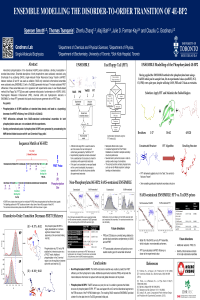
Hierarchical phosphorylation of the disordered 4E-BP2 protein stabilizes a binding incompatible 4-stranded beta domain while the C-terminal domain remains disordered. Ensemble descriptions of both phosphorylation states were calculated. The ensembles were restrained using Small-angle X-ray scattering (SAXS) and Paramagnetic Resonance Enhancement (PRE), while the single-molecule Förster Resonance Energy Transfer (smFRET) between residues 32 and 91 was used as validation of the ability of the restrained ensemble to agree with independent experimental evidence.
Initially, conformational ensembles were calculated using ENSEMBLE1 and SAXS-only restraints on an initial pool of 4E-BP2 conformers generated in TraDES.2 Bimodal distributions of the radius of gyration (RG) were obtained for both phospho forms of the protein. For non-phospho 4E-BP2, the back-calculated FRET efficiency was lower than the experimental value, while for the five-phospho 4E-BP2, the opposite happened. Adding PRE restraints for the five-phospho form, amplified the disagreement with the smFRET data. For both phospho forms, the average hydrodynamic radius (RH) of the calculated ensemble was smaller than the experimental value determined by Fluorescence Correlation Spectroscopy (FCS). These discrepancies highlight the inability of the TraDES prior to capture the secondary structure of 4E-BP2. Alternatively, we used a new Rosetta-based method (Fast Floppy Tail, FFT)3 to generate initial pools of conformations for the two 4E-BP2 phosphoforms. Applying SAXS, PRE, chemical shifts and hydrodynamic restraints in ENSEMBLE on these FFT-generated initial pools lead to better agreement with smFRET data and to a more accurate ensemble representation of 4E-BP2 in its two functionally-relevant forms.
- Feldman, H. J., & Hogue, C. W. (2000). Proteins: Structure, Function, and Bioinformatics, 39, 112-131.
- Krzeminski, Mickaël, et al. Bioinformatics29.3 (2013): 398-399.
- Ferrie, J. J., & Petersson, E. J. (2020). The Journal of Physical Chemistry B.
Keywords
Intrinsically disordered proteins
Computational
Ensemble modelling
Single-molecule fluorescence
Manuscript
sciforum-044559.pdf
Poster
CPPC_2021_4EBP2.pdf
Ultrasound‐Assisted Extraction of Zein from Corn
Targeting SARS-COV-2 Receptor Binding Domain with Stapled Peptides: An In-Silico Study