Event submissions
Published
 10.3390/CPPC2021-10236 (registering DOI)
 This submission belongs to the session C. Structural Biology and Computational Methods of the event First Canadian Peptide and Protein Community Virtual Symposium
Published date
27 May, 2021
Citation
Luana Janaina de Campos, Martin Conda-Sheridan, Nicholas Palermo, Targeting SARS-COV-2 Receptor Binding Domain with Stapled Peptides: An In-Silico Study, in Proceedings of First Canadian Peptide and Protein Community Virtual Symposium, 27 May–28 May 2021, MDPI: Basel, Switzerland, doi: 10.3390/CPPC2021-10236
Share
Email
Facebook
Twitter
LinkedIn
Targeting SARS-COV-2 Receptor Binding Domain with Stapled Peptides: An In-Silico Study
'%3e%3cpath%20d='M12.6647%2010.9104C12.4176%2010.325%2012.0589%209.7933%2011.6088%209.34485C11.16%208.89511%2010.6283%208.53653%2010.0432%208.28891C10.038%208.28629%2010.0327%208.28498%2010.0275%208.28236C10.8437%207.69282%2011.3743%206.73252%2011.3743%205.64907C11.3743%203.85423%209.92005%202.40002%208.12522%202.40002C6.33038%202.40002%204.87618%203.85423%204.87618%205.64907C4.87618%206.73252%205.40677%207.69282%206.22296%208.28367C6.21772%208.28629%206.21248%208.2876%206.20724%208.29022C5.62031%208.53783%205.09365%208.89287%204.64167%209.34616C4.19192%209.79496%203.83334%2010.3266%203.58573%2010.9117C3.34247%2011.4846%203.21128%2012.0987%203.19925%2012.721C3.1989%2012.735%203.20135%2012.7489%203.20646%2012.7619C3.21157%2012.7749%203.21924%2012.7868%203.22901%2012.7968C3.23877%2012.8068%203.25045%2012.8148%203.26334%2012.8202C3.27623%2012.8256%203.29007%2012.8284%203.30406%2012.8284H4.09012C4.14776%2012.8284%204.19362%2012.7825%204.19493%2012.7262C4.22113%2011.7148%204.62726%2010.7676%205.34519%2010.0497C6.08802%209.30686%207.07452%208.89811%208.12522%208.89811C9.17592%208.89811%2010.1624%209.30686%2010.9052%2010.0497C11.6232%2010.7676%2012.0293%2011.7148%2012.0555%2012.7262C12.0568%2012.7839%2012.1027%2012.8284%2012.1603%2012.8284H12.9464C12.9604%2012.8284%2012.9742%2012.8256%2012.9871%2012.8202C13%2012.8148%2013.0117%2012.8068%2013.0214%2012.7968C13.0312%2012.7868%2013.0389%2012.7749%2013.044%2012.7619C13.0491%2012.7489%2013.0515%2012.735%2013.0512%2012.721C13.0381%2012.0947%2012.9084%2011.4856%2012.6647%2010.9104ZM8.12522%207.90243C7.52388%207.90243%206.95792%207.66793%206.53214%207.24215C6.10636%206.81636%205.87185%206.2504%205.87185%205.64907C5.87185%205.04773%206.10636%204.48177%206.53214%204.05599C6.95792%203.63021%207.52388%203.3957%208.12522%203.3957C8.72655%203.3957%209.29252%203.63021%209.7183%204.05599C10.1441%204.48177%2010.3786%205.04773%2010.3786%205.64907C10.3786%206.2504%2010.1441%206.81636%209.7183%207.24215C9.29252%207.66793%208.72655%207.90243%208.12522%207.90243Z'%20fill='%235D1EE1'/%3e%3c/g%3e%3c/svg%3e)
Luana Janaina de Campos 1
Martin Conda-Sheridan 1
Nicholas Palermo 1
1. University of Nebraska Medical Center
Abstract
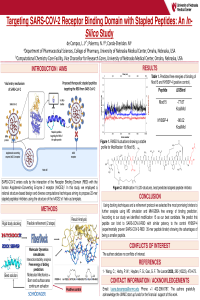
SARS-COV-2 has evolved into a pandemic of unprecedent scale. This coronavirus enters cells by the interaction of the Receptor Binding Domain (RBD) with the human Angiotensin-Converting Enzyme 2 receptor (hACE-2). In this study, we employed a rational structure-based design to propose 22-mer stapled peptides using the structure of the hACE2 α-1 helix as template. These peptides were designed to retain the alfa-helical character of the natural structure, to enhance binding affinity and to display a better solubility profile when compared to other designed peptides available in the literature. We employed different docking strategies (PATCHDOCK and ZDOCK) followed by a double-step refinement process (FIBERDOCK) to rank our peptides, followed by stability analysis/evaluation of the interaction profile of the best docking predictions using a 500 ns Molecular Dynamics (MD) simulation, and a further binding affinity analysis by the Molecular Mechanics/Generalized Born Surface Area (MM/GBSA) method. Our best structure presented a stable profile and could retain important interactions with the RBD even in the presence of the E484K RBD mutation. We predict this peptide can bind the viral RBD with similar potency to the control NYBSP-4 (a 30-mer experimentally proven peptide inhibitor) displaying the advantages of being a smaller peptide. Furthermore, our study provides valuable information for the rational design of double-stapled peptide as inhibitors of SARS-CoV-2 infection.
Keywords
Stapled peptide
SARS-COV-2
Receptor Binding Domain
Angiotensin-Converting Enzyme 2 receptor
Molecular Dynamics Simulation
Manuscript
sciforum-044801.pdf
Poster
sciforum_044801_manuscript_Luana_de_Campos_Poster.pdf
Modelling The Multifarious Conformations of The Intrinsically Disordered Protein 4e-Bp2 With Sm-Fret, Saxs & Pre Restraints
Measuring Conformational Selection in G Protein-Coupled Receptors by Single-Molecule Förster Resonance Energy Transfer