Event submissions
Published
 10.3390/CPPC2021-10240 (registering DOI)
 This submission belongs to the session A. Chemical-Biology and Medicinal Chemistry of the event First Canadian Peptide and Protein Community Virtual Symposium
Published date
27 May, 2021
Citation
Sérgio R. S. Veloso, Paula M. T. Ferreira, Elisabete M. S. Castanheira, Supramolecular Ultra-Short Dehydropeptide-Based Hydrogels As Potential Affordable Nanocarriers, in Proceedings of First Canadian Peptide and Protein Community Virtual Symposium, 27 May–28 May 2021, MDPI: Basel, Switzerland, doi: 10.3390/CPPC2021-10240
Share
Email
Facebook
Twitter
LinkedIn
Supramolecular Ultra-Short Dehydropeptide-Based Hydrogels As Potential Affordable Nanocarriers
'%3e%3cpath%20d='M12.6647%2010.9104C12.4176%2010.325%2012.0589%209.7933%2011.6088%209.34485C11.16%208.89511%2010.6283%208.53653%2010.0432%208.28891C10.038%208.28629%2010.0327%208.28498%2010.0275%208.28236C10.8437%207.69282%2011.3743%206.73252%2011.3743%205.64907C11.3743%203.85423%209.92005%202.40002%208.12522%202.40002C6.33038%202.40002%204.87618%203.85423%204.87618%205.64907C4.87618%206.73252%205.40677%207.69282%206.22296%208.28367C6.21772%208.28629%206.21248%208.2876%206.20724%208.29022C5.62031%208.53783%205.09365%208.89287%204.64167%209.34616C4.19192%209.79496%203.83334%2010.3266%203.58573%2010.9117C3.34247%2011.4846%203.21128%2012.0987%203.19925%2012.721C3.1989%2012.735%203.20135%2012.7489%203.20646%2012.7619C3.21157%2012.7749%203.21924%2012.7868%203.22901%2012.7968C3.23877%2012.8068%203.25045%2012.8148%203.26334%2012.8202C3.27623%2012.8256%203.29007%2012.8284%203.30406%2012.8284H4.09012C4.14776%2012.8284%204.19362%2012.7825%204.19493%2012.7262C4.22113%2011.7148%204.62726%2010.7676%205.34519%2010.0497C6.08802%209.30686%207.07452%208.89811%208.12522%208.89811C9.17592%208.89811%2010.1624%209.30686%2010.9052%2010.0497C11.6232%2010.7676%2012.0293%2011.7148%2012.0555%2012.7262C12.0568%2012.7839%2012.1027%2012.8284%2012.1603%2012.8284H12.9464C12.9604%2012.8284%2012.9742%2012.8256%2012.9871%2012.8202C13%2012.8148%2013.0117%2012.8068%2013.0214%2012.7968C13.0312%2012.7868%2013.0389%2012.7749%2013.044%2012.7619C13.0491%2012.7489%2013.0515%2012.735%2013.0512%2012.721C13.0381%2012.0947%2012.9084%2011.4856%2012.6647%2010.9104ZM8.12522%207.90243C7.52388%207.90243%206.95792%207.66793%206.53214%207.24215C6.10636%206.81636%205.87185%206.2504%205.87185%205.64907C5.87185%205.04773%206.10636%204.48177%206.53214%204.05599C6.95792%203.63021%207.52388%203.3957%208.12522%203.3957C8.72655%203.3957%209.29252%203.63021%209.7183%204.05599C10.1441%204.48177%2010.3786%205.04773%2010.3786%205.64907C10.3786%206.2504%2010.1441%206.81636%209.7183%207.24215C9.29252%207.66793%208.72655%207.90243%208.12522%207.90243Z'%20fill='%235D1EE1'/%3e%3c/g%3e%3c/svg%3e)
Sérgio R. S. Veloso 1
Paula M. T. Ferreira 2

Elisabete M. S. Castanheira 1
1. Physics Centre of Minho and Porto Universities (CF-UM-UP), University of Minho, Campus de Gualtar, 4710-057 Braga, Portugal
2. Centre of Chemistry, University of Minho, Campus de Gualtar, 4710-057 Braga, Portugal
Abstract
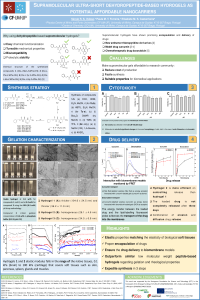
Self-assembled peptide-based hydrogels have shown promising properties for various applications, including resonance imaging and drug delivery. Here, the hydrogels’ molecules self-assemble into intertwined fibrillar structures through the cooperative effect of different non-covalent intra- and intermolecular interactions. Particularly, the peptide-based hydrogels are highly advantageous as nanocarriers for antitumour drug delivery owing to the low critical gelation concentration, amenable synthesis and structural tailoring of the rheological properties, as well as the biocompatibility and similarity to the extracellular matrix.
Lately, wider developments in the use of peptide-based supramolecular hydrogels with optimum drug delivery and mechanical properties in biomedical research and clinical translation are hampered by the limited commercial availability and prohibitive costs.
Hereby, considering the structural aspects that influence the assembly of peptide-based hydrogelators, a library of Cbz-protected dehydrodipeptides was synthesised and evaluated as minimalist hydrogels. The molecular aggregation, self-assembly, gelation and biocompatibility were thoroughly studied through fluorescence spectroscopy, and the mechanical properties were assessed. The compounds that afforded hydrogels were evaluated as drug delivery systems for curcumin and doxorubicin using biomembrane models. The hydrogels displayed similar properties to more complex supramolecular hydrogels. Moreover, the expeditious and scalable synthesis using amenable reaction conditions makes the Cbz-protected dehydrodipeptide hydrogels available at affordable cost to the research community.
Keywords
Hydrogels
Drug delivery
Self-assembly
Dipeptides
Supramolecular
Manuscript
sciforum-045255.pdf
Poster
sciforum_045255_manuscript_Poster.pdf
Measuring Conformational Selection in G Protein-Coupled Receptors by Single-Molecule Förster Resonance Energy Transfer
Synthesis Of Lactam Modulators Of The Interleukin-1 Receptor For Delaying Labor And Improving Neonatal Outcomes