Event submissions
Published
 10.3390/CPPC2021-10244 (registering DOI)
 This submission belongs to the session A. Chemical-Biology and Medicinal Chemistry of the event First Canadian Peptide and Protein Community Virtual Symposium
Published date
27 May, 2021
Citation
Vera D'Aloisio, Paolo Dognini, Gillian A. Hutcheon, Cristopher R. Coxon, Structural Composition Analysis of Approved Peptide Therapeutics and Diagnostics as a Guide For Future Peptide Drug Candidates, in Proceedings of First Canadian Peptide and Protein Community Virtual Symposium, 27 May–28 May 2021, MDPI: Basel, Switzerland, doi: 10.3390/CPPC2021-10244
Share
Email
Facebook
Twitter
LinkedIn
Structural Composition Analysis of Approved Peptide Therapeutics and Diagnostics as a Guide For Future Peptide Drug Candidates
'%3e%3cpath%20d='M12.6647%2010.9104C12.4176%2010.325%2012.0589%209.7933%2011.6088%209.34485C11.16%208.89511%2010.6283%208.53653%2010.0432%208.28891C10.038%208.28629%2010.0327%208.28498%2010.0275%208.28236C10.8437%207.69282%2011.3743%206.73252%2011.3743%205.64907C11.3743%203.85423%209.92005%202.40002%208.12522%202.40002C6.33038%202.40002%204.87618%203.85423%204.87618%205.64907C4.87618%206.73252%205.40677%207.69282%206.22296%208.28367C6.21772%208.28629%206.21248%208.2876%206.20724%208.29022C5.62031%208.53783%205.09365%208.89287%204.64167%209.34616C4.19192%209.79496%203.83334%2010.3266%203.58573%2010.9117C3.34247%2011.4846%203.21128%2012.0987%203.19925%2012.721C3.1989%2012.735%203.20135%2012.7489%203.20646%2012.7619C3.21157%2012.7749%203.21924%2012.7868%203.22901%2012.7968C3.23877%2012.8068%203.25045%2012.8148%203.26334%2012.8202C3.27623%2012.8256%203.29007%2012.8284%203.30406%2012.8284H4.09012C4.14776%2012.8284%204.19362%2012.7825%204.19493%2012.7262C4.22113%2011.7148%204.62726%2010.7676%205.34519%2010.0497C6.08802%209.30686%207.07452%208.89811%208.12522%208.89811C9.17592%208.89811%2010.1624%209.30686%2010.9052%2010.0497C11.6232%2010.7676%2012.0293%2011.7148%2012.0555%2012.7262C12.0568%2012.7839%2012.1027%2012.8284%2012.1603%2012.8284H12.9464C12.9604%2012.8284%2012.9742%2012.8256%2012.9871%2012.8202C13%2012.8148%2013.0117%2012.8068%2013.0214%2012.7968C13.0312%2012.7868%2013.0389%2012.7749%2013.044%2012.7619C13.0491%2012.7489%2013.0515%2012.735%2013.0512%2012.721C13.0381%2012.0947%2012.9084%2011.4856%2012.6647%2010.9104ZM8.12522%207.90243C7.52388%207.90243%206.95792%207.66793%206.53214%207.24215C6.10636%206.81636%205.87185%206.2504%205.87185%205.64907C5.87185%205.04773%206.10636%204.48177%206.53214%204.05599C6.95792%203.63021%207.52388%203.3957%208.12522%203.3957C8.72655%203.3957%209.29252%203.63021%209.7183%204.05599C10.1441%204.48177%2010.3786%205.04773%2010.3786%205.64907C10.3786%206.2504%2010.1441%206.81636%209.7183%207.24215C9.29252%207.66793%208.72655%207.90243%208.12522%207.90243Z'%20fill='%235D1EE1'/%3e%3c/g%3e%3c/svg%3e)
Vera D'Aloisio 1
Paolo Dognini 1
Gillian A. Hutcheon 1
Cristopher R. Coxon 2
1. Liverpool John Moores University
2. Heriot-Watt University
Abstract
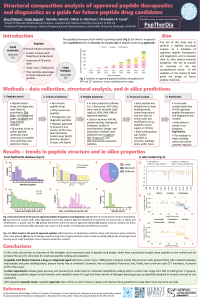
Since the approval of the first peptide therapeutic agent, the 51-amino acid (AA) hormone insulin, in 1923, drug discovery has progressively expanded into the chemical space between small molecules and large proteins. Subsequently, a significant number of peptides (and peptidomimetics) have received regulatory approval, reaching over 100 approved and marketed peptides in 2020. However, unlike small-molecule drugs, there is no general set of guidelines for designing a successful peptide-based drug and this makes the peptide chemists’ job of designing future peptide drug candidates challenging.
We have performed a detailed structural analysis on the approved peptide therapeutics and diagnostics, providing an overview of their key compositional trends to help guide the design of future peptide medicines. In detail, molar mass distribution, amino acid frequency, peptide modifications, macrocycles, N- and C-termini, origin of peptide design, and polar/lipophilic contribution of each member present in a given approved peptide have been investigated.
Over a total of 105 peptide pharmaceuticals analysed, 86% are natural or naturally-derived. Moreover, a bimodal distribution of peptide molar mass has emerged, with the large majority < 2000 g/mol. Among all the peptide constitutional members, most (around 81%) are represented by natural L-amino acids, while the residual 19% comprises non-natural AAs and modifications. A balance between polar and hydrophobic residues have been found within the peptide structures. Finally, 46% of the approved peptides are cyclic and 5 to 7 members cycles are the most common.
The data collected have been made freely available on PepTherDia (http://peptherdia.herokuapp.com), an online open-source database. Forecasting a starring role for peptides in the coming decades, we anticipate that new clear trends and, perhaps, rules in structural composition will emerge beyond our observations, leading to improved rational peptide drug design.
Keywords
peptide therapeutics and diagnostics
peptide market
structural analysis
approved peptides database
future peptide medicines
Manuscript
sciforum-045397.pdf
Poster
sciforum_045397_manuscript_V_D_Aloisio_1st_Canadian_Peptide_and_Protein_Community_Virtual_Symposium_Submitted_Version.pdf
Synthesis Of Lactam Modulators Of The Interleukin-1 Receptor For Delaying Labor And Improving Neonatal Outcomes
Exploring the Role of Urea Substitutions on Stabilizing Phenylalanine-based Peptide Amphiphiles Nanostructures