Event submissions
Published
 10.3390/CPPC2021-10245 (registering DOI)
 This submission belongs to the session B. Materials Science and Catalysis of the event First Canadian Peptide and Protein Community Virtual Symposium
Published date
27 May, 2021
Citation
Martin Conda-Sheridan, Huihua Xing, Agustín Picco, Cristián Huck-Iriart, Jeffrey Comer, Stacey Chin, Sieun Lee, Exploring the Role of Urea Substitutions on Stabilizing Phenylalanine-based Peptide Amphiphiles Nanostructures , in Proceedings of First Canadian Peptide and Protein Community Virtual Symposium, 27 May–28 May 2021, MDPI: Basel, Switzerland, doi: 10.3390/CPPC2021-10245
Share
Email
Facebook
Twitter
LinkedIn
Exploring the Role of Urea Substitutions on Stabilizing Phenylalanine-based Peptide Amphiphiles Nanostructures
'%3e%3cpath%20d='M12.6647%2010.9104C12.4176%2010.325%2012.0589%209.7933%2011.6088%209.34485C11.16%208.89511%2010.6283%208.53653%2010.0432%208.28891C10.038%208.28629%2010.0327%208.28498%2010.0275%208.28236C10.8437%207.69282%2011.3743%206.73252%2011.3743%205.64907C11.3743%203.85423%209.92005%202.40002%208.12522%202.40002C6.33038%202.40002%204.87618%203.85423%204.87618%205.64907C4.87618%206.73252%205.40677%207.69282%206.22296%208.28367C6.21772%208.28629%206.21248%208.2876%206.20724%208.29022C5.62031%208.53783%205.09365%208.89287%204.64167%209.34616C4.19192%209.79496%203.83334%2010.3266%203.58573%2010.9117C3.34247%2011.4846%203.21128%2012.0987%203.19925%2012.721C3.1989%2012.735%203.20135%2012.7489%203.20646%2012.7619C3.21157%2012.7749%203.21924%2012.7868%203.22901%2012.7968C3.23877%2012.8068%203.25045%2012.8148%203.26334%2012.8202C3.27623%2012.8256%203.29007%2012.8284%203.30406%2012.8284H4.09012C4.14776%2012.8284%204.19362%2012.7825%204.19493%2012.7262C4.22113%2011.7148%204.62726%2010.7676%205.34519%2010.0497C6.08802%209.30686%207.07452%208.89811%208.12522%208.89811C9.17592%208.89811%2010.1624%209.30686%2010.9052%2010.0497C11.6232%2010.7676%2012.0293%2011.7148%2012.0555%2012.7262C12.0568%2012.7839%2012.1027%2012.8284%2012.1603%2012.8284H12.9464C12.9604%2012.8284%2012.9742%2012.8256%2012.9871%2012.8202C13%2012.8148%2013.0117%2012.8068%2013.0214%2012.7968C13.0312%2012.7868%2013.0389%2012.7749%2013.044%2012.7619C13.0491%2012.7489%2013.0515%2012.735%2013.0512%2012.721C13.0381%2012.0947%2012.9084%2011.4856%2012.6647%2010.9104ZM8.12522%207.90243C7.52388%207.90243%206.95792%207.66793%206.53214%207.24215C6.10636%206.81636%205.87185%206.2504%205.87185%205.64907C5.87185%205.04773%206.10636%204.48177%206.53214%204.05599C6.95792%203.63021%207.52388%203.3957%208.12522%203.3957C8.72655%203.3957%209.29252%203.63021%209.7183%204.05599C10.1441%204.48177%2010.3786%205.04773%2010.3786%205.64907C10.3786%206.2504%2010.1441%206.81636%209.7183%207.24215C9.29252%207.66793%208.72655%207.90243%208.12522%207.90243Z'%20fill='%235D1EE1'/%3e%3c/g%3e%3c/svg%3e)
Martin Conda-Sheridan 1
Huihua Xing 1
Agustín Picco 2
Cristián Huck-Iriart 3
Jeffrey Comer 4
Stacey Chin 5
Sieun Lee 5
1. University of Nebraska Medical Center
2. INIFTA-CONICET-UNLP
3. Universidad Nacional de General San Martín
4. Kansas State University
5. Northwestern University
Abstract
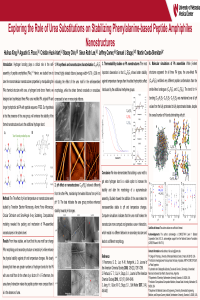
Hydrogen bonding plays a critical role in the self-assembly of peptide amphiphiles (PAs). Herein, we studied how to tune the macromolecular nanostructures’ property by manipulating the PA’s chemical structure with urea, a hydrogen bond donor. We designed and synthesized three PAs: urea modified PA, original PA, and longer hydrophobic tail PA with peptide sequence FFEE. The effect of pH, temperature, self-assembly pathway was studied by Transition Electron Microscopy, Atomic Force Microscopy, Circular Dichroism, and Small-Angle X-ray Scattering. From these studies, we found that the urea motif can change PA’s morphology and secondary structure at neutral pH while enhancing the physical stability against pH and temperature changes. The resulted hydrogel of urea PA showed better ability in the shear recovery test than the others. Computational modeling revealed the packing and mechanism of PA-assembled nanostructures at the atomic level, clearly showing that there are greater numbers of hydrogen bonds for the PA with urea motif than for the others by a factor of 1.4. Furthermore, the urea-phenyl interaction makes the peptide portion more compact than it is in the absence of urea. This study helps to clarify the mechanism of hydrogen bonding acting on PA’s nanostructures with the presence of π-π stacking and will thereby help in the design of a new generation of PAs.
Keywords
hydrogen bonding groups
peptide amphiphiles
nanostructures
self-assembly
Manuscript
sciforum-045427.pdf
Poster
sciforum_045427_manuscript_poster_Huihua_Xing.pdf
Structural Composition Analysis of Approved Peptide Therapeutics and Diagnostics as a Guide For Future Peptide Drug Candidates
Synthesis and Self-Assembly of Perylene Diimide-Conjugated Peptides