Event submissions
Published
 10.3390/CPPC2021-10246 (registering DOI)
 This submission belongs to the session A. Chemical-Biology and Medicinal Chemistry of the event First Canadian Peptide and Protein Community Virtual Symposium
Published date
27 May, 2021
Citation
Nadjib Kihal, Ali Nazemi, Steve Bourgault, Synthesis and Self-Assembly of Perylene Diimide-Conjugated Peptides, in Proceedings of First Canadian Peptide and Protein Community Virtual Symposium, 27 May–28 May 2021, MDPI: Basel, Switzerland, doi: 10.3390/CPPC2021-10246
Share
Email
Facebook
Twitter
LinkedIn
Synthesis and Self-Assembly of Perylene Diimide-Conjugated Peptides
'%3e%3cpath%20d='M12.6647%2010.9104C12.4176%2010.325%2012.0589%209.7933%2011.6088%209.34485C11.16%208.89511%2010.6283%208.53653%2010.0432%208.28891C10.038%208.28629%2010.0327%208.28498%2010.0275%208.28236C10.8437%207.69282%2011.3743%206.73252%2011.3743%205.64907C11.3743%203.85423%209.92005%202.40002%208.12522%202.40002C6.33038%202.40002%204.87618%203.85423%204.87618%205.64907C4.87618%206.73252%205.40677%207.69282%206.22296%208.28367C6.21772%208.28629%206.21248%208.2876%206.20724%208.29022C5.62031%208.53783%205.09365%208.89287%204.64167%209.34616C4.19192%209.79496%203.83334%2010.3266%203.58573%2010.9117C3.34247%2011.4846%203.21128%2012.0987%203.19925%2012.721C3.1989%2012.735%203.20135%2012.7489%203.20646%2012.7619C3.21157%2012.7749%203.21924%2012.7868%203.22901%2012.7968C3.23877%2012.8068%203.25045%2012.8148%203.26334%2012.8202C3.27623%2012.8256%203.29007%2012.8284%203.30406%2012.8284H4.09012C4.14776%2012.8284%204.19362%2012.7825%204.19493%2012.7262C4.22113%2011.7148%204.62726%2010.7676%205.34519%2010.0497C6.08802%209.30686%207.07452%208.89811%208.12522%208.89811C9.17592%208.89811%2010.1624%209.30686%2010.9052%2010.0497C11.6232%2010.7676%2012.0293%2011.7148%2012.0555%2012.7262C12.0568%2012.7839%2012.1027%2012.8284%2012.1603%2012.8284H12.9464C12.9604%2012.8284%2012.9742%2012.8256%2012.9871%2012.8202C13%2012.8148%2013.0117%2012.8068%2013.0214%2012.7968C13.0312%2012.7868%2013.0389%2012.7749%2013.044%2012.7619C13.0491%2012.7489%2013.0515%2012.735%2013.0512%2012.721C13.0381%2012.0947%2012.9084%2011.4856%2012.6647%2010.9104ZM8.12522%207.90243C7.52388%207.90243%206.95792%207.66793%206.53214%207.24215C6.10636%206.81636%205.87185%206.2504%205.87185%205.64907C5.87185%205.04773%206.10636%204.48177%206.53214%204.05599C6.95792%203.63021%207.52388%203.3957%208.12522%203.3957C8.72655%203.3957%209.29252%203.63021%209.7183%204.05599C10.1441%204.48177%2010.3786%205.04773%2010.3786%205.64907C10.3786%206.2504%2010.1441%206.81636%209.7183%207.24215C9.29252%207.66793%208.72655%207.90243%208.12522%207.90243Z'%20fill='%235D1EE1'/%3e%3c/g%3e%3c/svg%3e)
Nadjib Kihal 1,2

Ali Nazemi 1
Steve Bourgault 1,2
1. Department of Chemistry, Université du Québec à Montréal, QC, Canada.
2. Quebec Network for Research on Protein Function, Engineering and Applications, PROTEO
Abstract
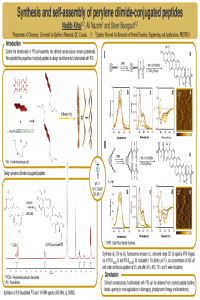
Perylenediimide derivatives (PDIs) constitute an important group of an organic π-conjugated system that has been abundantly studied owing to their excellent photostability, chemical robustness, synthetic accessibility, and optoelectronic properties. Assembling PDI molecules into tailored supramolecular structures leads to unique photochemical functionalities that can be exploited in various fields, from biomedicine to material sciences. However, the precise control over the directionality of PDI self-assembly into defined nanostructures remains problematic. In this study, we took advantage of the high aggregation propensity of amyloid peptides to design nanofilaments functionalized with PDI. The amyloidogenic domain of the islet polypeptide (IAPP), i.e., the segment 20-29 (I20-29), was used as the self-assembling core, which was connected to PDI by a flexible hexyl spacer. PDI-[Leu]2 derivative was prepared from perylene tetracarboxylic dianhydride (PTCDA), before being conjugated on the N-terminal amine of the elongated protected peptidyl-resin. By modulating the stoichiometry of the coupling reaction, two types of hybrid peptides were obtained: symmetric (PDI-[I20-29]2) and asymmetric (PDI-I20-29). Self-assembly was initiated by the successive dispersion of PDI-[I20-29]2 and PDI-I20-29 in an aqueous buffer and the solution was constantly rotary agitated at room temperature. The self-assembly process was periodically followed by measuring absorbance and fluorescence of PDI, by circular dichroism (CD) spectroscopy, and by atomic force microscopy. The analyses revealed that both PDI-peptides self-assembled into long, unbranched, and linear filaments with a cross-β-sheet quaternary organization. The UV-vis absorbance spectra exhibit a clear signature of H-aggregates for both assemblies. Overall, this study exposes that defined nanostructures functionalized with PDI can be obtained from amyloid peptide building blocks, opening to novel applications in bioimaging, photodynamic therapy, and bioelectronic.
Keywords
Self-assembly
perylenediimide
peptides
supramolecular
amyloid filaments
Manuscript
sciforum-045470.pdf
Poster
sciforum_045470_manuscript_CPPC_2021_NadjibKihal.pdf
Exploring the Role of Urea Substitutions on Stabilizing Phenylalanine-based Peptide Amphiphiles Nanostructures
Functional Characterization of Crocodylian Cathelicidins