Event submissions
Published
 10.3390/CPPC2021-10248 (registering DOI)
 This submission belongs to the session D. Synthetic and Mimetic Methods of the event First Canadian Peptide and Protein Community Virtual Symposium
Published date
27 May, 2021
Citation
Felix L. Santana, Morgan Alford, Bing (Catherine) Wu, Evan Haney, Karel Estrada, Noushin Akhoundsadegh, Gerardo Corzo, Robert Hancock, Functional Characterization of Crocodylian Cathelicidins, in Proceedings of First Canadian Peptide and Protein Community Virtual Symposium, 27 May–28 May 2021, MDPI: Basel, Switzerland, doi: 10.3390/CPPC2021-10248
Share
Email
Facebook
Twitter
LinkedIn
Functional Characterization of Crocodylian Cathelicidins
'%3e%3cpath%20d='M12.6647%2010.9104C12.4176%2010.325%2012.0589%209.7933%2011.6088%209.34485C11.16%208.89511%2010.6283%208.53653%2010.0432%208.28891C10.038%208.28629%2010.0327%208.28498%2010.0275%208.28236C10.8437%207.69282%2011.3743%206.73252%2011.3743%205.64907C11.3743%203.85423%209.92005%202.40002%208.12522%202.40002C6.33038%202.40002%204.87618%203.85423%204.87618%205.64907C4.87618%206.73252%205.40677%207.69282%206.22296%208.28367C6.21772%208.28629%206.21248%208.2876%206.20724%208.29022C5.62031%208.53783%205.09365%208.89287%204.64167%209.34616C4.19192%209.79496%203.83334%2010.3266%203.58573%2010.9117C3.34247%2011.4846%203.21128%2012.0987%203.19925%2012.721C3.1989%2012.735%203.20135%2012.7489%203.20646%2012.7619C3.21157%2012.7749%203.21924%2012.7868%203.22901%2012.7968C3.23877%2012.8068%203.25045%2012.8148%203.26334%2012.8202C3.27623%2012.8256%203.29007%2012.8284%203.30406%2012.8284H4.09012C4.14776%2012.8284%204.19362%2012.7825%204.19493%2012.7262C4.22113%2011.7148%204.62726%2010.7676%205.34519%2010.0497C6.08802%209.30686%207.07452%208.89811%208.12522%208.89811C9.17592%208.89811%2010.1624%209.30686%2010.9052%2010.0497C11.6232%2010.7676%2012.0293%2011.7148%2012.0555%2012.7262C12.0568%2012.7839%2012.1027%2012.8284%2012.1603%2012.8284H12.9464C12.9604%2012.8284%2012.9742%2012.8256%2012.9871%2012.8202C13%2012.8148%2013.0117%2012.8068%2013.0214%2012.7968C13.0312%2012.7868%2013.0389%2012.7749%2013.044%2012.7619C13.0491%2012.7489%2013.0515%2012.735%2013.0512%2012.721C13.0381%2012.0947%2012.9084%2011.4856%2012.6647%2010.9104ZM8.12522%207.90243C7.52388%207.90243%206.95792%207.66793%206.53214%207.24215C6.10636%206.81636%205.87185%206.2504%205.87185%205.64907C5.87185%205.04773%206.10636%204.48177%206.53214%204.05599C6.95792%203.63021%207.52388%203.3957%208.12522%203.3957C8.72655%203.3957%209.29252%203.63021%209.7183%204.05599C10.1441%204.48177%2010.3786%205.04773%2010.3786%205.64907C10.3786%206.2504%2010.1441%206.81636%209.7183%207.24215C9.29252%207.66793%208.72655%207.90243%208.12522%207.90243Z'%20fill='%235D1EE1'/%3e%3c/g%3e%3c/svg%3e)
Felix L. Santana 1,2
Morgan Alford 3
Bing (Catherine) Wu 3
Evan Haney 3
Karel Estrada 4
Noushin Akhoundsadegh 3
Gerardo Corzo 2
Robert Hancock 3
1. Center for Microbial Diseases and Immunity Research, Department of Microbiology and Immunology, University of British Columbia, Vancouver, British Columbia, Canada
2. Departamento de Medicina Molecular y Bioprocesos, Instituto de Biotecnología, Universidad Nacional Autónoma de México, Cuernavaca, Morelos, Mexico.
3. Center for Microbial Diseases and Immunity Research, Department of Microbiology and Immunology, University of British Columbia, Vancouver, British Columbia, Canada.
4. Unidad de Secuenciación Masiva y Bioinformática, Instituto de Biotecnología, Universidad Nacional Autónoma de México, Cuernavaca, Morelos, Mexico.
Abstract
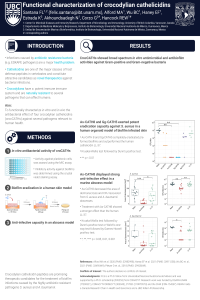
Cathelicidins are one of the major classes of host defense peptides in vertebrates. These peptides display broad spectrum anti-infective properties against several pathogens and are also able to modulate host immune responses which makes them attractive candidates for novel therapeutics.
A bioinformatics approach was used to identify novel cathelicidin sequences from the genomes of four crocodylian species. Based on certain physico-chemical parameters (such as charge, helicity and amphipathicity) combined with phylogenetic analysis, four cathelicidin peptides were selected for chemical synthesis and characterization. The antimicrobial and antibiofilm activity of the peptides was assessed in vitro and in vivo against several bacterial pathogens of medical importance using an organoid model of skin biofilm infection and a murine abscess model.
The crocodylian cathelicidins showed broad and potent in vitro antimicrobial and antibiofilm activity against several species of bacteria. Notably, As-CATH8 and Gg-CATH5 showed good eradication capacity against Staphyloccocus aureus biofilms in an organoid model of biofilm infected skin, outperforming the human cathelicidin LL-37. As-CATH8 was also superior to LL-37 against bacterial abscesses arising from S. aureus and Acinetobacter baumannii in a murine model of high density bacterial infection. In this case, treatment with As-CATH8 significantly decreased the number of bacteria recovered from the abscess after three days and also reduced the abscess size. Overall, this work highlights the therapeutic potential of crocodylian cathelicidins against bacterial infections.
Keywords
host defense peptides
antimicrobial peptides
cathelicidins
crocodiles
Manuscript
sciforum-045998.pdf
Poster
sciforum_045998_manuscript_poster_SantanaFL_CPPC.pdf
Synthesis and Self-Assembly of Perylene Diimide-Conjugated Peptides
Expanded Toolbox for Directing the Biosynthesis of Macrocyclic Peptides in Bacterial Cells