Event submissions
Published

This submission belongs to the session S1. Nanomedicine and Precision Medicine of the event 1st International Electronic Conference on Biomedicine
Published date
31 May, 2021
Citation
Samira F. da Silva, Joana Domingues, Joana C. Antunes, Helena P. Felgueiras, Assessment of essential oil-loaded nanofibrous mats against the Escherichia virus MS2, a mimetic of SARS-CoV-2, for potential applications as inner layers in individual protection masks, in Proceedings of 1st International Electronic Conference on Biomedicine, 1 June–26 June 2021, MDPI: Basel, Switzerland, doi: 10.3390/ECB2021-10253
Share
Email
Facebook
Twitter
LinkedIn
Assessment of essential oil-loaded nanofibrous mats against the Escherichia virus MS2, a mimetic of SARS-CoV-2, for potential applications as inner layers in individual protection masks
'%3e%3cpath%20d='M12.6647%2010.9104C12.4176%2010.325%2012.0589%209.7933%2011.6088%209.34485C11.16%208.89511%2010.6283%208.53653%2010.0432%208.28891C10.038%208.28629%2010.0327%208.28498%2010.0275%208.28236C10.8437%207.69282%2011.3743%206.73252%2011.3743%205.64907C11.3743%203.85423%209.92005%202.40002%208.12522%202.40002C6.33038%202.40002%204.87618%203.85423%204.87618%205.64907C4.87618%206.73252%205.40677%207.69282%206.22296%208.28367C6.21772%208.28629%206.21248%208.2876%206.20724%208.29022C5.62031%208.53783%205.09365%208.89287%204.64167%209.34616C4.19192%209.79496%203.83334%2010.3266%203.58573%2010.9117C3.34247%2011.4846%203.21128%2012.0987%203.19925%2012.721C3.1989%2012.735%203.20135%2012.7489%203.20646%2012.7619C3.21157%2012.7749%203.21924%2012.7868%203.22901%2012.7968C3.23877%2012.8068%203.25045%2012.8148%203.26334%2012.8202C3.27623%2012.8256%203.29007%2012.8284%203.30406%2012.8284H4.09012C4.14776%2012.8284%204.19362%2012.7825%204.19493%2012.7262C4.22113%2011.7148%204.62726%2010.7676%205.34519%2010.0497C6.08802%209.30686%207.07452%208.89811%208.12522%208.89811C9.17592%208.89811%2010.1624%209.30686%2010.9052%2010.0497C11.6232%2010.7676%2012.0293%2011.7148%2012.0555%2012.7262C12.0568%2012.7839%2012.1027%2012.8284%2012.1603%2012.8284H12.9464C12.9604%2012.8284%2012.9742%2012.8256%2012.9871%2012.8202C13%2012.8148%2013.0117%2012.8068%2013.0214%2012.7968C13.0312%2012.7868%2013.0389%2012.7749%2013.044%2012.7619C13.0491%2012.7489%2013.0515%2012.735%2013.0512%2012.721C13.0381%2012.0947%2012.9084%2011.4856%2012.6647%2010.9104ZM8.12522%207.90243C7.52388%207.90243%206.95792%207.66793%206.53214%207.24215C6.10636%206.81636%205.87185%206.2504%205.87185%205.64907C5.87185%205.04773%206.10636%204.48177%206.53214%204.05599C6.95792%203.63021%207.52388%203.3957%208.12522%203.3957C8.72655%203.3957%209.29252%203.63021%209.7183%204.05599C10.1441%204.48177%2010.3786%205.04773%2010.3786%205.64907C10.3786%206.2504%2010.1441%206.81636%209.7183%207.24215C9.29252%207.66793%208.72655%207.90243%208.12522%207.90243Z'%20fill='%235D1EE1'/%3e%3c/g%3e%3c/svg%3e)
Samira F. da Silva 1
Joana Domingues 1

Joana C. Antunes 1

Helena P. Felgueiras 2
1. Centre for Textile Science and Technology, University of Minho
2. Centre for Textile Science and Technology, University of Minho, Portugal
Abstract
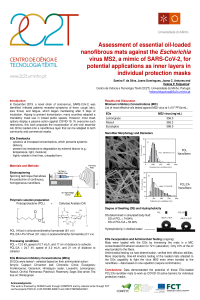
In December 2019, a novel strain of coronavirus, SARS-CoV-2, was identified. Infected patients revealed symptoms of fever, cough (dry), sore throat, and fatigue, which began manifesting after 5 days of incubation. Hoping to prevent transmission, many countries adopted a mandatory mask use in closed public spaces. However, most mask options display a passive action against COVID-19. To overcome such restrictions, this work proposes the incorporation of anti-viral essential oils (EOs) loaded onto a nanofibrous layer that can be adapted to both community and commercial masks.
Twenty EOs selected based on their antimicrobial nature were examined for the first time against the Escherichia virus MS2. The most effective were the lemongrass (LO), Niaouli (NO) and eucalyptus (ELO) with a minimum inhibitory concentration (MIC) of 356.0 mg/mL, 365.2 mg/mL and 586.0 mg/mL, respectively. Polycaprolactone (PCL) and cellulose acetate (CA) were prepared individually at 14 wt% in chloroform/dimethylformamide (DMF) and 10 wt% in acetone/DMF, respectively, and combined at 3:1 ratio. Polymeric solutions were then processed via eletrospinning with processing parameters being optimized to 24.7 kV, 3.2 mL/h and 21 cm. Uniform, beadless nanofibers were obtained. Mats were characterized as mechanically resilient, to endure movements arising from mask positioning, and hydrophobic in nature, to repel droplets coming from the exterior. Loading of the nanofibrous mats was accomplished via physisorption using the free -OH groups of the CA as linkers. Mats were loaded with the EOs at MIC concentration for 72 h (saturation). Presence of the EOs was confirmed along the mats. Antimicrobial testing via halo determination, verified their diffusion abilities. More importantly, time-kill kinetics testing of the loaded mats attested to the EOs capability to fight the virus MS2 even when bonded to the nanofibers. Data demonstrated the potential of these EOs-loaded PCL/CA nanofibers mats to work as COVID-19 active barriers for individual protection masks.
Keywords
eletrospinning
hydrophobic barrier
mechanical resistance
antimicrobial
fighting covid-19 virus
Manuscript
sciforum-043888.pdf
Poster
2021.04.22_ECO Samira.pdf
Protein nanocages for anticancer metal-based drug delivery
Hydrogel-like films modified with cinnamon leaf oil: a new scaffolding system capable of inhibiting Pseudomonas aeruginosa bacteria