Event submissions
Published

This submission belongs to the session S1. Nanomedicine and Precision Medicine of the event 1st International Electronic Conference on Biomedicine
Published date
31 May, 2021
Citation
Catarina S. Miranda, Joana C. Antunes, Natália C. Homem, Helena P. Felgueiras, Hydrogel-like films modified with cinnamon leaf oil: a new scaffolding system capable of inhibiting Pseudomonas aeruginosa bacteria, in Proceedings of 1st International Electronic Conference on Biomedicine, 1 June–26 June 2021, MDPI: Basel, Switzerland, doi: 10.3390/ECB2021-10254
Share
Email
Facebook
Twitter
LinkedIn
Hydrogel-like films modified with cinnamon leaf oil: a new scaffolding system capable of inhibiting Pseudomonas aeruginosa bacteria
'%3e%3cpath%20d='M12.6647%2010.9104C12.4176%2010.325%2012.0589%209.7933%2011.6088%209.34485C11.16%208.89511%2010.6283%208.53653%2010.0432%208.28891C10.038%208.28629%2010.0327%208.28498%2010.0275%208.28236C10.8437%207.69282%2011.3743%206.73252%2011.3743%205.64907C11.3743%203.85423%209.92005%202.40002%208.12522%202.40002C6.33038%202.40002%204.87618%203.85423%204.87618%205.64907C4.87618%206.73252%205.40677%207.69282%206.22296%208.28367C6.21772%208.28629%206.21248%208.2876%206.20724%208.29022C5.62031%208.53783%205.09365%208.89287%204.64167%209.34616C4.19192%209.79496%203.83334%2010.3266%203.58573%2010.9117C3.34247%2011.4846%203.21128%2012.0987%203.19925%2012.721C3.1989%2012.735%203.20135%2012.7489%203.20646%2012.7619C3.21157%2012.7749%203.21924%2012.7868%203.22901%2012.7968C3.23877%2012.8068%203.25045%2012.8148%203.26334%2012.8202C3.27623%2012.8256%203.29007%2012.8284%203.30406%2012.8284H4.09012C4.14776%2012.8284%204.19362%2012.7825%204.19493%2012.7262C4.22113%2011.7148%204.62726%2010.7676%205.34519%2010.0497C6.08802%209.30686%207.07452%208.89811%208.12522%208.89811C9.17592%208.89811%2010.1624%209.30686%2010.9052%2010.0497C11.6232%2010.7676%2012.0293%2011.7148%2012.0555%2012.7262C12.0568%2012.7839%2012.1027%2012.8284%2012.1603%2012.8284H12.9464C12.9604%2012.8284%2012.9742%2012.8256%2012.9871%2012.8202C13%2012.8148%2013.0117%2012.8068%2013.0214%2012.7968C13.0312%2012.7868%2013.0389%2012.7749%2013.044%2012.7619C13.0491%2012.7489%2013.0515%2012.735%2013.0512%2012.721C13.0381%2012.0947%2012.9084%2011.4856%2012.6647%2010.9104ZM8.12522%207.90243C7.52388%207.90243%206.95792%207.66793%206.53214%207.24215C6.10636%206.81636%205.87185%206.2504%205.87185%205.64907C5.87185%205.04773%206.10636%204.48177%206.53214%204.05599C6.95792%203.63021%207.52388%203.3957%208.12522%203.3957C8.72655%203.3957%209.29252%203.63021%209.7183%204.05599C10.1441%204.48177%2010.3786%205.04773%2010.3786%205.64907C10.3786%206.2504%2010.1441%206.81636%209.7183%207.24215C9.29252%207.66793%208.72655%207.90243%208.12522%207.90243Z'%20fill='%235D1EE1'/%3e%3c/g%3e%3c/svg%3e)
Catarina S. Miranda 1

Joana C. Antunes 1

Natália C. Homem 1

Helena P. Felgueiras 1
1. Centre for Textile Science and Technology (2C2T), University of Minho
Abstract
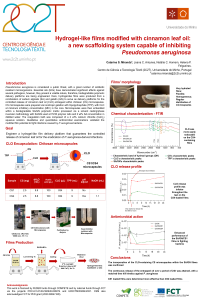
Pseudomonas aeruginosa is considered a pathogen with clinical relevance, due to its intrinsic antibiotic resistance. For this reason, it is crucial to think of alternatives to treat P. aeruginosa-derived infections. Essential oils (EOs), natural products, possessing anti-inflammatory, antiseptic and analgesic properties, have been applied in this aim. Yet due to their volatile nature, polymeric microcapsules are frequently engineered to incorporate the antimicrobial agents at the core and work as drug carriers. As the result, the microcapsules protect the antimicrobial agents from the surrounding environment and, consequently, prevent undesirable effects, such as early degradation. In this study, a delivery platform for a controlled release of cinnamon leaf oil (CLO) was developed, resorting to chitosan (CS)/tripolyphosphate (TPP) microcapsules embedded in a hydrogel-like matrix. CS microcapsules were produced without any pH adjustment (CS1) and with pH adjusted to 5.0 (CS4). Subsequently, the microcapsules were incorporated within sodium alginate (SA) and gelatin (GN) hydrogel-like films, prepared by the solvent casting-phase inversion method. SA and GN were selected since SA presents a fast ionic gelation with divalent cations and GN has a good biodegradability. Fourier-transform infrared spectroscopy analysis confirmed the effective incorporation of CS microcapsules with CLO within the SA/GN films. A continuous release of the entrapped CLO was achieved. In addition, a matched time kill kinetics against the bacteria was attained, and the SA/GN/CS1 films were determined more efficient. Data revelated the outstanding potential of CLO loaded films for the inhibition of P. aeruginosa.
Keywords
bio-based polymers
natural extracts
controlled drug release
bactericidal effects
Manuscript
sciforum-044013.pdf
Poster
Poster ECB.pdf
Assessment of essential oil-loaded nanofibrous mats against the Escherichia virus MS2, a mimetic of SARS-CoV-2, for potential applications as inner layers in individual protection masks
Probiotics administration ameliorate azoxymethane induced-carcinogenesis by reducing the formation of aberrant crypt foci and modulation oxidative stress in rats