Event submissions
Published

This submission belongs to the session S3. Cancer Therapeutics of the event 1st International Electronic Conference on Biomedicine
Published date
31 May, 2021
Citation
Aleksey V Belikov, Alexey D Vyatkin, Danila V Otnykov, Sergey V Leonov, TCGA PanCanAtlas data analysis suggests multiple possibilities for personalized cancer therapy, in Proceedings of 1st International Electronic Conference on Biomedicine, 1 June–26 June 2021, MDPI: Basel, Switzerland, doi: 10.3390/ECB2021-10269
Share
Email
Facebook
Twitter
LinkedIn
TCGA PanCanAtlas data analysis suggests multiple possibilities for personalized cancer therapy
'%3e%3cpath%20d='M12.6647%2010.9104C12.4176%2010.325%2012.0589%209.7933%2011.6088%209.34485C11.16%208.89511%2010.6283%208.53653%2010.0432%208.28891C10.038%208.28629%2010.0327%208.28498%2010.0275%208.28236C10.8437%207.69282%2011.3743%206.73252%2011.3743%205.64907C11.3743%203.85423%209.92005%202.40002%208.12522%202.40002C6.33038%202.40002%204.87618%203.85423%204.87618%205.64907C4.87618%206.73252%205.40677%207.69282%206.22296%208.28367C6.21772%208.28629%206.21248%208.2876%206.20724%208.29022C5.62031%208.53783%205.09365%208.89287%204.64167%209.34616C4.19192%209.79496%203.83334%2010.3266%203.58573%2010.9117C3.34247%2011.4846%203.21128%2012.0987%203.19925%2012.721C3.1989%2012.735%203.20135%2012.7489%203.20646%2012.7619C3.21157%2012.7749%203.21924%2012.7868%203.22901%2012.7968C3.23877%2012.8068%203.25045%2012.8148%203.26334%2012.8202C3.27623%2012.8256%203.29007%2012.8284%203.30406%2012.8284H4.09012C4.14776%2012.8284%204.19362%2012.7825%204.19493%2012.7262C4.22113%2011.7148%204.62726%2010.7676%205.34519%2010.0497C6.08802%209.30686%207.07452%208.89811%208.12522%208.89811C9.17592%208.89811%2010.1624%209.30686%2010.9052%2010.0497C11.6232%2010.7676%2012.0293%2011.7148%2012.0555%2012.7262C12.0568%2012.7839%2012.1027%2012.8284%2012.1603%2012.8284H12.9464C12.9604%2012.8284%2012.9742%2012.8256%2012.9871%2012.8202C13%2012.8148%2013.0117%2012.8068%2013.0214%2012.7968C13.0312%2012.7868%2013.0389%2012.7749%2013.044%2012.7619C13.0491%2012.7489%2013.0515%2012.735%2013.0512%2012.721C13.0381%2012.0947%2012.9084%2011.4856%2012.6647%2010.9104ZM8.12522%207.90243C7.52388%207.90243%206.95792%207.66793%206.53214%207.24215C6.10636%206.81636%205.87185%206.2504%205.87185%205.64907C5.87185%205.04773%206.10636%204.48177%206.53214%204.05599C6.95792%203.63021%207.52388%203.3957%208.12522%203.3957C8.72655%203.3957%209.29252%203.63021%209.7183%204.05599C10.1441%204.48177%2010.3786%205.04773%2010.3786%205.64907C10.3786%206.2504%2010.1441%206.81636%209.7183%207.24215C9.29252%207.66793%208.72655%207.90243%208.12522%207.90243Z'%20fill='%235D1EE1'/%3e%3c/g%3e%3c/svg%3e)
Aleksey V Belikov 1
Alexey D Vyatkin 2
Danila V Otnykov 3
Sergey V Leonov 1
1. Laboratory of Innovative Medicine, School of Biological and Medical Physics, Moscow Institute of Physics and Technology
2. Moscow Institute of Physics and Technology
3. School of Biological and Medical Physics, Moscow Institute of Physics and Technology
Abstract
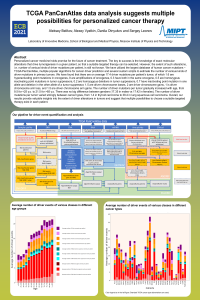
Personalized cancer medicine holds promise for the future of cancer treatment. The key to success is the knowledge of exact molecular alterations that drive tumorigenesis in a given patient, so that a suitable targeted therapy can be selected. However, the extent of such alterations, i.e. number of various kinds of driver mutations per patient, is still not known. We have utilized the largest database of human cancer mutations – TCGA PanCanAtlas, multiple popular algorithms for cancer driver prediction and several custom scripts to estimate the number of various kinds of driver mutations in primary tumors. We have found that there are on average 19.6 driver mutations per patient’s tumor, of which 2.4 are hyperactivating SNA mutations in oncogenes, 9.2 are CNA amplifications of oncogenes, 0.6 have both in the same oncogene, 0.2 are homozygous inactivating SNA mutations in tumor suppressors, 1.1 have inactivating SNA mutation in one allele and CNA deletion in the other allele of a tumor suppressor, 1.5 are driver chromosome losses, 2 are driver chromosome gains, 1 is driver chromosome arm loss, and 1.6 are driver chromosome arm gains. The number of driver mutations per tumor gradually increased with age, from 12.5 for <25 y.o. to 23.6 for >85 y.o. There was no big difference between genders (19.9 in males vs 19.2 in females). The number of driver mutations per tumor varied strongly between cancer types, from 1.5 in thyroid carcinoma to 43 in lung squamous cell carcinoma. Overall, our results provide valuable insights into the extent of driver alterations in tumors and suggest that multiple possibilities to choose a suitable targeted therapy exist in each patient.
Keywords
personalized medicine
targeted therapy
driver mutation
SNA
CNA
aneuploidy
chromosome
arm
gain
loss
tumorigenesis
carcinogenesis
TCGA
PanCanAtlas
oncogene
tumor suppressor
Manuscript
sciforum-041442 layout done.pdf
Poster
ECB2021 poster.pdf
The study of natural compounds as antidepressants by bioinformatics methods
Cancer Stem Cells and Somatic Stem Cells as Potential New Drug Targets, and Prognosis Markers, and Therapy Efficacy Predictors in Breast Cancer Treatment