Event submissions
Published

This submission belongs to the session S3. Cancer Therapeutics of the event 1st International Electronic Conference on Biomedicine
Published date
31 May, 2021
Citation
Isabella Damiani, Silvia Castiglioni, Valentina Rusconi, Clara Rossi, Alberto Corsini, Stefano Bellosta, In vitro characterization of an anti-HER2 affibody-monomethyl auristatin E conjugate in HER2-positive breast cancer cells, in Proceedings of 1st International Electronic Conference on Biomedicine, 1 June–26 June 2021, MDPI: Basel, Switzerland, doi: 10.3390/ECB2021-10277
Share
Email
Facebook
Twitter
LinkedIn
In vitro characterization of an anti-HER2 affibody-monomethyl auristatin E conjugate in HER2-positive breast cancer cells
'%3e%3cpath%20d='M12.6647%2010.9104C12.4176%2010.325%2012.0589%209.7933%2011.6088%209.34485C11.16%208.89511%2010.6283%208.53653%2010.0432%208.28891C10.038%208.28629%2010.0327%208.28498%2010.0275%208.28236C10.8437%207.69282%2011.3743%206.73252%2011.3743%205.64907C11.3743%203.85423%209.92005%202.40002%208.12522%202.40002C6.33038%202.40002%204.87618%203.85423%204.87618%205.64907C4.87618%206.73252%205.40677%207.69282%206.22296%208.28367C6.21772%208.28629%206.21248%208.2876%206.20724%208.29022C5.62031%208.53783%205.09365%208.89287%204.64167%209.34616C4.19192%209.79496%203.83334%2010.3266%203.58573%2010.9117C3.34247%2011.4846%203.21128%2012.0987%203.19925%2012.721C3.1989%2012.735%203.20135%2012.7489%203.20646%2012.7619C3.21157%2012.7749%203.21924%2012.7868%203.22901%2012.7968C3.23877%2012.8068%203.25045%2012.8148%203.26334%2012.8202C3.27623%2012.8256%203.29007%2012.8284%203.30406%2012.8284H4.09012C4.14776%2012.8284%204.19362%2012.7825%204.19493%2012.7262C4.22113%2011.7148%204.62726%2010.7676%205.34519%2010.0497C6.08802%209.30686%207.07452%208.89811%208.12522%208.89811C9.17592%208.89811%2010.1624%209.30686%2010.9052%2010.0497C11.6232%2010.7676%2012.0293%2011.7148%2012.0555%2012.7262C12.0568%2012.7839%2012.1027%2012.8284%2012.1603%2012.8284H12.9464C12.9604%2012.8284%2012.9742%2012.8256%2012.9871%2012.8202C13%2012.8148%2013.0117%2012.8068%2013.0214%2012.7968C13.0312%2012.7868%2013.0389%2012.7749%2013.044%2012.7619C13.0491%2012.7489%2013.0515%2012.735%2013.0512%2012.721C13.0381%2012.0947%2012.9084%2011.4856%2012.6647%2010.9104ZM8.12522%207.90243C7.52388%207.90243%206.95792%207.66793%206.53214%207.24215C6.10636%206.81636%205.87185%206.2504%205.87185%205.64907C5.87185%205.04773%206.10636%204.48177%206.53214%204.05599C6.95792%203.63021%207.52388%203.3957%208.12522%203.3957C8.72655%203.3957%209.29252%203.63021%209.7183%204.05599C10.1441%204.48177%2010.3786%205.04773%2010.3786%205.64907C10.3786%206.2504%2010.1441%206.81636%209.7183%207.24215C9.29252%207.66793%208.72655%207.90243%208.12522%207.90243Z'%20fill='%235D1EE1'/%3e%3c/g%3e%3c/svg%3e)
Isabella Damiani 1
Silvia Castiglioni 1
Valentina Rusconi 1
Clara Rossi 1
Alberto Corsini 1
Stefano Bellosta 1
1. Department of Pharmacological and Biomolecular Sciences, University of Milan, Italy
Abstract
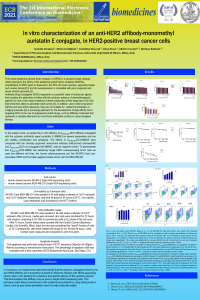
Antibody-drug conjugates (ADCs) are used in anticancer therapy with some limitations due to their molecular properties. An alternative to monoclonal antibodies is the affibody, composed of 58 aminoacids, with lower binding affinities, small size, and rapid blood clearance and tissue distribution. We investigated the in vitro efficacy of a novel anti-HER2 ZHER2:2891 affibody conjugated to a cytotoxic drug auristatin E (MMAE) in HER2-positive human cancer cells. Adenocarcinoma cell line SK-BR-3, expressing high levels of HER2, and mammary gland adenocarcinoma MDA-MB-231, expressing basal levels of HER2, were treated with ZHER2:2891DCS-MMAE and trastuzumab (as reference compound).
ZHER2:2891DCS-MMAE induced a significant time-dependent toxic effect in SK-BR-3 cells. A 30% reduction in cell viability was found after 10 min exposure at 7 nM with an IC50 of 80.2 nM. On the contrary, MDA-MB-231 cells were not affected by the affibody complex. The HER2-specific cytotoxic effect of the ZHER2:2891DCS-MMAE has been also confirmed by measuring apoptosis by flow cytometry. In SK-BR-3 cells, increasing concentrations of conjugated affibody, induced cell death after 10 min of treatment with the strongest effect observed after 48 hours. Also, treatment with ZHER2:2891DCS-MMAE reduced (up to 50%) HER2 expression at both mRNA and protein levels in SK-BR-3 cells after 24 hours of treatment.
In conclusion, the cytotoxic conjugate based on the anti-HER2 affibody and MMAE efficiently interacts with HER2 over-expressing cancer cells, allowing the selective and specific delivery of the cytotoxic payload. The basal HER2 expressing cells are not affected most probably due to a lower uptake of drug conjugate. This confirms that affibody may be used to target HER2 overexpressing cells while sparing normal cells.
Keywords
affibody
HER2
trastuzumab
breast cancer
Manuscript
sciforum-044836 layout done.pdf
Poster
Poster ECB 2021 Isabella Damiani.pdf
Synergistic effects of 5-fluorouracil in combination with diosmetin in colorectal cancer cells
A green method to synthesis the size-controllable gold nanostars for photo-based therapies