Event submissions
Published

This submission belongs to the session S2. Nutraceuticals, Nano Nutraceuticals and Nano Pharmaceuticals of the event 1st International Electronic Conference on Biomedicine
Published date
01 Jun, 2021
Citation
Mariana Lucas, Marisa Freitas, Artur M. S. Silva, Eduarda Fernandes, Daniela Ribeiro, Modulation of human neutrophils’ oxidative burst by hydroxylated 2-styrylchromones: the relevance of the catechol group, in Proceedings of 1st International Electronic Conference on Biomedicine, 1 June–26 June 2021, MDPI: Basel, Switzerland, doi: 10.3390/ECB2021-10283
Share
Email
Facebook
Twitter
LinkedIn
Modulation of human neutrophils’ oxidative burst by hydroxylated 2-styrylchromones: the relevance of the catechol group
'%3e%3cpath%20d='M12.6647%2010.9104C12.4176%2010.325%2012.0589%209.7933%2011.6088%209.34485C11.16%208.89511%2010.6283%208.53653%2010.0432%208.28891C10.038%208.28629%2010.0327%208.28498%2010.0275%208.28236C10.8437%207.69282%2011.3743%206.73252%2011.3743%205.64907C11.3743%203.85423%209.92005%202.40002%208.12522%202.40002C6.33038%202.40002%204.87618%203.85423%204.87618%205.64907C4.87618%206.73252%205.40677%207.69282%206.22296%208.28367C6.21772%208.28629%206.21248%208.2876%206.20724%208.29022C5.62031%208.53783%205.09365%208.89287%204.64167%209.34616C4.19192%209.79496%203.83334%2010.3266%203.58573%2010.9117C3.34247%2011.4846%203.21128%2012.0987%203.19925%2012.721C3.1989%2012.735%203.20135%2012.7489%203.20646%2012.7619C3.21157%2012.7749%203.21924%2012.7868%203.22901%2012.7968C3.23877%2012.8068%203.25045%2012.8148%203.26334%2012.8202C3.27623%2012.8256%203.29007%2012.8284%203.30406%2012.8284H4.09012C4.14776%2012.8284%204.19362%2012.7825%204.19493%2012.7262C4.22113%2011.7148%204.62726%2010.7676%205.34519%2010.0497C6.08802%209.30686%207.07452%208.89811%208.12522%208.89811C9.17592%208.89811%2010.1624%209.30686%2010.9052%2010.0497C11.6232%2010.7676%2012.0293%2011.7148%2012.0555%2012.7262C12.0568%2012.7839%2012.1027%2012.8284%2012.1603%2012.8284H12.9464C12.9604%2012.8284%2012.9742%2012.8256%2012.9871%2012.8202C13%2012.8148%2013.0117%2012.8068%2013.0214%2012.7968C13.0312%2012.7868%2013.0389%2012.7749%2013.044%2012.7619C13.0491%2012.7489%2013.0515%2012.735%2013.0512%2012.721C13.0381%2012.0947%2012.9084%2011.4856%2012.6647%2010.9104ZM8.12522%207.90243C7.52388%207.90243%206.95792%207.66793%206.53214%207.24215C6.10636%206.81636%205.87185%206.2504%205.87185%205.64907C5.87185%205.04773%206.10636%204.48177%206.53214%204.05599C6.95792%203.63021%207.52388%203.3957%208.12522%203.3957C8.72655%203.3957%209.29252%203.63021%209.7183%204.05599C10.1441%204.48177%2010.3786%205.04773%2010.3786%205.64907C10.3786%206.2504%2010.1441%206.81636%209.7183%207.24215C9.29252%207.66793%208.72655%207.90243%208.12522%207.90243Z'%20fill='%235D1EE1'/%3e%3c/g%3e%3c/svg%3e)
Mariana Lucas 1

Marisa Freitas 2

Artur M. S. Silva 3

Eduarda Fernandes 2

Daniela Ribeiro 2
1. LAQV, REQUIMTE, Laboratory of Applied Chemistry, Department of Chemical Sciences, Faculty of Pharmacy, University of Porto, 4050-313 Porto, Portugal.
2. LAQV, REQUIMTE, Laboratory of Applied Chemistry, Department of Chemical Sciences, Faculty of Pharmacy, University of Porto, 4050-313 Porto, Portugal
3. Department of Chemistry & QOPNA, University of Aveiro, Campus de Santiago, 3810-193 Aveiro, Portugal
Abstract
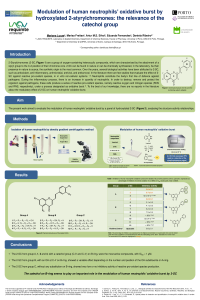
2-Styrylchromones (2-SC) are a group of oxygen-containing heterocyclic compounds, which are characterized by the attachment of a styryl group to the C-2 position of their chromone core. Over the years, several biological activities have been attributed to 2-SC, such as antioxidant, anti-inflammatory, antimicrobial, antiviral, and antitumor. 1,2 Nonetheless, there are no reports in the literature about the effect of 2-SC on human neutrophils’ oxidative burst.
Therefore, the present study aims to evaluate the modulation of human neutrophils’ oxidative burst by a panel of hydroxylated 2-SC, analysing the structure-activity relationships. For that purpose, freshly isolated neutrophils from human blood were stimulated with phorbol-12-myristate-13-acetate and a chemiluminescence method was applied to evaluate the oxidative burst, using luminol as probe. 3
Considering the OH substituents present on B-ring of 2-SC, the tested compounds can be divided into three groups: group 1, with a catechol group (C-3’ and C-4’); group 2, with an OH at C-4’ and group 3, without any substitution on B-ring. The 2-SC from group 1 were the most active, with IC50 values in the order of 1 µM. In conclusion, the catechol B-ring appears to play an important role in the modulation of human neutrophils’ oxidative burst by 2-SC.
References: 1. Gomes et al. DOI: 10.2174/138955710791112550; 2. Santos et al. DOI: 10.1002/ejoc.201700003; 3. Ribeiro et al. DOI: 10.1016/j.ejmech.2013.06.019
Acknowledgements: The work was supported by PT national funds (FCT/MCTES) through grant UIDB/50006/2020 (LAQV-REQUIMTE Associate Laboratory) and from the European Union (FEDER funds through COMPETE POCI-01-0145-FEDER-029253).
Keywords
2-styrychromones
oxidative burst
human neutrophils
structure-activity relationship
Manuscript
sciforum-041814.pdf
Poster
Poster ECB 2021_Mariana Lucas.pdf
Acute and chronic effects of medium-chain triglyceride supplementation on metabolic parameters and working memory in rats
Green synthesis, characterization, and bioactivity of silver-nanoparticles from algal polysaccharide of Chnoospara minima