Event submissions
Published

This submission belongs to the session S8. Nanomaterials and Its Application in Biomedicine, including Drug/Gene/Vaccine Delivery, Imaging, Medical Devices and Surgical Implants of the event 1st International Electronic Conference on Biomedicine
Published date
01 Jun, 2021
Citation
Yubia De Anda-Flores, Elizabeth Carvajal-Millan, Jaime Lizardi-Mendoza, Agustin Rascon-Chu, Ana Luisa Martínez-López, Judith Tanori-Cordova, Covalent Electrosprayed Nanoparticles Based on Protease Treated Arabinoxylans , in Proceedings of 1st International Electronic Conference on Biomedicine, 1 June–26 June 2021, MDPI: Basel, Switzerland, doi: 10.3390/ECB2021-10286
Share
Email
Facebook
Twitter
LinkedIn
Covalent Electrosprayed Nanoparticles Based on Protease Treated Arabinoxylans

Yubia De Anda-Flores 1

Elizabeth Carvajal-Millan 1
'%3e%3cpath%20d='M12.6647%2010.9104C12.4176%2010.325%2012.0589%209.7933%2011.6088%209.34485C11.16%208.89511%2010.6283%208.53653%2010.0432%208.28891C10.038%208.28629%2010.0327%208.28498%2010.0275%208.28236C10.8437%207.69282%2011.3743%206.73252%2011.3743%205.64907C11.3743%203.85423%209.92005%202.40002%208.12522%202.40002C6.33038%202.40002%204.87618%203.85423%204.87618%205.64907C4.87618%206.73252%205.40677%207.69282%206.22296%208.28367C6.21772%208.28629%206.21248%208.2876%206.20724%208.29022C5.62031%208.53783%205.09365%208.89287%204.64167%209.34616C4.19192%209.79496%203.83334%2010.3266%203.58573%2010.9117C3.34247%2011.4846%203.21128%2012.0987%203.19925%2012.721C3.1989%2012.735%203.20135%2012.7489%203.20646%2012.7619C3.21157%2012.7749%203.21924%2012.7868%203.22901%2012.7968C3.23877%2012.8068%203.25045%2012.8148%203.26334%2012.8202C3.27623%2012.8256%203.29007%2012.8284%203.30406%2012.8284H4.09012C4.14776%2012.8284%204.19362%2012.7825%204.19493%2012.7262C4.22113%2011.7148%204.62726%2010.7676%205.34519%2010.0497C6.08802%209.30686%207.07452%208.89811%208.12522%208.89811C9.17592%208.89811%2010.1624%209.30686%2010.9052%2010.0497C11.6232%2010.7676%2012.0293%2011.7148%2012.0555%2012.7262C12.0568%2012.7839%2012.1027%2012.8284%2012.1603%2012.8284H12.9464C12.9604%2012.8284%2012.9742%2012.8256%2012.9871%2012.8202C13%2012.8148%2013.0117%2012.8068%2013.0214%2012.7968C13.0312%2012.7868%2013.0389%2012.7749%2013.044%2012.7619C13.0491%2012.7489%2013.0515%2012.735%2013.0512%2012.721C13.0381%2012.0947%2012.9084%2011.4856%2012.6647%2010.9104ZM8.12522%207.90243C7.52388%207.90243%206.95792%207.66793%206.53214%207.24215C6.10636%206.81636%205.87185%206.2504%205.87185%205.64907C5.87185%205.04773%206.10636%204.48177%206.53214%204.05599C6.95792%203.63021%207.52388%203.3957%208.12522%203.3957C8.72655%203.3957%209.29252%203.63021%209.7183%204.05599C10.1441%204.48177%2010.3786%205.04773%2010.3786%205.64907C10.3786%206.2504%2010.1441%206.81636%209.7183%207.24215C9.29252%207.66793%208.72655%207.90243%208.12522%207.90243Z'%20fill='%235D1EE1'/%3e%3c/g%3e%3c/svg%3e)
Jaime Lizardi-Mendoza 1
Agustin Rascon-Chu 1
Ana Luisa Martínez-López 2
Judith Tanori-Cordova 3
1. Research Center for Food and Development (CIAD, A.C.)
2. University of Navarra
3. University of Sonora
Abstract
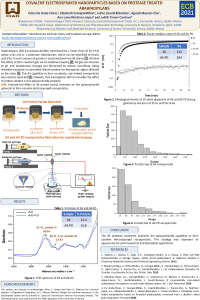
Arabinoxylans (AX) are polysaccharides constituted by a linear chain of β-(1→4) xylose units and α-L-arabinose substitutions, which can be esterified to ferulic acid (FA). A small amount of protein is associated with the AX chains [1]. AX have the ability to form covalent gels via FA oxidative coupling [2]. AX gels are resistant to pH and temperature changes but fermented by colonic microbiota, being therefore attractive as controlled release systems for therapeutic agents directed to the colon [3]. The AX capability to form covalently cross-linked nanoparticles was recently reported [4]; however, that investigation did not consider the effect of protein content in this polysaccharide property. The present study aimed to evaluate the effect of AX protein partial remotion on the polysaccharide potential to form covalent electrosprayed nanoparticles. AX were partially deproteinized using protease (AX-PD), resulting in a decrease in protein content from 16.4±0.5 to 10.8±0.1 %. Fourier transform infrared spectrum of AX-PD showed a diminution in the amide I and II bands concerning AX. The elastic modulus of laccase-induced AX-DP gels (1% w/v) was higher (284±12 Pa) than the value registered for AX gels (222±5 Pa). Electrosprayed 1% (w/v) AX and AX-PD nanoparticles revealed a spherical morphology when analyzed by transmission electron microscopy. The nanoparticles size distribution ranged from 19 to 390 nm and from 30 to 330 nm for AX and AX-PD, respectively. These results indicate that AX protease treatment improves the polysaccharide capability to form covalent electrosprayed nanoparticles, which could be used for pharmaceutical and biomedical applications.
References
- Saulnier, L.; Guillon, F.; Sado, P.-E.; Chateigner-Boutin, A.-L.; Rouau, X. Plant Cell Wall Polysaccharides in Storage Organs: Xylans (Food Applications). In Reference Module in Chemistry, Molecular Sciences and Chemical Engineering; Elsevier, 2013; p. np ISBN 978-0-12-409547-2.
- Morales-Ortega, A.; Niño-Medina, G.; Carvajal-Millán, E.; Gardea-Béjar, A.; Torres-Chávez, P.; López-Franco, Y.; Rascón-Chu, A.; Lizardi-Mendoza, J. Los Arabinoxilanos Ferulados De Cereales. Una Revisión De Sus. Rev. Fitotec. Mex. 2013, 36, 439–446.
- Martínez-López, A.L.; Carvajal-Millan, E.; Sotelo-Cruz, N.; Micard, V.; Rascón-Chu, A.; López-Franco, Y.L.; Lizardi-Mendoza, J.; Canett-Romero, R. Enzymatically cross-linked arabinoxylan microspheres as oral insulin delivery system. Int. J. Biol. Macromol. 2019, 126, 952–959, doi:10.1016/j.ijbiomac.2018.12.192.
- De Anda-Flores, Y.; Carvajal-Millan, E.; Lizardi-Mendoza, J.; Rascon-Chu, A.; Martínez-López, A.L.; Marquez-Escalante, J.; Brown-Bojorquez, F.; Tanori-Cordova, J. Covalently cross-linked nanoparticles based on ferulated arabinoxylans recovered from a distiller’s dried grains byproduct. Processes 2020, 8, 691, doi:10.3390/PR8060691.
Keywords
arabinoxylans
protease
polysaccharide
nanoparticles
Manuscript
sciforum-044791 .pdf
Poster
Poster De Anda-Flores et al., 2021.pdf
Blood compatibility of originally synthesized amphiphilic dendrons
Neuroprotective therapeutic strategy against neuronal damage