Event submissions
Published

This submission belongs to the session S7. Exploring Biomedicines in Behavioral Neurology and Neuropsychiatry of the event 1st International Electronic Conference on Biomedicine
Published date
03 Jun, 2021
Citation
Masaru Tanaka, Ágnes Szabó, Bálint Lőrinczi, István Szatmári, Ferenc Fülöp, László Vécsei, Antidepressant-like Effects of Kynurenic Acid Analogues, in Proceedings of 1st International Electronic Conference on Biomedicine, 1 June–26 June 2021, MDPI: Basel, Switzerland, doi: 10.3390/ECB2021-10301
Share
Email
Facebook
Twitter
LinkedIn
Antidepressant-like Effects of Kynurenic Acid Analogues

Masaru Tanaka 1

Ágnes Szabó 2

Bálint Lőrinczi 3

István Szatmári 3
'%3e%3cpath%20d='M12.6647%2010.9104C12.4176%2010.325%2012.0589%209.7933%2011.6088%209.34485C11.16%208.89511%2010.6283%208.53653%2010.0432%208.28891C10.038%208.28629%2010.0327%208.28498%2010.0275%208.28236C10.8437%207.69282%2011.3743%206.73252%2011.3743%205.64907C11.3743%203.85423%209.92005%202.40002%208.12522%202.40002C6.33038%202.40002%204.87618%203.85423%204.87618%205.64907C4.87618%206.73252%205.40677%207.69282%206.22296%208.28367C6.21772%208.28629%206.21248%208.2876%206.20724%208.29022C5.62031%208.53783%205.09365%208.89287%204.64167%209.34616C4.19192%209.79496%203.83334%2010.3266%203.58573%2010.9117C3.34247%2011.4846%203.21128%2012.0987%203.19925%2012.721C3.1989%2012.735%203.20135%2012.7489%203.20646%2012.7619C3.21157%2012.7749%203.21924%2012.7868%203.22901%2012.7968C3.23877%2012.8068%203.25045%2012.8148%203.26334%2012.8202C3.27623%2012.8256%203.29007%2012.8284%203.30406%2012.8284H4.09012C4.14776%2012.8284%204.19362%2012.7825%204.19493%2012.7262C4.22113%2011.7148%204.62726%2010.7676%205.34519%2010.0497C6.08802%209.30686%207.07452%208.89811%208.12522%208.89811C9.17592%208.89811%2010.1624%209.30686%2010.9052%2010.0497C11.6232%2010.7676%2012.0293%2011.7148%2012.0555%2012.7262C12.0568%2012.7839%2012.1027%2012.8284%2012.1603%2012.8284H12.9464C12.9604%2012.8284%2012.9742%2012.8256%2012.9871%2012.8202C13%2012.8148%2013.0117%2012.8068%2013.0214%2012.7968C13.0312%2012.7868%2013.0389%2012.7749%2013.044%2012.7619C13.0491%2012.7489%2013.0515%2012.735%2013.0512%2012.721C13.0381%2012.0947%2012.9084%2011.4856%2012.6647%2010.9104ZM8.12522%207.90243C7.52388%207.90243%206.95792%207.66793%206.53214%207.24215C6.10636%206.81636%205.87185%206.2504%205.87185%205.64907C5.87185%205.04773%206.10636%204.48177%206.53214%204.05599C6.95792%203.63021%207.52388%203.3957%208.12522%203.3957C8.72655%203.3957%209.29252%203.63021%209.7183%204.05599C10.1441%204.48177%2010.3786%205.04773%2010.3786%205.64907C10.3786%206.2504%2010.1441%206.81636%209.7183%207.24215C9.29252%207.66793%208.72655%207.90243%208.12522%207.90243Z'%20fill='%235D1EE1'/%3e%3c/g%3e%3c/svg%3e)
Ferenc Fülöp 3

László Vécsei 2,4
1. ELKH-SZTE Neuroscience Research Group, Danube Neuroscience Research Laboratory, Eötvös Loránd Research Network, University of Szeged (ELKH-SZTE), Tisza Lajos krt. 113, H-6725 Szeged, Hungary
2. Department of Neurology, Interdisciplinary Excellence Centre, Faculty of Medicine, University of Szeged, Semmelweis u. 6, H-6725 Szeged, Hungary
3. Institute of Pharmaceutical Chemistry and Research Group for Stereochemistry, Hungarian Academy of Sciences, University of Szeged, 6720 Szeged, Hungary
4. MTA-SZTE, Neuroscience Research Group, Semmelweis u. 6, Szeged, H-6725 Hungary
Abstract
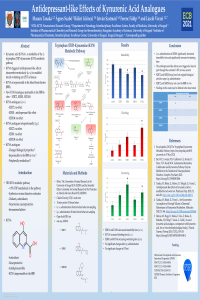
Kynurenic acid (KYNA) is a metabolite of the L-tryptophan (TRP)-kynurenine (KYN) pathway which has been shown to possess neuroprotective and antidepressant-like properties. The intracerebroventricular (i.c.v.) administration of kynurenic acid (KYNA) triggered antidepressant-like effects at least in part through the serotonin 5-hydroxytryptamine (5-HT) type 2 receptors, D2, D3, D4 dopamine receptors, and gamma-aminobutyric acid subunit A (GABAA) receptors in modified forced swimming test (FST) of mouse. However, KYNA is impermeable to the blood-brain-barrier (BBB) and thus it is probably a cause that the peripheral administration of KYNA did not exhibit an antidepressant-like effect.
New KYNA analogues were designed to overcome the BBB in attempt to deliver neuroprotective KYNA molecules to the central nervous system (CNS). The antidepressant-like effects of KYNA analogues SZR-72, SZR-81, and SZR-104 were studied i.c.v. and intraperitoneally (i.p.) with a modified FST.
The FST revealed that i.c.v. administration of SZR-81 significantly decreased immobility and significantly increased swimming time, which suggested that its antidepressant-like effects were triggered through the serotonin 5-HT nervous system. SZR-72 and SZR-104 did not significantly change either immobility, climbing, or swimming time, suggesting SZR-72and SZR-104 did not have antidepressant-like effects. Furthermore, i.p. administration of SZR-81 did not change either immobility, climbing, or swimming time like i.c.v. administration.
Two of the KYNA analogues SZR-72and SZR-104 may not have the antidepressant-like properties and SZR-81 may not cross the BBB or be modified on the way to the CNS. Novel KYNA analogues are expected to be designed in search of potent antidepressants which reserve antidepressant properties, cross the BBB, and target in the CNS.
Keywords
depression
antidepressant
kynurenines
kynurenic acid
analogues
blood-brain-barrier
Manuscript
sciforum-044011.pdf
Poster
Poster Presentations.pdf
Self-Nano Emulsifying Drug-Delivery Systems: From the Development to The Current Applications and Update of the Biopharmaceutical Aspect
Antibacterial assessment of sodium alginate/gelatin films loaded with propolis extract