Event submissions
Published

This submission belongs to the session S. Systematics and Morphology of the event The 1st International Electronic Conference on Entomology
Published date
30 Jun, 2021
Academic Editor
'%3e%3cpath%20d='M12.6657%2010.9104C12.4185%2010.325%2012.0599%209.79327%2011.6097%209.34482C11.1609%208.89508%2010.6293%208.5365%2010.0442%208.28888C10.0389%208.28626%2010.0337%208.28495%2010.0285%208.28233C10.8446%207.69279%2011.3752%206.73249%2011.3752%205.64904C11.3752%203.8542%209.92103%202.39999%208.1262%202.39999C6.33136%202.39999%204.87715%203.8542%204.87715%205.64904C4.87715%206.73249%205.40774%207.69279%206.22393%208.28364C6.21869%208.28626%206.21345%208.28757%206.20821%208.29019C5.62129%208.5378%205.09463%208.89284%204.64265%209.34613C4.1929%209.79493%203.83432%2010.3266%203.58671%2010.9117C3.34345%2011.4845%203.21226%2012.0987%203.20023%2012.7209C3.19988%2012.7349%203.20233%2012.7488%203.20744%2012.7619C3.21255%2012.7749%203.22022%2012.7867%203.22998%2012.7968C3.23975%2012.8068%203.25142%2012.8147%203.26431%2012.8202C3.2772%2012.8256%203.29105%2012.8284%203.30504%2012.8284H4.09109C4.14874%2012.8284%204.19459%2012.7825%204.1959%2012.7262C4.2221%2011.7148%204.62823%2010.7676%205.34617%2010.0497C6.08899%209.30683%207.0755%208.89808%208.1262%208.89808C9.17689%208.89808%2010.1634%209.30683%2010.9062%2010.0497C11.6242%2010.7676%2012.0303%2011.7148%2012.0565%2012.7262C12.0578%2012.7838%2012.1037%2012.8284%2012.1613%2012.8284H12.9474C12.9613%2012.8284%2012.9752%2012.8256%2012.9881%2012.8202C13.001%2012.8147%2013.0126%2012.8068%2013.0224%2012.7968C13.0322%2012.7867%2013.0398%2012.7749%2013.0449%2012.7619C13.0501%2012.7488%2013.0525%2012.7349%2013.0522%2012.7209C13.0391%2012.0947%2012.9094%2011.4855%2012.6657%2010.9104ZM8.1262%207.9024C7.52486%207.9024%206.9589%207.6679%206.53312%207.24211C6.10733%206.81633%205.87283%206.25037%205.87283%205.64904C5.87283%205.0477%206.10733%204.48174%206.53312%204.05596C6.9589%203.63018%207.52486%203.39567%208.1262%203.39567C8.72753%203.39567%209.29349%203.63018%209.71927%204.05596C10.1451%204.48174%2010.3796%205.0477%2010.3796%205.64904C10.3796%206.25037%2010.1451%206.81633%209.71927%207.24211C9.29349%207.6679%208.72753%207.9024%208.1262%207.9024Z'%20fill='%235D1EE1'/%3e%3c/g%3e%3c/svg%3e) Andjeljko Petrović
Andjeljko PetrovićCitation
Bojan Ilić, Jelena Milovanović, Vukica Vujić, Zvezdana Jovanović, Vladimir Tomić, Luka Lučić, Slobodan Makarov, Non-Systemic Metamorphosis in Callipodida (Myriapoda, Diplopoda): the Case of an Endemic Balkan Millipede Apfelbeckia insculpta (L. Koch, 1867), in Proceedings of The 1st International Electronic Conference on Entomology, 1 July–15 July 2021, MDPI: Basel, Switzerland, doi: 10.3390/IECE-10360
Share
Email
Facebook
Twitter
LinkedIn
Non-Systemic Metamorphosis in Callipodida (Myriapoda, Diplopoda): the Case of an Endemic Balkan Millipede Apfelbeckia insculpta (L. Koch, 1867)
'%3e%3cpath%20d='M12.6647%2010.9104C12.4176%2010.325%2012.0589%209.7933%2011.6088%209.34485C11.16%208.89511%2010.6283%208.53653%2010.0432%208.28891C10.038%208.28629%2010.0327%208.28498%2010.0275%208.28236C10.8437%207.69282%2011.3743%206.73252%2011.3743%205.64907C11.3743%203.85423%209.92005%202.40002%208.12522%202.40002C6.33038%202.40002%204.87618%203.85423%204.87618%205.64907C4.87618%206.73252%205.40677%207.69282%206.22296%208.28367C6.21772%208.28629%206.21248%208.2876%206.20724%208.29022C5.62031%208.53783%205.09365%208.89287%204.64167%209.34616C4.19192%209.79496%203.83334%2010.3266%203.58573%2010.9117C3.34247%2011.4846%203.21128%2012.0987%203.19925%2012.721C3.1989%2012.735%203.20135%2012.7489%203.20646%2012.7619C3.21157%2012.7749%203.21924%2012.7868%203.22901%2012.7968C3.23877%2012.8068%203.25045%2012.8148%203.26334%2012.8202C3.27623%2012.8256%203.29007%2012.8284%203.30406%2012.8284H4.09012C4.14776%2012.8284%204.19362%2012.7825%204.19493%2012.7262C4.22113%2011.7148%204.62726%2010.7676%205.34519%2010.0497C6.08802%209.30686%207.07452%208.89811%208.12522%208.89811C9.17592%208.89811%2010.1624%209.30686%2010.9052%2010.0497C11.6232%2010.7676%2012.0293%2011.7148%2012.0555%2012.7262C12.0568%2012.7839%2012.1027%2012.8284%2012.1603%2012.8284H12.9464C12.9604%2012.8284%2012.9742%2012.8256%2012.9871%2012.8202C13%2012.8148%2013.0117%2012.8068%2013.0214%2012.7968C13.0312%2012.7868%2013.0389%2012.7749%2013.044%2012.7619C13.0491%2012.7489%2013.0515%2012.735%2013.0512%2012.721C13.0381%2012.0947%2012.9084%2011.4856%2012.6647%2010.9104ZM8.12522%207.90243C7.52388%207.90243%206.95792%207.66793%206.53214%207.24215C6.10636%206.81636%205.87185%206.2504%205.87185%205.64907C5.87185%205.04773%206.10636%204.48177%206.53214%204.05599C6.95792%203.63021%207.52388%203.3957%208.12522%203.3957C8.72655%203.3957%209.29252%203.63021%209.7183%204.05599C10.1441%204.48177%2010.3786%205.04773%2010.3786%205.64907C10.3786%206.2504%2010.1441%206.81636%209.7183%207.24215C9.29252%207.66793%208.72655%207.90243%208.12522%207.90243Z'%20fill='%235D1EE1'/%3e%3c/g%3e%3c/svg%3e)
Bojan Ilić 1
Jelena Milovanović 2
Vukica Vujić 2
Zvezdana Jovanović 2
Vladimir Tomić 2
Luka Lučić 2
Slobodan Makarov 2
1. University of Belgrade – Faculty of Biology, Studentski Trg 16, 11000 Belgrade, Serbia
2. University of Belgrade - Faculty of Biology
Abstract
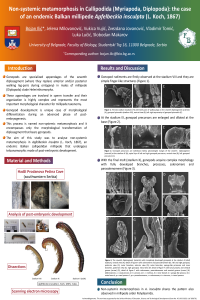
Gonopods are specialized appendages of the seventh diplosegment (where they replace anterior and/or posterior walking leg-pairs during ontogeny) in males of millipede (Diplopoda) clade Helminthomorpha. They are involved in sperm transfer; their organization is highly complex and represents the most important morphological character for millipede taxonomy. Gonopod development is unique case of morphological differentiation during an advanced phase of post-embryogenesis. This process is named non-systemic metamorphosis and it encompasses only the morphological transformation of diplosegment that bears gonopods. To our best knowledge, there are no data on non-systemic metamorphosis in diplopod order Callipodida. Only the anterior pair of walking legs of the seventh diplosegment is replaced with gonopods during post-embryogenesis in callipodidan males. For this study, we analyzed non-systemic metamorphosis in Apfelbeckia insulpta (L. Koch, 1867), an endemic Balkan callipodidan that undergoes teloanamorphic mode of post-embryonic development and reaches adulthood after nine molts. With the ninth molt, adult stadium (stadium X) is achieved and there are no additional molts. The gonopod differentiation in A. insculpta was explored utilizing scanning electron microscopy. Gonopod rudiments are firstly observed at the stadium VIII and they are simple finger-like structures. At the following stadium, gonopod precursors are enlarged and dilated at the base. With the final molt (stadium X), gonopods acquires complex morphology with fully developed branches, processes, solenomere and parasolenomere. With abrupt changes that take place only between penultimate and ultimate phase of gonopod differentiation, non-systemic metamorphosis in our study species follows the pattern observed in millipede order Polydesmida.
Keywords
millipedes
post-embryonic development
gonopods
Manuscript
sciforum-046660-layout(1).pdf
Poster
Ilic et al IECE.pdf
Testing the Hypothesis of Modularity on Head Capsule in Millipede Megaphyllum bosniense (Verhoeff, 1897) (Diplopoda: Julida)
Mortality of the Red Flour Beetle (Tribolium castaneum) when Exposed to Croatian Strain of Entomopathogenic Nematodes Steinernema feltiae