Event submissions
Published

This submission belongs to the session B. Biology, Behavior and Physiology of the event The 1st International Electronic Conference on Entomology
Published date
30 Jun, 2021
Academic Editor
'%3e%3cpath%20d='M12.6657%2010.9104C12.4185%2010.325%2012.0599%209.79327%2011.6097%209.34482C11.1609%208.89508%2010.6293%208.5365%2010.0442%208.28888C10.0389%208.28626%2010.0337%208.28495%2010.0285%208.28233C10.8446%207.69279%2011.3752%206.73249%2011.3752%205.64904C11.3752%203.8542%209.92103%202.39999%208.1262%202.39999C6.33136%202.39999%204.87715%203.8542%204.87715%205.64904C4.87715%206.73249%205.40774%207.69279%206.22393%208.28364C6.21869%208.28626%206.21345%208.28757%206.20821%208.29019C5.62129%208.5378%205.09463%208.89284%204.64265%209.34613C4.1929%209.79493%203.83432%2010.3266%203.58671%2010.9117C3.34345%2011.4845%203.21226%2012.0987%203.20023%2012.7209C3.19988%2012.7349%203.20233%2012.7488%203.20744%2012.7619C3.21255%2012.7749%203.22022%2012.7867%203.22998%2012.7968C3.23975%2012.8068%203.25142%2012.8147%203.26431%2012.8202C3.2772%2012.8256%203.29105%2012.8284%203.30504%2012.8284H4.09109C4.14874%2012.8284%204.19459%2012.7825%204.1959%2012.7262C4.2221%2011.7148%204.62823%2010.7676%205.34617%2010.0497C6.08899%209.30683%207.0755%208.89808%208.1262%208.89808C9.17689%208.89808%2010.1634%209.30683%2010.9062%2010.0497C11.6242%2010.7676%2012.0303%2011.7148%2012.0565%2012.7262C12.0578%2012.7838%2012.1037%2012.8284%2012.1613%2012.8284H12.9474C12.9613%2012.8284%2012.9752%2012.8256%2012.9881%2012.8202C13.001%2012.8147%2013.0126%2012.8068%2013.0224%2012.7968C13.0322%2012.7867%2013.0398%2012.7749%2013.0449%2012.7619C13.0501%2012.7488%2013.0525%2012.7349%2013.0522%2012.7209C13.0391%2012.0947%2012.9094%2011.4855%2012.6657%2010.9104ZM8.1262%207.9024C7.52486%207.9024%206.9589%207.6679%206.53312%207.24211C6.10733%206.81633%205.87283%206.25037%205.87283%205.64904C5.87283%205.0477%206.10733%204.48174%206.53312%204.05596C6.9589%203.63018%207.52486%203.39567%208.1262%203.39567C8.72753%203.39567%209.29349%203.63018%209.71927%204.05596C10.1451%204.48174%2010.3796%205.0477%2010.3796%205.64904C10.3796%206.25037%2010.1451%206.81633%209.71927%207.24211C9.29349%207.6679%208.72753%207.9024%208.1262%207.9024Z'%20fill='%235D1EE1'/%3e%3c/g%3e%3c/svg%3e) Donato Romano
Donato RomanoCitation
Atousa Farahpour-Haghani, Mahdi Jalaeian, Distinguish Behavioral Characteristics of Diasemiopsis Ramburial (Duponchel, 1833) and Nomophila noctuella (Denis & Schiffermuller, 1775) (Lepidop-Tera: Crambidae) on Azolla spp., in Proceedings of The 1st International Electronic Conference on Entomology, 1 July–15 July 2021, MDPI: Basel, Switzerland, doi: 10.3390/IECE-10378
Share
Email
Facebook
Twitter
LinkedIn
Distinguish Behavioral Characteristics of Diasemiopsis Ramburial (Duponchel, 1833) and Nomophila noctuella (Denis & Schiffermuller, 1775) (Lepidop-Tera: Crambidae) on Azolla spp.
'%3e%3cpath%20d='M12.6647%2010.9104C12.4176%2010.325%2012.0589%209.7933%2011.6088%209.34485C11.16%208.89511%2010.6283%208.53653%2010.0432%208.28891C10.038%208.28629%2010.0327%208.28498%2010.0275%208.28236C10.8437%207.69282%2011.3743%206.73252%2011.3743%205.64907C11.3743%203.85423%209.92005%202.40002%208.12522%202.40002C6.33038%202.40002%204.87618%203.85423%204.87618%205.64907C4.87618%206.73252%205.40677%207.69282%206.22296%208.28367C6.21772%208.28629%206.21248%208.2876%206.20724%208.29022C5.62031%208.53783%205.09365%208.89287%204.64167%209.34616C4.19192%209.79496%203.83334%2010.3266%203.58573%2010.9117C3.34247%2011.4846%203.21128%2012.0987%203.19925%2012.721C3.1989%2012.735%203.20135%2012.7489%203.20646%2012.7619C3.21157%2012.7749%203.21924%2012.7868%203.22901%2012.7968C3.23877%2012.8068%203.25045%2012.8148%203.26334%2012.8202C3.27623%2012.8256%203.29007%2012.8284%203.30406%2012.8284H4.09012C4.14776%2012.8284%204.19362%2012.7825%204.19493%2012.7262C4.22113%2011.7148%204.62726%2010.7676%205.34519%2010.0497C6.08802%209.30686%207.07452%208.89811%208.12522%208.89811C9.17592%208.89811%2010.1624%209.30686%2010.9052%2010.0497C11.6232%2010.7676%2012.0293%2011.7148%2012.0555%2012.7262C12.0568%2012.7839%2012.1027%2012.8284%2012.1603%2012.8284H12.9464C12.9604%2012.8284%2012.9742%2012.8256%2012.9871%2012.8202C13%2012.8148%2013.0117%2012.8068%2013.0214%2012.7968C13.0312%2012.7868%2013.0389%2012.7749%2013.044%2012.7619C13.0491%2012.7489%2013.0515%2012.735%2013.0512%2012.721C13.0381%2012.0947%2012.9084%2011.4856%2012.6647%2010.9104ZM8.12522%207.90243C7.52388%207.90243%206.95792%207.66793%206.53214%207.24215C6.10636%206.81636%205.87185%206.2504%205.87185%205.64907C5.87185%205.04773%206.10636%204.48177%206.53214%204.05599C6.95792%203.63021%207.52388%203.3957%208.12522%203.3957C8.72655%203.3957%209.29252%203.63021%209.7183%204.05599C10.1441%204.48177%2010.3786%205.04773%2010.3786%205.64907C10.3786%206.2504%2010.1441%206.81636%209.7183%207.24215C9.29252%207.66793%208.72655%207.90243%208.12522%207.90243Z'%20fill='%235D1EE1'/%3e%3c/g%3e%3c/svg%3e)
Atousa Farahpour-Haghani 1
Mahdi Jalaeian 1
1. Rice Research Institute of Iran (RRII), Agricultural Research, Education and Extension Organization (AREEO), Rasht, Iran
Abstract
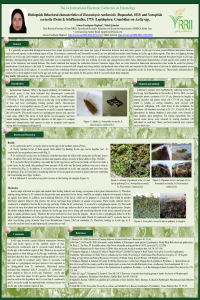
It is generally accepted that biological invasions have major ecosystem impacts and create new types of interaction between local and exotic species. Azolla spp. invasion caused different interactions between local and exotic species in the northern region of Iran. Diasemiopsis ramburialis and Nomophila noctuella are two spilomelinae moths found feeding on Azolla spp.in these regions. They have overlapping feeding periods on Azolla spp. and immature stages would be confused easily. N. noctuella was recorded as a polyphagous and pest species while D. ramburialis had no other reported host plant beside Azolla spp., therefore, distinguishing these species from each other was so important for anyone who was working on Azolla spp. management in these Areas. Behavioral characteristics of both species were studied for five years in the laboratory and natural habitats. The results indicated that despite the similarities between immature stages, there are some distinctive behavioral characteristics that would be useful for primary identification of each species in the field. D. ramburialis larvae constructed well-shaped and strong shelters, and produced more silken webs and remained in the shelter most of the time. In addition pupation occurs near the feeding site in this species. N. noctuella larvae have wandering behavior and prefer to move in margins, therefore in this species, pupation occurs far from the feeding site . These results indicated that D. ramburialis is more adapted to feed Azolla spp. and Azolla spp. are main host plants for this species while N. noctuella chose them randomly.
Keywords
Spilomelinae
Azolla spp.
Behavioral characteristic
Manuscript
sciforum-046680-layout.pdf
Poster
poster.pdf
Morphology of Immature Stages of Sphaerophoria rueppellii (Wiedemann, 1830) (Diptera, Syrphidae) a Predator of Aphids Pest
Field Screening of Arabica Coffee Genotypes against Coffee White Stem Borer (Xylotrechus quadripes) and Leaf Rust (Hemileia vastatrix) Infestation in Kaski, Nepal