Event submissions
Published

This submission belongs to the session P. Posters of the event The 1st International Electronic Conference on Entomology
Published date
30 Jun, 2021
Academic Editor
'%3e%3cpath%20d='M12.6657%2010.9104C12.4185%2010.325%2012.0599%209.79327%2011.6097%209.34482C11.1609%208.89508%2010.6293%208.5365%2010.0442%208.28888C10.0389%208.28626%2010.0337%208.28495%2010.0285%208.28233C10.8446%207.69279%2011.3752%206.73249%2011.3752%205.64904C11.3752%203.8542%209.92103%202.39999%208.1262%202.39999C6.33136%202.39999%204.87715%203.8542%204.87715%205.64904C4.87715%206.73249%205.40774%207.69279%206.22393%208.28364C6.21869%208.28626%206.21345%208.28757%206.20821%208.29019C5.62129%208.5378%205.09463%208.89284%204.64265%209.34613C4.1929%209.79493%203.83432%2010.3266%203.58671%2010.9117C3.34345%2011.4845%203.21226%2012.0987%203.20023%2012.7209C3.19988%2012.7349%203.20233%2012.7488%203.20744%2012.7619C3.21255%2012.7749%203.22022%2012.7867%203.22998%2012.7968C3.23975%2012.8068%203.25142%2012.8147%203.26431%2012.8202C3.2772%2012.8256%203.29105%2012.8284%203.30504%2012.8284H4.09109C4.14874%2012.8284%204.19459%2012.7825%204.1959%2012.7262C4.2221%2011.7148%204.62823%2010.7676%205.34617%2010.0497C6.08899%209.30683%207.0755%208.89808%208.1262%208.89808C9.17689%208.89808%2010.1634%209.30683%2010.9062%2010.0497C11.6242%2010.7676%2012.0303%2011.7148%2012.0565%2012.7262C12.0578%2012.7838%2012.1037%2012.8284%2012.1613%2012.8284H12.9474C12.9613%2012.8284%2012.9752%2012.8256%2012.9881%2012.8202C13.001%2012.8147%2013.0126%2012.8068%2013.0224%2012.7968C13.0322%2012.7867%2013.0398%2012.7749%2013.0449%2012.7619C13.0501%2012.7488%2013.0525%2012.7349%2013.0522%2012.7209C13.0391%2012.0947%2012.9094%2011.4855%2012.6657%2010.9104ZM8.1262%207.9024C7.52486%207.9024%206.9589%207.6679%206.53312%207.24211C6.10733%206.81633%205.87283%206.25037%205.87283%205.64904C5.87283%205.0477%206.10733%204.48174%206.53312%204.05596C6.9589%203.63018%207.52486%203.39567%208.1262%203.39567C8.72753%203.39567%209.29349%203.63018%209.71927%204.05596C10.1451%204.48174%2010.3796%205.0477%2010.3796%205.64904C10.3796%206.25037%2010.1451%206.81633%209.71927%207.24211C9.29349%207.6679%208.72753%207.9024%208.1262%207.9024Z'%20fill='%235D1EE1'/%3e%3c/g%3e%3c/svg%3e) Silvio Erler
Silvio ErlerCitation
meray kadee, Oz Barazani, Sharoni Shafir, Plant Insect Interaction: Linking Herbivory and Pollinators As Selection Agents in Populations of Eruca sativa, in Proceedings of The 1st International Electronic Conference on Entomology, 1 July–15 July 2021, MDPI: Basel, Switzerland, doi: 10.3390/IECE-10384
Share
Email
Facebook
Twitter
LinkedIn
Plant Insect Interaction: Linking Herbivory and Pollinators As Selection Agents in Populations of Eruca sativa
'%3e%3cpath%20d='M12.6647%2010.9104C12.4176%2010.325%2012.0589%209.7933%2011.6088%209.34485C11.16%208.89511%2010.6283%208.53653%2010.0432%208.28891C10.038%208.28629%2010.0327%208.28498%2010.0275%208.28236C10.8437%207.69282%2011.3743%206.73252%2011.3743%205.64907C11.3743%203.85423%209.92005%202.40002%208.12522%202.40002C6.33038%202.40002%204.87618%203.85423%204.87618%205.64907C4.87618%206.73252%205.40677%207.69282%206.22296%208.28367C6.21772%208.28629%206.21248%208.2876%206.20724%208.29022C5.62031%208.53783%205.09365%208.89287%204.64167%209.34616C4.19192%209.79496%203.83334%2010.3266%203.58573%2010.9117C3.34247%2011.4846%203.21128%2012.0987%203.19925%2012.721C3.1989%2012.735%203.20135%2012.7489%203.20646%2012.7619C3.21157%2012.7749%203.21924%2012.7868%203.22901%2012.7968C3.23877%2012.8068%203.25045%2012.8148%203.26334%2012.8202C3.27623%2012.8256%203.29007%2012.8284%203.30406%2012.8284H4.09012C4.14776%2012.8284%204.19362%2012.7825%204.19493%2012.7262C4.22113%2011.7148%204.62726%2010.7676%205.34519%2010.0497C6.08802%209.30686%207.07452%208.89811%208.12522%208.89811C9.17592%208.89811%2010.1624%209.30686%2010.9052%2010.0497C11.6232%2010.7676%2012.0293%2011.7148%2012.0555%2012.7262C12.0568%2012.7839%2012.1027%2012.8284%2012.1603%2012.8284H12.9464C12.9604%2012.8284%2012.9742%2012.8256%2012.9871%2012.8202C13%2012.8148%2013.0117%2012.8068%2013.0214%2012.7968C13.0312%2012.7868%2013.0389%2012.7749%2013.044%2012.7619C13.0491%2012.7489%2013.0515%2012.735%2013.0512%2012.721C13.0381%2012.0947%2012.9084%2011.4856%2012.6647%2010.9104ZM8.12522%207.90243C7.52388%207.90243%206.95792%207.66793%206.53214%207.24215C6.10636%206.81636%205.87185%206.2504%205.87185%205.64907C5.87185%205.04773%206.10636%204.48177%206.53214%204.05599C6.95792%203.63021%207.52388%203.3957%208.12522%203.3957C8.72655%203.3957%209.29252%203.63021%209.7183%204.05599C10.1441%204.48177%2010.3786%205.04773%2010.3786%205.64907C10.3786%206.2504%2010.1441%206.81636%209.7183%207.24215C9.29252%207.66793%208.72655%207.90243%208.12522%207.90243Z'%20fill='%235D1EE1'/%3e%3c/g%3e%3c/svg%3e)
meray kadee 1
Oz Barazani 2
Sharoni Shafir 1
1. B. Triwaks Bee Research Center, Department of Entomology, The Hebrew University of Jerusalem, Faculty of Agriculture, Food, and the Environment, Rehovot 76100, Israel
2. Institute of Plant Sciences, Agricultural Research Organization, 7505101 Rishon LeZion, Israel
Abstract
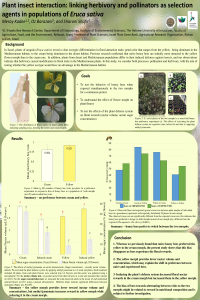
In Israel, arugula (Eruca sativa) plants reveal a clear ecotypic differentiation in floral attraction traits: petal color that ranges from the yellow, being dominant in the Mediterranean habitat, to the cream being dominant in the desert habitat. The Mediterranean habitat is characterized by greater floral diversity than the desert habitat, and honey bees (Apis mellifera) are the main pollinator in the Mediterranean habitat. Diamondback moths (DBM) (Plutella xylostella) are more prevalent in the desert habitat than in the Mediterranean habitat. Whereas adult moths are pollinators, the larvae are specialist herbivores on E. sativa. Pollination and herbivory are traditionally studied in isolation from each other, in this study we consider both processes, with the aim of testing whether the yellow ecotype would have an advantage in the Mediterranean habitat. Previous research confirmed that naïve honey bees are initially more attracted to the yellow flower morph than to the cream one. However, in the present study, we found that the yellow ecotype produces lower quantities of nectar, and at lower total dissolved solids (TDS) concentrations, than the cream one. Furthermore, when bees could forage on the plants (and experience the associated rewards), they shifted to equal visitation between the two ecotypes. Intriguingly, inducing the plant’s defense system (by administration of methyl jasmonate) reduced nectar volume and concentration in the cream morph while increasing it in the yellow morph. Overall, our results suggest trade-offs between floral advertisement, reward, and secondary metabolites production, mediated by herbivory and affecting pollination. To study the outcome of competition between the two morphs in the Mediterranean habitat, we are running a long-term (four seasons) semi-field experiment in which the evolutionary process is mediated by honey bee pollination. Seed production, seed germination rate, and paternity (by ecotype-specific genetic markers) is determined from the outcome of the first generation, and used to establish the “selected” population of ecotypes for the second generation. We believe our study will lead to a better understanding of interactions involved in the evolution of diversity in Eruca sativa populations.
Keywords
Apis mellifera
Ecotype
Eruca sativa
Plant defense system
Manuscript
sciforum-046770-layout(1).pdf
Poster
sciforum-046770.pdf
Hemolymph Nutrient Homeostasis in the Tenebrio molitor Larvae Affected by Solanaceae glycoalkaloids
Analysis of the Successional Patterns of Insects on the Remains of Methadone-Dependent Rabbits