Event submissions
Published

This submission belongs to the session P. Posters of the event The 1st International Electronic Conference on Entomology
Published date
30 Jun, 2021
Academic Editor
'%3e%3cpath%20d='M12.6657%2010.9104C12.4185%2010.325%2012.0599%209.79327%2011.6097%209.34482C11.1609%208.89508%2010.6293%208.5365%2010.0442%208.28888C10.0389%208.28626%2010.0337%208.28495%2010.0285%208.28233C10.8446%207.69279%2011.3752%206.73249%2011.3752%205.64904C11.3752%203.8542%209.92103%202.39999%208.1262%202.39999C6.33136%202.39999%204.87715%203.8542%204.87715%205.64904C4.87715%206.73249%205.40774%207.69279%206.22393%208.28364C6.21869%208.28626%206.21345%208.28757%206.20821%208.29019C5.62129%208.5378%205.09463%208.89284%204.64265%209.34613C4.1929%209.79493%203.83432%2010.3266%203.58671%2010.9117C3.34345%2011.4845%203.21226%2012.0987%203.20023%2012.7209C3.19988%2012.7349%203.20233%2012.7488%203.20744%2012.7619C3.21255%2012.7749%203.22022%2012.7867%203.22998%2012.7968C3.23975%2012.8068%203.25142%2012.8147%203.26431%2012.8202C3.2772%2012.8256%203.29105%2012.8284%203.30504%2012.8284H4.09109C4.14874%2012.8284%204.19459%2012.7825%204.1959%2012.7262C4.2221%2011.7148%204.62823%2010.7676%205.34617%2010.0497C6.08899%209.30683%207.0755%208.89808%208.1262%208.89808C9.17689%208.89808%2010.1634%209.30683%2010.9062%2010.0497C11.6242%2010.7676%2012.0303%2011.7148%2012.0565%2012.7262C12.0578%2012.7838%2012.1037%2012.8284%2012.1613%2012.8284H12.9474C12.9613%2012.8284%2012.9752%2012.8256%2012.9881%2012.8202C13.001%2012.8147%2013.0126%2012.8068%2013.0224%2012.7968C13.0322%2012.7867%2013.0398%2012.7749%2013.0449%2012.7619C13.0501%2012.7488%2013.0525%2012.7349%2013.0522%2012.7209C13.0391%2012.0947%2012.9094%2011.4855%2012.6657%2010.9104ZM8.1262%207.9024C7.52486%207.9024%206.9589%207.6679%206.53312%207.24211C6.10733%206.81633%205.87283%206.25037%205.87283%205.64904C5.87283%205.0477%206.10733%204.48174%206.53312%204.05596C6.9589%203.63018%207.52486%203.39567%208.1262%203.39567C8.72753%203.39567%209.29349%203.63018%209.71927%204.05596C10.1451%204.48174%2010.3796%205.0477%2010.3796%205.64904C10.3796%206.25037%2010.1451%206.81633%209.71927%207.24211C9.29349%207.6679%208.72753%207.9024%208.1262%207.9024Z'%20fill='%235D1EE1'/%3e%3c/g%3e%3c/svg%3e) Nickolas Kavallieratos
Nickolas KavallieratosCitation
Micaela García, Fabiana Verónica Consolo, Martín Pablo Porrini, Paula Melisa Garrido, Isolation of Fungal Metabolites as a Therapeutical Alternative to Control Nosema ceranae (Microspora, Nosematidae) in Apis mellifera (Hymenoptera, Apidae), in Proceedings of The 1st International Electronic Conference on Entomology, 1 July–15 July 2021, MDPI: Basel, Switzerland, doi: 10.3390/IECE-10386
Share
Email
Facebook
Twitter
LinkedIn
Isolation of Fungal Metabolites as a Therapeutical Alternative to Control Nosema ceranae (Microspora, Nosematidae) in Apis mellifera (Hymenoptera, Apidae)
'%3e%3cpath%20d='M12.6647%2010.9104C12.4176%2010.325%2012.0589%209.7933%2011.6088%209.34485C11.16%208.89511%2010.6283%208.53653%2010.0432%208.28891C10.038%208.28629%2010.0327%208.28498%2010.0275%208.28236C10.8437%207.69282%2011.3743%206.73252%2011.3743%205.64907C11.3743%203.85423%209.92005%202.40002%208.12522%202.40002C6.33038%202.40002%204.87618%203.85423%204.87618%205.64907C4.87618%206.73252%205.40677%207.69282%206.22296%208.28367C6.21772%208.28629%206.21248%208.2876%206.20724%208.29022C5.62031%208.53783%205.09365%208.89287%204.64167%209.34616C4.19192%209.79496%203.83334%2010.3266%203.58573%2010.9117C3.34247%2011.4846%203.21128%2012.0987%203.19925%2012.721C3.1989%2012.735%203.20135%2012.7489%203.20646%2012.7619C3.21157%2012.7749%203.21924%2012.7868%203.22901%2012.7968C3.23877%2012.8068%203.25045%2012.8148%203.26334%2012.8202C3.27623%2012.8256%203.29007%2012.8284%203.30406%2012.8284H4.09012C4.14776%2012.8284%204.19362%2012.7825%204.19493%2012.7262C4.22113%2011.7148%204.62726%2010.7676%205.34519%2010.0497C6.08802%209.30686%207.07452%208.89811%208.12522%208.89811C9.17592%208.89811%2010.1624%209.30686%2010.9052%2010.0497C11.6232%2010.7676%2012.0293%2011.7148%2012.0555%2012.7262C12.0568%2012.7839%2012.1027%2012.8284%2012.1603%2012.8284H12.9464C12.9604%2012.8284%2012.9742%2012.8256%2012.9871%2012.8202C13%2012.8148%2013.0117%2012.8068%2013.0214%2012.7968C13.0312%2012.7868%2013.0389%2012.7749%2013.044%2012.7619C13.0491%2012.7489%2013.0515%2012.735%2013.0512%2012.721C13.0381%2012.0947%2012.9084%2011.4856%2012.6647%2010.9104ZM8.12522%207.90243C7.52388%207.90243%206.95792%207.66793%206.53214%207.24215C6.10636%206.81636%205.87185%206.2504%205.87185%205.64907C5.87185%205.04773%206.10636%204.48177%206.53214%204.05599C6.95792%203.63021%207.52388%203.3957%208.12522%203.3957C8.72655%203.3957%209.29252%203.63021%209.7183%204.05599C10.1441%204.48177%2010.3786%205.04773%2010.3786%205.64907C10.3786%206.2504%2010.1441%206.81636%209.7183%207.24215C9.29252%207.66793%208.72655%207.90243%208.12522%207.90243Z'%20fill='%235D1EE1'/%3e%3c/g%3e%3c/svg%3e)
Micaela García 1
Fabiana Verónica Consolo 2

Martín Pablo Porrini 3
Paula Melisa Garrido 4
1. Centro de Investigación en Abejas Sociales. Universidad Nacional de Mar del Plata. Argentina.
2. Instituto de Investigaciones en Biodiversidad y Biotecnología (INBIOTEC-CONICET), Fundación para Investigaciones Biológicas Aplicadas (FIBA). Argentina
3. Instituto de Investigaciones en Producción Sanidad y Ambiente (IIPROSAM). UNMDP - CONICET. Centro de Asociación Simple CIC PBA. Argentina
4. Instituto de Investigaciones en Producción Sanidad y Ambiente (IIPROSAM). UNMDP - CONICET. Centro de Asociación Simple CIC PBA. Argentina.
Abstract
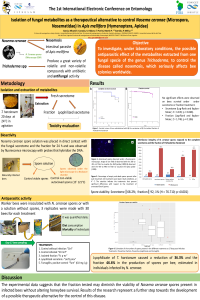
A growing body of evidence suggests that Nosema ceranae is one of the causes of the increased honeybee mortality reported in recent years. However, few drugs are known to be active against this parasite, which can generate adverse effects at individual and colony level. The main objective of this study was to investigate, under laboratory conditions, the possible antiparasitic effect of the metabolites extracted from one fungal specie of the genus Trichoderma. Isolated fractions or complete secretome (fresh or lyophilized) of the fungal strain were extracted. We carried out in vitro test to evaluate the direct effect of the secretome or the compounds extracted on the viability of N. ceranae spores by means of using microscopy techniques with fluorescent probes. The findings show that the fresh complete secretome and one isolated fraction are not toxic for bees, but also have promising bioactivity against the pathogen. Both treatments presented a significant inactivation of spores (68.2 % and 92.1 % respectively) after a 24-hour exposition period. In addition, the antiparasitic activity of the treatments after lyophilisation also showed a significant reduction in the spore viability (36.3 % and 46.6 % respectively). The experimental data suggests that the fraction tested may diminish the viability of spores present in infected bees without altering honeybee survival. Results of the research represent a further step towards the development of a possible therapeutic alternative for the control of this disease.
Keywords
Honeybees
nosemosis
therapeutic products
beekeeping
Manuscript
sciforum-046819-layout.pdf
Poster
sciforum-046819-poster.pdf
Analysis of the Successional Patterns of Insects on the Remains of Methadone-Dependent Rabbits
Comparative susceptibility and sublethal response of a Bt-resistant Spodoptera frugiperda population to chlorantraniliprole