Event submissions
Published

This submission belongs to the session P. Pest Management of the event The 1st International Electronic Conference on Entomology
Published date
30 Jun, 2021
Academic Editor
'%3e%3cpath%20d='M12.6657%2010.9104C12.4185%2010.325%2012.0599%209.79327%2011.6097%209.34482C11.1609%208.89508%2010.6293%208.5365%2010.0442%208.28888C10.0389%208.28626%2010.0337%208.28495%2010.0285%208.28233C10.8446%207.69279%2011.3752%206.73249%2011.3752%205.64904C11.3752%203.8542%209.92103%202.39999%208.1262%202.39999C6.33136%202.39999%204.87715%203.8542%204.87715%205.64904C4.87715%206.73249%205.40774%207.69279%206.22393%208.28364C6.21869%208.28626%206.21345%208.28757%206.20821%208.29019C5.62129%208.5378%205.09463%208.89284%204.64265%209.34613C4.1929%209.79493%203.83432%2010.3266%203.58671%2010.9117C3.34345%2011.4845%203.21226%2012.0987%203.20023%2012.7209C3.19988%2012.7349%203.20233%2012.7488%203.20744%2012.7619C3.21255%2012.7749%203.22022%2012.7867%203.22998%2012.7968C3.23975%2012.8068%203.25142%2012.8147%203.26431%2012.8202C3.2772%2012.8256%203.29105%2012.8284%203.30504%2012.8284H4.09109C4.14874%2012.8284%204.19459%2012.7825%204.1959%2012.7262C4.2221%2011.7148%204.62823%2010.7676%205.34617%2010.0497C6.08899%209.30683%207.0755%208.89808%208.1262%208.89808C9.17689%208.89808%2010.1634%209.30683%2010.9062%2010.0497C11.6242%2010.7676%2012.0303%2011.7148%2012.0565%2012.7262C12.0578%2012.7838%2012.1037%2012.8284%2012.1613%2012.8284H12.9474C12.9613%2012.8284%2012.9752%2012.8256%2012.9881%2012.8202C13.001%2012.8147%2013.0126%2012.8068%2013.0224%2012.7968C13.0322%2012.7867%2013.0398%2012.7749%2013.0449%2012.7619C13.0501%2012.7488%2013.0525%2012.7349%2013.0522%2012.7209C13.0391%2012.0947%2012.9094%2011.4855%2012.6657%2010.9104ZM8.1262%207.9024C7.52486%207.9024%206.9589%207.6679%206.53312%207.24211C6.10733%206.81633%205.87283%206.25037%205.87283%205.64904C5.87283%205.0477%206.10733%204.48174%206.53312%204.05596C6.9589%203.63018%207.52486%203.39567%208.1262%203.39567C8.72753%203.39567%209.29349%203.63018%209.71927%204.05596C10.1451%204.48174%2010.3796%205.0477%2010.3796%205.64904C10.3796%206.25037%2010.1451%206.81633%209.71927%207.24211C9.29349%207.6679%208.72753%207.9024%208.1262%207.9024Z'%20fill='%235D1EE1'/%3e%3c/g%3e%3c/svg%3e) Rob Morrison
Rob MorrisonCitation
Evandro Carlos Chaves, Camila Oliveira Santos, Matheus Alberto de Almeida, Matheus Souza e Silva, Thadeu Carlos de Souza, Letícia Aparecida Ferreira Pinto, Leidiana Márcia Ribeiro, Morgana de Souza Miranda, Royner Ortiz Rojas, Eliseu José Guedes Pereira, Comparative susceptibility and sublethal response of a Bt-resistant Spodoptera frugiperda population to chlorantraniliprole, in Proceedings of The 1st International Electronic Conference on Entomology, 1 July–15 July 2021, MDPI: Basel, Switzerland, doi: 10.3390/IECE-10387
Share
Email
Facebook
Twitter
LinkedIn
Comparative susceptibility and sublethal response of a Bt-resistant Spodoptera frugiperda population to chlorantraniliprole
'%3e%3cpath%20d='M12.6647%2010.9104C12.4176%2010.325%2012.0589%209.7933%2011.6088%209.34485C11.16%208.89511%2010.6283%208.53653%2010.0432%208.28891C10.038%208.28629%2010.0327%208.28498%2010.0275%208.28236C10.8437%207.69282%2011.3743%206.73252%2011.3743%205.64907C11.3743%203.85423%209.92005%202.40002%208.12522%202.40002C6.33038%202.40002%204.87618%203.85423%204.87618%205.64907C4.87618%206.73252%205.40677%207.69282%206.22296%208.28367C6.21772%208.28629%206.21248%208.2876%206.20724%208.29022C5.62031%208.53783%205.09365%208.89287%204.64167%209.34616C4.19192%209.79496%203.83334%2010.3266%203.58573%2010.9117C3.34247%2011.4846%203.21128%2012.0987%203.19925%2012.721C3.1989%2012.735%203.20135%2012.7489%203.20646%2012.7619C3.21157%2012.7749%203.21924%2012.7868%203.22901%2012.7968C3.23877%2012.8068%203.25045%2012.8148%203.26334%2012.8202C3.27623%2012.8256%203.29007%2012.8284%203.30406%2012.8284H4.09012C4.14776%2012.8284%204.19362%2012.7825%204.19493%2012.7262C4.22113%2011.7148%204.62726%2010.7676%205.34519%2010.0497C6.08802%209.30686%207.07452%208.89811%208.12522%208.89811C9.17592%208.89811%2010.1624%209.30686%2010.9052%2010.0497C11.6232%2010.7676%2012.0293%2011.7148%2012.0555%2012.7262C12.0568%2012.7839%2012.1027%2012.8284%2012.1603%2012.8284H12.9464C12.9604%2012.8284%2012.9742%2012.8256%2012.9871%2012.8202C13%2012.8148%2013.0117%2012.8068%2013.0214%2012.7968C13.0312%2012.7868%2013.0389%2012.7749%2013.044%2012.7619C13.0491%2012.7489%2013.0515%2012.735%2013.0512%2012.721C13.0381%2012.0947%2012.9084%2011.4856%2012.6647%2010.9104ZM8.12522%207.90243C7.52388%207.90243%206.95792%207.66793%206.53214%207.24215C6.10636%206.81636%205.87185%206.2504%205.87185%205.64907C5.87185%205.04773%206.10636%204.48177%206.53214%204.05599C6.95792%203.63021%207.52388%203.3957%208.12522%203.3957C8.72655%203.3957%209.29252%203.63021%209.7183%204.05599C10.1441%204.48177%2010.3786%205.04773%2010.3786%205.64907C10.3786%206.2504%2010.1441%206.81636%209.7183%207.24215C9.29252%207.66793%208.72655%207.90243%208.12522%207.90243Z'%20fill='%235D1EE1'/%3e%3c/g%3e%3c/svg%3e)
Evandro Carlos Chaves 1
Camila Oliveira Santos 1
Matheus Alberto de Almeida 1
Matheus Souza e Silva 1
Thadeu Carlos de Souza 1
Letícia Aparecida Ferreira Pinto 1
Leidiana Márcia Ribeiro 1
Morgana de Souza Miranda 1
Royner Ortiz Rojas 1

Eliseu José Guedes Pereira 1
1. Universidade Federal de Viçosa
Abstract
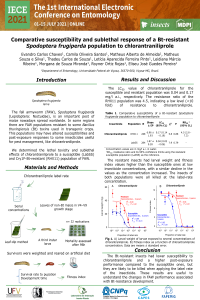
The fall armyworm (FAW), Spodoptera frugiperda (Lepidoptera: Noctuidae), is an important pest of maize nowadays spread worldwide. In some regions there are FAW populations resistant to some Bacillus thuringiensis (Bt) toxins used in transgenic crops. This populations may have altered susceptibilities and post-exposure responses to some insecticides useful for pest management, like chlorantraniliprole. We determined the lethal toxicity and sublethal effects of chlorantraniliprole to a susceptible (LabSS) and Cry1F-Bt-resistant (RHX11) population of FAW. Based on the insecticide label rate, serial concentrations were used to expose the insects using the leaf-dip method. Leaves of non-Bt maize in V4–V9 growth stage were immersed in the concentrations for 5s. After drying, the leaf sections were placed with a third instar larva to the experimental unit (n = 32 replications). Mortality was assessed after 96h, and the survivors were weighted and reared on artificial diet. Using the estimates of survival rate to pupation, development time and pupal weight, a fitness index was determined. The LC50 value of chlorantraniliprole for the susceptible and resistant population was 0.04 and 0.17 mg/l a.i., respectively. The resistance ratio of the RHX11 population was 4.5, indicating a low level (<10 fold) of resistance to chlorantraniliprole. The resistant insects had larval weight and fitness index values higher than the susceptible ones at low insecticide concentrations, with a similar decline in the values as the concentration increased. The insects of both populations were all killed at the label-rate concentration. The Bt-resistant insects had lower susceptibility to chlorantraniliprole and a higher post-exposure performance compared to the susceptible ones, but they are likely to be killed when applying the label rate of the insecticide. These results are useful to understand the changes in FAW performance associated with Bt-resistance development.
Keywords
fall armyworm
anthranilic diamide
Cry1F resistance
Bacillus thuringiensis
post-exposure effects
fitness
Manuscript
sciforum_046783_.pdf
Poster
sciforum_046783_manuscript_Poster_FAW_IECE.pdf
Isolation of Fungal Metabolites as a Therapeutical Alternative to Control Nosema ceranae (Microspora, Nosematidae) in Apis mellifera (Hymenoptera, Apidae)
Significance of Genus-Level Taxonomic Composition of Alpine Leaf Beetles (Coleoptera, Chrysomelidae) for Zoogeographic Studie