Event submissions
Published
 10.3390/IECMD2021-10406 (registering DOI)
 This submission belongs to the session 8. Epidemiology & Public Health of the event The 1st International Electronic Conference on Medicine
Published date
30 Jun, 2021
Academic Editor
'%3e%3cpath%20d='M12.6657%2010.9104C12.4185%2010.325%2012.0599%209.79327%2011.6097%209.34482C11.1609%208.89508%2010.6293%208.5365%2010.0442%208.28888C10.0389%208.28626%2010.0337%208.28495%2010.0285%208.28233C10.8446%207.69279%2011.3752%206.73249%2011.3752%205.64904C11.3752%203.8542%209.92103%202.39999%208.1262%202.39999C6.33136%202.39999%204.87715%203.8542%204.87715%205.64904C4.87715%206.73249%205.40774%207.69279%206.22393%208.28364C6.21869%208.28626%206.21345%208.28757%206.20821%208.29019C5.62129%208.5378%205.09463%208.89284%204.64265%209.34613C4.1929%209.79493%203.83432%2010.3266%203.58671%2010.9117C3.34345%2011.4845%203.21226%2012.0987%203.20023%2012.7209C3.19988%2012.7349%203.20233%2012.7488%203.20744%2012.7619C3.21255%2012.7749%203.22022%2012.7867%203.22998%2012.7968C3.23975%2012.8068%203.25142%2012.8147%203.26431%2012.8202C3.2772%2012.8256%203.29105%2012.8284%203.30504%2012.8284H4.09109C4.14874%2012.8284%204.19459%2012.7825%204.1959%2012.7262C4.2221%2011.7148%204.62823%2010.7676%205.34617%2010.0497C6.08899%209.30683%207.0755%208.89808%208.1262%208.89808C9.17689%208.89808%2010.1634%209.30683%2010.9062%2010.0497C11.6242%2010.7676%2012.0303%2011.7148%2012.0565%2012.7262C12.0578%2012.7838%2012.1037%2012.8284%2012.1613%2012.8284H12.9474C12.9613%2012.8284%2012.9752%2012.8256%2012.9881%2012.8202C13.001%2012.8147%2013.0126%2012.8068%2013.0224%2012.7968C13.0322%2012.7867%2013.0398%2012.7749%2013.0449%2012.7619C13.0501%2012.7488%2013.0525%2012.7349%2013.0522%2012.7209C13.0391%2012.0947%2012.9094%2011.4855%2012.6657%2010.9104ZM8.1262%207.9024C7.52486%207.9024%206.9589%207.6679%206.53312%207.24211C6.10733%206.81633%205.87283%206.25037%205.87283%205.64904C5.87283%205.0477%206.10733%204.48174%206.53312%204.05596C6.9589%203.63018%207.52486%203.39567%208.1262%203.39567C8.72753%203.39567%209.29349%203.63018%209.71927%204.05596C10.1451%204.48174%2010.3796%205.0477%2010.3796%205.64904C10.3796%206.25037%2010.1451%206.81633%209.71927%207.24211C9.29349%207.6679%208.72753%207.9024%208.1262%207.9024Z'%20fill='%235D1EE1'/%3e%3c/g%3e%3c/svg%3e) Edgaras Stankevicius
Edgaras StankeviciusCitation
Ewelina Czenczek- Lewandowska, Justyna Wyszyńska, Justyna Leszczak, Joanna Baran, Aneta Weres, Comparison of the level of physical activity in young adults before and during the Covid-19 pandemic - a longitudinal study, in Proceedings of The 1st International Electronic Conference on Medicine, 20 June–30 June 2021, MDPI: Basel, Switzerland, doi: 10.3390/IECMD2021-10406
Share
Email
Facebook
Twitter
LinkedIn
Comparison of the level of physical activity in young adults before and during the Covid-19 pandemic - a longitudinal study
'%3e%3cpath%20d='M12.6647%2010.9104C12.4176%2010.325%2012.0589%209.7933%2011.6088%209.34485C11.16%208.89511%2010.6283%208.53653%2010.0432%208.28891C10.038%208.28629%2010.0327%208.28498%2010.0275%208.28236C10.8437%207.69282%2011.3743%206.73252%2011.3743%205.64907C11.3743%203.85423%209.92005%202.40002%208.12522%202.40002C6.33038%202.40002%204.87618%203.85423%204.87618%205.64907C4.87618%206.73252%205.40677%207.69282%206.22296%208.28367C6.21772%208.28629%206.21248%208.2876%206.20724%208.29022C5.62031%208.53783%205.09365%208.89287%204.64167%209.34616C4.19192%209.79496%203.83334%2010.3266%203.58573%2010.9117C3.34247%2011.4846%203.21128%2012.0987%203.19925%2012.721C3.1989%2012.735%203.20135%2012.7489%203.20646%2012.7619C3.21157%2012.7749%203.21924%2012.7868%203.22901%2012.7968C3.23877%2012.8068%203.25045%2012.8148%203.26334%2012.8202C3.27623%2012.8256%203.29007%2012.8284%203.30406%2012.8284H4.09012C4.14776%2012.8284%204.19362%2012.7825%204.19493%2012.7262C4.22113%2011.7148%204.62726%2010.7676%205.34519%2010.0497C6.08802%209.30686%207.07452%208.89811%208.12522%208.89811C9.17592%208.89811%2010.1624%209.30686%2010.9052%2010.0497C11.6232%2010.7676%2012.0293%2011.7148%2012.0555%2012.7262C12.0568%2012.7839%2012.1027%2012.8284%2012.1603%2012.8284H12.9464C12.9604%2012.8284%2012.9742%2012.8256%2012.9871%2012.8202C13%2012.8148%2013.0117%2012.8068%2013.0214%2012.7968C13.0312%2012.7868%2013.0389%2012.7749%2013.044%2012.7619C13.0491%2012.7489%2013.0515%2012.735%2013.0512%2012.721C13.0381%2012.0947%2012.9084%2011.4856%2012.6647%2010.9104ZM8.12522%207.90243C7.52388%207.90243%206.95792%207.66793%206.53214%207.24215C6.10636%206.81636%205.87185%206.2504%205.87185%205.64907C5.87185%205.04773%206.10636%204.48177%206.53214%204.05599C6.95792%203.63021%207.52388%203.3957%208.12522%203.3957C8.72655%203.3957%209.29252%203.63021%209.7183%204.05599C10.1441%204.48177%2010.3786%205.04773%2010.3786%205.64907C10.3786%206.2504%2010.1441%206.81636%209.7183%207.24215C9.29252%207.66793%208.72655%207.90243%208.12522%207.90243Z'%20fill='%235D1EE1'/%3e%3c/g%3e%3c/svg%3e)
Ewelina Czenczek- Lewandowska 1

Justyna Wyszyńska 1

Justyna Leszczak 1

Joanna Baran 1
Aneta Weres 1
1. Institute of Health Sciences, Medical College, University of Rzeszów, Poland
Abstract
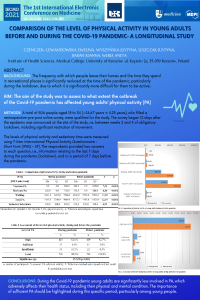
Background and objective: The frequency with which people leave their homes and the time they spend in recreational places is significantly reduced at the time of the pandemic, particularly during the lockdown, due to which it is significantly more difficult for them to be active. The aim of the study was to assess to what extent the outbreak of the Covid-19 pandemic has affected young adults’ physical activity (PA). Methods: A total of 506 people aged 18 to 34 ( 24.67 years ± 4.23 years), who filled a restrospective-pre-post online survey, were qualified for the study. The survey began 12 days after the epidemic was announced at the site of the study, i.e. between weeks 2 and 4 of obligatory lockdown, including significant restriction of movement. The levels of physical activity and sedentary time were measured using 7-item International Physical Activity Questionnaire - Short Form (IPAQ – SF). The respondents provided two answers to each question, i.e., information relating to the last 7 days during the pandemic (lockdown), and to a period of 7 days before the pandemic. Results: During the pandemic, young adults spent significantly less time performing physical activity showed as median [Q1-Q3]: Me=8752.5 [5403.0-11820.0] vs. 5483.0 [2380.0-9009.0] metabolic equivalents (MET) min/week (p<0.001) and they spent more time engaging in sedentary behaviours, Me=240 [120.0-360.0] vs. 300 [180.0-420.0] min/day (p<0.001). During the pandemic, respondents spent less energy engaging in vigorous PA from Me=480.00 [0.0- 1920.0] vs. 0.00 [0.0-1920.0] (MET) min/week, 100% decline, (p<0.001); or in moderate PA from Me=360.00 [0.0- 840.0] vs. 240.00 [0.0-720.0] (MET) min/week, 33.34% decline, and they walked much less from Me= 6930.0 [3762.0-9702.0] vs. 3861.0 [1485.0-7260.0] (MET) min/week, 44.29% decline (p<0.001). Conclusions: During the Covid-19 pandemic young adults are significantly less involved in PA, which adversely affects their health status, including their physical and mental condition. The importance of sufficient PA should be highlighted during this specific period, particularly among young people.
Keywords
physical activity
young adults
Covid-19
sedentary behaviours
Manuscript
sciforum-046515.pdf
Poster
Poster-Medicina Conference 2021.pdf
Impact of Selected Factors on Effects of Hand Rehabilitation in Stroke Patients – A Pilot Study