Event submissions
EventsThe 1st International Electronic Conference on Chemical Sensors and Analytical Chemistry
Published
 10.3390/CSAC2021-10440 (registering DOI)
 This submission belongs to the session G. General: Poster of the event The 1st International Electronic Conference on Chemical Sensors and Analytical Chemistry
Published date
30 Jun, 2021
Academic Editor
'%3e%3cpath%20d='M12.6657%2010.9104C12.4185%2010.325%2012.0599%209.79327%2011.6097%209.34482C11.1609%208.89508%2010.6293%208.5365%2010.0442%208.28888C10.0389%208.28626%2010.0337%208.28495%2010.0285%208.28233C10.8446%207.69279%2011.3752%206.73249%2011.3752%205.64904C11.3752%203.8542%209.92103%202.39999%208.1262%202.39999C6.33136%202.39999%204.87715%203.8542%204.87715%205.64904C4.87715%206.73249%205.40774%207.69279%206.22393%208.28364C6.21869%208.28626%206.21345%208.28757%206.20821%208.29019C5.62129%208.5378%205.09463%208.89284%204.64265%209.34613C4.1929%209.79493%203.83432%2010.3266%203.58671%2010.9117C3.34345%2011.4845%203.21226%2012.0987%203.20023%2012.7209C3.19988%2012.7349%203.20233%2012.7488%203.20744%2012.7619C3.21255%2012.7749%203.22022%2012.7867%203.22998%2012.7968C3.23975%2012.8068%203.25142%2012.8147%203.26431%2012.8202C3.2772%2012.8256%203.29105%2012.8284%203.30504%2012.8284H4.09109C4.14874%2012.8284%204.19459%2012.7825%204.1959%2012.7262C4.2221%2011.7148%204.62823%2010.7676%205.34617%2010.0497C6.08899%209.30683%207.0755%208.89808%208.1262%208.89808C9.17689%208.89808%2010.1634%209.30683%2010.9062%2010.0497C11.6242%2010.7676%2012.0303%2011.7148%2012.0565%2012.7262C12.0578%2012.7838%2012.1037%2012.8284%2012.1613%2012.8284H12.9474C12.9613%2012.8284%2012.9752%2012.8256%2012.9881%2012.8202C13.001%2012.8147%2013.0126%2012.8068%2013.0224%2012.7968C13.0322%2012.7867%2013.0398%2012.7749%2013.0449%2012.7619C13.0501%2012.7488%2013.0525%2012.7349%2013.0522%2012.7209C13.0391%2012.0947%2012.9094%2011.4855%2012.6657%2010.9104ZM8.1262%207.9024C7.52486%207.9024%206.9589%207.6679%206.53312%207.24211C6.10733%206.81633%205.87283%206.25037%205.87283%205.64904C5.87283%205.0477%206.10733%204.48174%206.53312%204.05596C6.9589%203.63018%207.52486%203.39567%208.1262%203.39567C8.72753%203.39567%209.29349%203.63018%209.71927%204.05596C10.1451%204.48174%2010.3796%205.0477%2010.3796%205.64904C10.3796%206.25037%2010.1451%206.81633%209.71927%207.24211C9.29349%207.6679%208.72753%207.9024%208.1262%207.9024Z'%20fill='%235D1EE1'/%3e%3c/g%3e%3c/svg%3e) Manuel Algarra
Manuel AlgarraCitation
Edward Muntean, High performance liquid chromatographic assessment of carotenoids’ stability during thermal food processing, in Proceedings of The 1st International Electronic Conference on Chemical Sensors and Analytical Chemistry, 1 July–15 July 2021, MDPI: Basel, Switzerland, doi: 10.3390/CSAC2021-10440
Share
Email
Facebook
Twitter
LinkedIn
High performance liquid chromatographic assessment of carotenoids’ stability during thermal food processing

Edward Muntean 1,2
1. University of Agricultural Sciences and Veterinary Medicine Cluj Napoca, Romania
2. Research & Development Station for Agriculture, Turda, Romania
Abstract
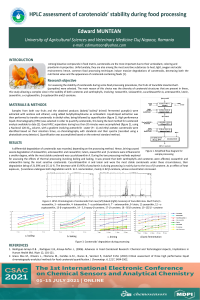
Carotenoids are among of the most important bioactive compounds in food products due to their antioxidant, coloring, provitamin A and many health-related properties. Unfortunately, they are some of the most sensitive substances to heat, light, oxygen and acidic environments; hence, common food processing techniques cause important degradations of carotenoids, decreasing both the nutritional value and the appearance of carotenoid-containing foods. For assessing the stability of carotenoids during some thermal food processing procedures, the fruits of Cucurbita maxima Duch. (pumpkin) were selected, the main reason of this choice being both the amount and the diversity of carotenoids they contain, this study including both carotenes and xanthophylls. An optimized high performance liquid chromatography (HPLC) method was developed in order to properly quantify the involved carotenoids. Samples from both raw and processed fruits were extracted with acetone and diethyl ether; liquid-liquid extractions were then performed to transfer carotenoids in diethyl ether, being followed by saponification’s with methanolic potassium hydroxide. HPLC separations were achieved in less than 20 minutes, using a Nucleosil 120-3C18 column, with a gradient involving acetonitrile : water (9 : 1) and ethyl acetate; detection was accomplished using a Waters photodiode array detector. The identification of carotenoids was achieved on the basis of their visible spectral characteristics, retention times amd co-chromatography with standards; for quantification the external standard method was used. A differential degradation of carotenoids was observed, depending on the processing method: during the thermal processing, both xanthophylls and carotenes were affected, zeaxanthin and violaxanthin being the most sensitive carotenoids, while cucurbitaxanthin A and lutein and were the most stable ones. The decrease with almost one third of the provitamin A activity during thermal processing was mainly due to the degradation of beta-carotene.
Keywords
high performance liquid chromatography
carotenoids
stability
thermal degradation
Manuscript
sciforum_046413-abstract.pdf
Poster
Muntean Edward stability.pdf
Novel rGO-based gas sensor platform for low-power gas sensing applications
Poly(bromocresol purple)-based voltammetric sensor for the simultaneous quantification of ferulic acid and vanillin