Event submissions
EventsThe 1st International Electronic Conference on Chemical Sensors and Analytical Chemistry
Published

This submission belongs to the session G. General: Poster of the event The 1st International Electronic Conference on Chemical Sensors and Analytical Chemistry
Published date
30 Jun, 2021
Academic Editor
'%3e%3cpath%20d='M12.6657%2010.9104C12.4185%2010.325%2012.0599%209.79327%2011.6097%209.34482C11.1609%208.89508%2010.6293%208.5365%2010.0442%208.28888C10.0389%208.28626%2010.0337%208.28495%2010.0285%208.28233C10.8446%207.69279%2011.3752%206.73249%2011.3752%205.64904C11.3752%203.8542%209.92103%202.39999%208.1262%202.39999C6.33136%202.39999%204.87715%203.8542%204.87715%205.64904C4.87715%206.73249%205.40774%207.69279%206.22393%208.28364C6.21869%208.28626%206.21345%208.28757%206.20821%208.29019C5.62129%208.5378%205.09463%208.89284%204.64265%209.34613C4.1929%209.79493%203.83432%2010.3266%203.58671%2010.9117C3.34345%2011.4845%203.21226%2012.0987%203.20023%2012.7209C3.19988%2012.7349%203.20233%2012.7488%203.20744%2012.7619C3.21255%2012.7749%203.22022%2012.7867%203.22998%2012.7968C3.23975%2012.8068%203.25142%2012.8147%203.26431%2012.8202C3.2772%2012.8256%203.29105%2012.8284%203.30504%2012.8284H4.09109C4.14874%2012.8284%204.19459%2012.7825%204.1959%2012.7262C4.2221%2011.7148%204.62823%2010.7676%205.34617%2010.0497C6.08899%209.30683%207.0755%208.89808%208.1262%208.89808C9.17689%208.89808%2010.1634%209.30683%2010.9062%2010.0497C11.6242%2010.7676%2012.0303%2011.7148%2012.0565%2012.7262C12.0578%2012.7838%2012.1037%2012.8284%2012.1613%2012.8284H12.9474C12.9613%2012.8284%2012.9752%2012.8256%2012.9881%2012.8202C13.001%2012.8147%2013.0126%2012.8068%2013.0224%2012.7968C13.0322%2012.7867%2013.0398%2012.7749%2013.0449%2012.7619C13.0501%2012.7488%2013.0525%2012.7349%2013.0522%2012.7209C13.0391%2012.0947%2012.9094%2011.4855%2012.6657%2010.9104ZM8.1262%207.9024C7.52486%207.9024%206.9589%207.6679%206.53312%207.24211C6.10733%206.81633%205.87283%206.25037%205.87283%205.64904C5.87283%205.0477%206.10733%204.48174%206.53312%204.05596C6.9589%203.63018%207.52486%203.39567%208.1262%203.39567C8.72753%203.39567%209.29349%203.63018%209.71927%204.05596C10.1451%204.48174%2010.3796%205.0477%2010.3796%205.64904C10.3796%206.25037%2010.1451%206.81633%209.71927%207.24211C9.29349%207.6679%208.72753%207.9024%208.1262%207.9024Z'%20fill='%235D1EE1'/%3e%3c/g%3e%3c/svg%3e) Run Zhang
Run ZhangCitation
Qing Wang, Manel del Valle, Determination of Chemical Oxygen Demand (COD) Using Nanoparticle-Modified Voltammetric Sensors and Electronic Tongue Principles, in Proceedings of The 1st International Electronic Conference on Chemical Sensors and Analytical Chemistry, 1 July–15 July 2021, MDPI: Basel, Switzerland, doi: 10.3390/CSAC2021-10442
Share
Email
Facebook
Twitter
LinkedIn
Determination of Chemical Oxygen Demand (COD) Using Nanoparticle-Modified Voltammetric Sensors and Electronic Tongue Principles
'%3e%3cpath%20d='M12.6647%2010.9104C12.4176%2010.325%2012.0589%209.7933%2011.6088%209.34485C11.16%208.89511%2010.6283%208.53653%2010.0432%208.28891C10.038%208.28629%2010.0327%208.28498%2010.0275%208.28236C10.8437%207.69282%2011.3743%206.73252%2011.3743%205.64907C11.3743%203.85423%209.92005%202.40002%208.12522%202.40002C6.33038%202.40002%204.87618%203.85423%204.87618%205.64907C4.87618%206.73252%205.40677%207.69282%206.22296%208.28367C6.21772%208.28629%206.21248%208.2876%206.20724%208.29022C5.62031%208.53783%205.09365%208.89287%204.64167%209.34616C4.19192%209.79496%203.83334%2010.3266%203.58573%2010.9117C3.34247%2011.4846%203.21128%2012.0987%203.19925%2012.721C3.1989%2012.735%203.20135%2012.7489%203.20646%2012.7619C3.21157%2012.7749%203.21924%2012.7868%203.22901%2012.7968C3.23877%2012.8068%203.25045%2012.8148%203.26334%2012.8202C3.27623%2012.8256%203.29007%2012.8284%203.30406%2012.8284H4.09012C4.14776%2012.8284%204.19362%2012.7825%204.19493%2012.7262C4.22113%2011.7148%204.62726%2010.7676%205.34519%2010.0497C6.08802%209.30686%207.07452%208.89811%208.12522%208.89811C9.17592%208.89811%2010.1624%209.30686%2010.9052%2010.0497C11.6232%2010.7676%2012.0293%2011.7148%2012.0555%2012.7262C12.0568%2012.7839%2012.1027%2012.8284%2012.1603%2012.8284H12.9464C12.9604%2012.8284%2012.9742%2012.8256%2012.9871%2012.8202C13%2012.8148%2013.0117%2012.8068%2013.0214%2012.7968C13.0312%2012.7868%2013.0389%2012.7749%2013.044%2012.7619C13.0491%2012.7489%2013.0515%2012.735%2013.0512%2012.721C13.0381%2012.0947%2012.9084%2011.4856%2012.6647%2010.9104ZM8.12522%207.90243C7.52388%207.90243%206.95792%207.66793%206.53214%207.24215C6.10636%206.81636%205.87185%206.2504%205.87185%205.64907C5.87185%205.04773%206.10636%204.48177%206.53214%204.05599C6.95792%203.63021%207.52388%203.3957%208.12522%203.3957C8.72655%203.3957%209.29252%203.63021%209.7183%204.05599C10.1441%204.48177%2010.3786%205.04773%2010.3786%205.64907C10.3786%206.2504%2010.1441%206.81636%209.7183%207.24215C9.29252%207.66793%208.72655%207.90243%208.12522%207.90243Z'%20fill='%235D1EE1'/%3e%3c/g%3e%3c/svg%3e)
Qing Wang 1

Manel del Valle 2
1. Group of Sensors and Biosensors, Department of Chemistry, Universitat Autònoma de Barcelona
2. Universitat Autonoma de Barcelona
Abstract
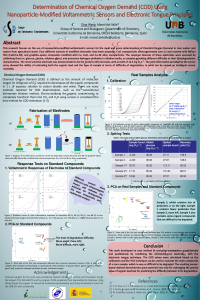
Chemical Oxygen Demand (COD) is a widely used parameter in analysing and controlling the degree of pollution in water. COD is defined as the amount of molecular oxygen (in milligrams of O2) required to decompose all the organic compounds in 1 L of aqueous solution to carbon dioxide and water. There are many methods reported for COD determination, such as the conventional dichromate titration method. Electro-oxidizing the organic contaminants to completely transform them into CO2 and H2O using sensors is considered the best method for COD estimation. Increasing attention has been paid to electrochemical methods because they are highly sensitive, time-saving, low-cost, and easy to operate. In this sense, copper electrodes have been reported based on the fact that copper in alkaline media acts as a powerful electrocatalyst for oxidation of aminoacids and carbohydrates, which are believed to be the major culprits for organic pollution. Cyclic voltammetry was the technique used to obtain the voltammetric responses. Commonly, different organic compounds show different shapes of cyclic voltammograms and different current intensity in different concentrations.
In this work, four kinds of electrodes modified with copper (Cu)/copper oxide (CuO)/nickel copper alloy (Ni Cu alloy) nanoparticles were studied for COD analysis employing the cyclic voltammetry technique: Nafion film covered electrodeposited CuO/Cu nanoparticle electrode (E1), Cu nanoparticle-graphite composite electrode (E2), CuO nanoparticle-graphite composite electrode (E3) and Ni Cu alloy nanoparticle-graphite composite electrode (E4). The COD values were determined by the ploted calibration of COD values vs. the current intensity. Glucose, glycine, potassium hydrogen phthalate (KHP) and ethylene glycol, which show different reducibilities, were chosen to be the standard substances to play the role of organic contaminants with different degradation difficulties.
From the obtained cyclic voltammograms, we can see that glucose is very easy to be oxidized by those four electrodes and electrode E1 shows the best performance, with a linear range of 19.2~1120.8 mg/L and limit of detection of 27.5 mg/L. Besides, the compound KHP is very difficult to be oxidized by these four electrodes. Nevertheless, the obtained voltammetric profiles presented different shapes with the tested organic compounds, suggesting these four electrodes can compose an electronic tongue array for multivariate analysis. As a result, the main component of river samples, which is easy or difficult to be degraded, can be evaluated by the PCA technique. This evaluation is very helpful for the accuracy of COD detection. The resulting sensor-based method demonstrates great potential not only for estimating the precise value of COD, but for predicting the difficulty behavior in its degradation, in a simple, fast, and clean methodology, which is completely suited to the present demands of green techniques.
Keywords
Chemical Oxygen Demand
copper (oxide) nanoparticle electrodes
nickel copper alloy nanoparticle electrode
cyclic voltammetry
electronic tongue
Manuscript
sciforum-046478_original_Abstract_Qing_Wang.pdf
Poster
sciforum_046478_manuscript_Poster_Qing_Wang.pdf
Poly(bromocresol purple)-based voltammetric sensor for the simultaneous quantification of ferulic acid and vanillin
Advances in visual immunoassays for sensitive detection of mycotoxins in food - a review