Event submissions
EventsThe 1st International Electronic Conference on Chemical Sensors and Analytical Chemistry
Published

This submission belongs to the session B. Biosensors of the event The 1st International Electronic Conference on Chemical Sensors and Analytical Chemistry
Published date
30 Jun, 2021
Academic Editor
'%3e%3cpath%20d='M12.6657%2010.9104C12.4185%2010.325%2012.0599%209.79327%2011.6097%209.34482C11.1609%208.89508%2010.6293%208.5365%2010.0442%208.28888C10.0389%208.28626%2010.0337%208.28495%2010.0285%208.28233C10.8446%207.69279%2011.3752%206.73249%2011.3752%205.64904C11.3752%203.8542%209.92103%202.39999%208.1262%202.39999C6.33136%202.39999%204.87715%203.8542%204.87715%205.64904C4.87715%206.73249%205.40774%207.69279%206.22393%208.28364C6.21869%208.28626%206.21345%208.28757%206.20821%208.29019C5.62129%208.5378%205.09463%208.89284%204.64265%209.34613C4.1929%209.79493%203.83432%2010.3266%203.58671%2010.9117C3.34345%2011.4845%203.21226%2012.0987%203.20023%2012.7209C3.19988%2012.7349%203.20233%2012.7488%203.20744%2012.7619C3.21255%2012.7749%203.22022%2012.7867%203.22998%2012.7968C3.23975%2012.8068%203.25142%2012.8147%203.26431%2012.8202C3.2772%2012.8256%203.29105%2012.8284%203.30504%2012.8284H4.09109C4.14874%2012.8284%204.19459%2012.7825%204.1959%2012.7262C4.2221%2011.7148%204.62823%2010.7676%205.34617%2010.0497C6.08899%209.30683%207.0755%208.89808%208.1262%208.89808C9.17689%208.89808%2010.1634%209.30683%2010.9062%2010.0497C11.6242%2010.7676%2012.0303%2011.7148%2012.0565%2012.7262C12.0578%2012.7838%2012.1037%2012.8284%2012.1613%2012.8284H12.9474C12.9613%2012.8284%2012.9752%2012.8256%2012.9881%2012.8202C13.001%2012.8147%2013.0126%2012.8068%2013.0224%2012.7968C13.0322%2012.7867%2013.0398%2012.7749%2013.0449%2012.7619C13.0501%2012.7488%2013.0525%2012.7349%2013.0522%2012.7209C13.0391%2012.0947%2012.9094%2011.4855%2012.6657%2010.9104ZM8.1262%207.9024C7.52486%207.9024%206.9589%207.6679%206.53312%207.24211C6.10733%206.81633%205.87283%206.25037%205.87283%205.64904C5.87283%205.0477%206.10733%204.48174%206.53312%204.05596C6.9589%203.63018%207.52486%203.39567%208.1262%203.39567C8.72753%203.39567%209.29349%203.63018%209.71927%204.05596C10.1451%204.48174%2010.3796%205.0477%2010.3796%205.64904C10.3796%206.25037%2010.1451%206.81633%209.71927%207.24211C9.29349%207.6679%208.72753%207.9024%208.1262%207.9024Z'%20fill='%235D1EE1'/%3e%3c/g%3e%3c/svg%3e) Constantin Apetrei
Constantin ApetreiCitation
Ricarda Torre, Maria Freitas, Estefanía Costa-Rama, Henri P.A. Nouws, Cristina Delerue-Matos, Tropomyosin analysis in foods using an electrochemical immunosensing approach, in Proceedings of The 1st International Electronic Conference on Chemical Sensors and Analytical Chemistry, 1 July–15 July 2021, MDPI: Basel, Switzerland, doi: 10.3390/CSAC2021-10471
Share
Email
Facebook
Twitter
LinkedIn
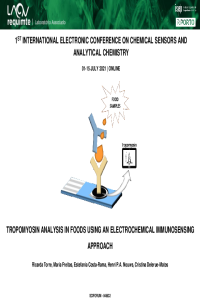
Tropomyosin analysis in foods using an electrochemical immunosensing approach
'%3e%3cpath%20d='M12.6647%2010.9104C12.4176%2010.325%2012.0589%209.7933%2011.6088%209.34485C11.16%208.89511%2010.6283%208.53653%2010.0432%208.28891C10.038%208.28629%2010.0327%208.28498%2010.0275%208.28236C10.8437%207.69282%2011.3743%206.73252%2011.3743%205.64907C11.3743%203.85423%209.92005%202.40002%208.12522%202.40002C6.33038%202.40002%204.87618%203.85423%204.87618%205.64907C4.87618%206.73252%205.40677%207.69282%206.22296%208.28367C6.21772%208.28629%206.21248%208.2876%206.20724%208.29022C5.62031%208.53783%205.09365%208.89287%204.64167%209.34616C4.19192%209.79496%203.83334%2010.3266%203.58573%2010.9117C3.34247%2011.4846%203.21128%2012.0987%203.19925%2012.721C3.1989%2012.735%203.20135%2012.7489%203.20646%2012.7619C3.21157%2012.7749%203.21924%2012.7868%203.22901%2012.7968C3.23877%2012.8068%203.25045%2012.8148%203.26334%2012.8202C3.27623%2012.8256%203.29007%2012.8284%203.30406%2012.8284H4.09012C4.14776%2012.8284%204.19362%2012.7825%204.19493%2012.7262C4.22113%2011.7148%204.62726%2010.7676%205.34519%2010.0497C6.08802%209.30686%207.07452%208.89811%208.12522%208.89811C9.17592%208.89811%2010.1624%209.30686%2010.9052%2010.0497C11.6232%2010.7676%2012.0293%2011.7148%2012.0555%2012.7262C12.0568%2012.7839%2012.1027%2012.8284%2012.1603%2012.8284H12.9464C12.9604%2012.8284%2012.9742%2012.8256%2012.9871%2012.8202C13%2012.8148%2013.0117%2012.8068%2013.0214%2012.7968C13.0312%2012.7868%2013.0389%2012.7749%2013.044%2012.7619C13.0491%2012.7489%2013.0515%2012.735%2013.0512%2012.721C13.0381%2012.0947%2012.9084%2011.4856%2012.6647%2010.9104ZM8.12522%207.90243C7.52388%207.90243%206.95792%207.66793%206.53214%207.24215C6.10636%206.81636%205.87185%206.2504%205.87185%205.64907C5.87185%205.04773%206.10636%204.48177%206.53214%204.05599C6.95792%203.63021%207.52388%203.3957%208.12522%203.3957C8.72655%203.3957%209.29252%203.63021%209.7183%204.05599C10.1441%204.48177%2010.3786%205.04773%2010.3786%205.64907C10.3786%206.2504%2010.1441%206.81636%209.7183%207.24215C9.29252%207.66793%208.72655%207.90243%208.12522%207.90243Z'%20fill='%235D1EE1'/%3e%3c/g%3e%3c/svg%3e)
Ricarda Torre 1

Maria Freitas 1

Estefanía Costa-Rama 2
Henri P.A. Nouws 1

Cristina Delerue-Matos 1
1. REQUIMTE/LAQV, Instituto Superior de Engenharia do Porto, Porto, Portugal
2. Departamento de Química Física y Analítica, Universidad de Oviedo, Oviedo, Spain
Abstract
Allergies to seafood have a relevant impact on public health since the unknown intake of products thereof can cause serious health problems. Tropomyosin (TPM) has been identified as a major shellfish allergen. Crustaceans, especially shrimps, are of particular concern because of the presence of TPM in their muscle tissue. Although attempts have been made to reduce its allergenicity by boiling, this does not guarantee the total absence of TPM [1]. So, the detection of trace levels of TPM in food products can prevent health problems. For this purpose, electrochemical immunosensors are adequate analytical tools since they provide highly selective, sensitive, fast, and cheap analysis and are suitable for in situ applications.
In this work, a simple voltammetric immunosensor for the determination of TPM in commercial food products was developed. A sandwich-type immunoassay was performed on screen-printed carbon electrodes. Monoclonal and polyclonal antibodies were used to capture and detect TPM. To obtain the analytical signal an alkaline phosphatase-labelled secondary antibody and 3-indoxyl phosphate / silver nitrate (enzymatic substrate) were employed; the enzymatically deposited silver was analysed by linear sweep voltammetry. Using a factorial design, several experimental parameters were optimized: capture antibody 20 µg mL-1; secondary antibody dilution 1:2,000; alkaline phosphatase-labelled detection antibody dilution 1:40,000; and an assay time of ~3 h. A linear concentration range was established between 2.5 and 20 ng mL-1 (ip (µA) = 0,787 × [TPM] (ng mL-1) + 5,45, n = 5, r = 0,990, Vx0 = 8.8 %) and the LOD was 1.7 ng mL-1. These performance characteristics will allow the quantification of trace levels of the target allergen in food products.
[1] Laly, S.J, Sankar, T.V., Panda, S.K., Effect of pressure cooking alone and in combination with other treatments on shrimp allergic protein, tropomyosin. Journal of Food Science and Technology (2021). https://doi.org/10.1007/s13197-021-05124-2
Keywords
Seafood allergy
tropomyosin
food allergy
screen-printed electrodes
electrochemical biosensor
Manuscript
sciforum_046832_layout.pdf
Poster
sciforum_046832_slides_CSAC2021_presentation_TPM.pdf
SnO2 sensing performance toward volatile organic compounds
SEMICONDUCTOR OXIDES GAS SENSORS: CORRELATION BETWEEN CONDUCTION MECHANISMS AND THEIR SENSING PERFORMANCES