Event submissions
Published

This submission belongs to the session P. Posters of the event The 1st International Electronic Conference on Entomology
Published date
01 Jul, 2021
Academic Editor
'%3e%3cpath%20d='M12.6657%2010.9104C12.4185%2010.325%2012.0599%209.79327%2011.6097%209.34482C11.1609%208.89508%2010.6293%208.5365%2010.0442%208.28888C10.0389%208.28626%2010.0337%208.28495%2010.0285%208.28233C10.8446%207.69279%2011.3752%206.73249%2011.3752%205.64904C11.3752%203.8542%209.92103%202.39999%208.1262%202.39999C6.33136%202.39999%204.87715%203.8542%204.87715%205.64904C4.87715%206.73249%205.40774%207.69279%206.22393%208.28364C6.21869%208.28626%206.21345%208.28757%206.20821%208.29019C5.62129%208.5378%205.09463%208.89284%204.64265%209.34613C4.1929%209.79493%203.83432%2010.3266%203.58671%2010.9117C3.34345%2011.4845%203.21226%2012.0987%203.20023%2012.7209C3.19988%2012.7349%203.20233%2012.7488%203.20744%2012.7619C3.21255%2012.7749%203.22022%2012.7867%203.22998%2012.7968C3.23975%2012.8068%203.25142%2012.8147%203.26431%2012.8202C3.2772%2012.8256%203.29105%2012.8284%203.30504%2012.8284H4.09109C4.14874%2012.8284%204.19459%2012.7825%204.1959%2012.7262C4.2221%2011.7148%204.62823%2010.7676%205.34617%2010.0497C6.08899%209.30683%207.0755%208.89808%208.1262%208.89808C9.17689%208.89808%2010.1634%209.30683%2010.9062%2010.0497C11.6242%2010.7676%2012.0303%2011.7148%2012.0565%2012.7262C12.0578%2012.7838%2012.1037%2012.8284%2012.1613%2012.8284H12.9474C12.9613%2012.8284%2012.9752%2012.8256%2012.9881%2012.8202C13.001%2012.8147%2013.0126%2012.8068%2013.0224%2012.7968C13.0322%2012.7867%2013.0398%2012.7749%2013.0449%2012.7619C13.0501%2012.7488%2013.0525%2012.7349%2013.0522%2012.7209C13.0391%2012.0947%2012.9094%2011.4855%2012.6657%2010.9104ZM8.1262%207.9024C7.52486%207.9024%206.9589%207.6679%206.53312%207.24211C6.10733%206.81633%205.87283%206.25037%205.87283%205.64904C5.87283%205.0477%206.10733%204.48174%206.53312%204.05596C6.9589%203.63018%207.52486%203.39567%208.1262%203.39567C8.72753%203.39567%209.29349%203.63018%209.71927%204.05596C10.1451%204.48174%2010.3796%205.0477%2010.3796%205.64904C10.3796%206.25037%2010.1451%206.81633%209.71927%207.24211C9.29349%207.6679%208.72753%207.9024%208.1262%207.9024Z'%20fill='%235D1EE1'/%3e%3c/g%3e%3c/svg%3e) Nickolas Kavallieratos
Nickolas KavallieratosCitation
Julia Sławianowska, Hubert Sytykiewicz, Assessment of Population Growth of Rhopalosiphum padi L. Aphids on the Seedlings of Selected Maize Cultivars, in Proceedings of The 1st International Electronic Conference on Entomology, 1 July–15 July 2021, MDPI: Basel, Switzerland, doi: 10.3390/IECE-10513
Share
Email
Facebook
Twitter
LinkedIn
Assessment of Population Growth of Rhopalosiphum padi L. Aphids on the Seedlings of Selected Maize Cultivars
'%3e%3cpath%20d='M12.6647%2010.9104C12.4176%2010.325%2012.0589%209.7933%2011.6088%209.34485C11.16%208.89511%2010.6283%208.53653%2010.0432%208.28891C10.038%208.28629%2010.0327%208.28498%2010.0275%208.28236C10.8437%207.69282%2011.3743%206.73252%2011.3743%205.64907C11.3743%203.85423%209.92005%202.40002%208.12522%202.40002C6.33038%202.40002%204.87618%203.85423%204.87618%205.64907C4.87618%206.73252%205.40677%207.69282%206.22296%208.28367C6.21772%208.28629%206.21248%208.2876%206.20724%208.29022C5.62031%208.53783%205.09365%208.89287%204.64167%209.34616C4.19192%209.79496%203.83334%2010.3266%203.58573%2010.9117C3.34247%2011.4846%203.21128%2012.0987%203.19925%2012.721C3.1989%2012.735%203.20135%2012.7489%203.20646%2012.7619C3.21157%2012.7749%203.21924%2012.7868%203.22901%2012.7968C3.23877%2012.8068%203.25045%2012.8148%203.26334%2012.8202C3.27623%2012.8256%203.29007%2012.8284%203.30406%2012.8284H4.09012C4.14776%2012.8284%204.19362%2012.7825%204.19493%2012.7262C4.22113%2011.7148%204.62726%2010.7676%205.34519%2010.0497C6.08802%209.30686%207.07452%208.89811%208.12522%208.89811C9.17592%208.89811%2010.1624%209.30686%2010.9052%2010.0497C11.6232%2010.7676%2012.0293%2011.7148%2012.0555%2012.7262C12.0568%2012.7839%2012.1027%2012.8284%2012.1603%2012.8284H12.9464C12.9604%2012.8284%2012.9742%2012.8256%2012.9871%2012.8202C13%2012.8148%2013.0117%2012.8068%2013.0214%2012.7968C13.0312%2012.7868%2013.0389%2012.7749%2013.044%2012.7619C13.0491%2012.7489%2013.0515%2012.735%2013.0512%2012.721C13.0381%2012.0947%2012.9084%2011.4856%2012.6647%2010.9104ZM8.12522%207.90243C7.52388%207.90243%206.95792%207.66793%206.53214%207.24215C6.10636%206.81636%205.87185%206.2504%205.87185%205.64907C5.87185%205.04773%206.10636%204.48177%206.53214%204.05599C6.95792%203.63021%207.52388%203.3957%208.12522%203.3957C8.72655%203.3957%209.29252%203.63021%209.7183%204.05599C10.1441%204.48177%2010.3786%205.04773%2010.3786%205.64907C10.3786%206.2504%2010.1441%206.81636%209.7183%207.24215C9.29252%207.66793%208.72655%207.90243%208.12522%207.90243Z'%20fill='%235D1EE1'/%3e%3c/g%3e%3c/svg%3e)
Julia Sławianowska 1
Hubert Sytykiewicz 2
1. Institute of Biological Sciences, Faculty of Exact and Natural Sciences, Siedlce University of Natural Sciences and Humanities, 14 Prusa St., 08-110 Siedlce, Poland
2. Institute of Biological Sciences, Faculty of Sciences, Siedlce University of Natural Sciences and Humanities, 14 Prusa St., 08-110 Siedlce, Poland
Abstract
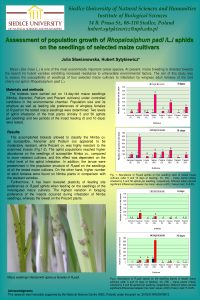
Maize (Zea mays L.) is one of the most economically important cereal species. However, climate change and anthropogenic factors may contribute to increased susceptibility to a wide variety of pests, resulting in significant yield losses. At present, maize breeding is directed towards the search for hybrid varieties exhibiting increased resistance to unfavorable environmental factors. The aim of this study was to assess the susceptibility of seedlings of four selected maize cultivars to infestation by wingless females of the bird cherry-oat aphid (Rhopalosiphum padi L.). The biotests were carried out on 14-day-old maize seedlings (Nimba, Kanonier, Podium and Prezent cultivars) under controlled conditions in the environmental chamber. Population size and its structure as well as feeding site preferences of wingless females of R. padi on the tested maize seedlings were determined. Two levels of aphid colonization of the host plants (initially 5 and 50 aphids per seedling) and two periods of insect feeding (5 and 10 days) were tested. So far, there are no available reports on the interaction between the examined maize varieties and the bird cherry-oat aphid. The results of the experiments allowed to classify the Nimba cv. as susceptible, Kanonier and Podium cvs appeared to be moderately resistant, while Prezent cv. was highly resistant to the examined insects. The aphid populations reached higher numbers on susceptible Nimba seedlings in comparison to more resistant cultivars, and this effect was dependent on the initial level of aphid colonization. In addition, the larvae were predominant in the population structure of R. padi on seedlings of all the tested maize cultivars. On the other hand, higher number of adult females were found on Nimba plants, compared to the resistant varieties. Furthermore, it has been revealed plasticity of feeding site preferences of R. padi aphids when feeding on the seedlings of the investigated maize cultivars.
Keywords
Maize
Rhopalosiphum padi
feeding
infestation
Manuscript
sciforum-046694- Copy.pdf
Poster
Poster_2021.pdf
Engaging Citizen-Scientists in Mapping Alien Species: Introducing Alientoma, A Dynamic Database for Alien Insects in Greece
Biology and Distribution of Box Tree Moth (Cydalima perspectalis) (Walker, 1859) in Southern Ontario