Event submissions
Published

This submission belongs to the session P. Posters of the event The 1st International Electronic Conference on Entomology
Published date
01 Jul, 2021
Academic Editor
'%3e%3cpath%20d='M12.6657%2010.9104C12.4185%2010.325%2012.0599%209.79327%2011.6097%209.34482C11.1609%208.89508%2010.6293%208.5365%2010.0442%208.28888C10.0389%208.28626%2010.0337%208.28495%2010.0285%208.28233C10.8446%207.69279%2011.3752%206.73249%2011.3752%205.64904C11.3752%203.8542%209.92103%202.39999%208.1262%202.39999C6.33136%202.39999%204.87715%203.8542%204.87715%205.64904C4.87715%206.73249%205.40774%207.69279%206.22393%208.28364C6.21869%208.28626%206.21345%208.28757%206.20821%208.29019C5.62129%208.5378%205.09463%208.89284%204.64265%209.34613C4.1929%209.79493%203.83432%2010.3266%203.58671%2010.9117C3.34345%2011.4845%203.21226%2012.0987%203.20023%2012.7209C3.19988%2012.7349%203.20233%2012.7488%203.20744%2012.7619C3.21255%2012.7749%203.22022%2012.7867%203.22998%2012.7968C3.23975%2012.8068%203.25142%2012.8147%203.26431%2012.8202C3.2772%2012.8256%203.29105%2012.8284%203.30504%2012.8284H4.09109C4.14874%2012.8284%204.19459%2012.7825%204.1959%2012.7262C4.2221%2011.7148%204.62823%2010.7676%205.34617%2010.0497C6.08899%209.30683%207.0755%208.89808%208.1262%208.89808C9.17689%208.89808%2010.1634%209.30683%2010.9062%2010.0497C11.6242%2010.7676%2012.0303%2011.7148%2012.0565%2012.7262C12.0578%2012.7838%2012.1037%2012.8284%2012.1613%2012.8284H12.9474C12.9613%2012.8284%2012.9752%2012.8256%2012.9881%2012.8202C13.001%2012.8147%2013.0126%2012.8068%2013.0224%2012.7968C13.0322%2012.7867%2013.0398%2012.7749%2013.0449%2012.7619C13.0501%2012.7488%2013.0525%2012.7349%2013.0522%2012.7209C13.0391%2012.0947%2012.9094%2011.4855%2012.6657%2010.9104ZM8.1262%207.9024C7.52486%207.9024%206.9589%207.6679%206.53312%207.24211C6.10733%206.81633%205.87283%206.25037%205.87283%205.64904C5.87283%205.0477%206.10733%204.48174%206.53312%204.05596C6.9589%203.63018%207.52486%203.39567%208.1262%203.39567C8.72753%203.39567%209.29349%203.63018%209.71927%204.05596C10.1451%204.48174%2010.3796%205.0477%2010.3796%205.64904C10.3796%206.25037%2010.1451%206.81633%209.71927%207.24211C9.29349%207.6679%208.72753%207.9024%208.1262%207.9024Z'%20fill='%235D1EE1'/%3e%3c/g%3e%3c/svg%3e) Nickolas Kavallieratos
Nickolas KavallieratosCitation
Sthandiwe Kanyile, Tobias Engl, Martin Kaltenpoth, Nutritional Symbionts Confer Structural Defence Against Predation and Fungal Infection in a Grain Pest Beetle, in Proceedings of The 1st International Electronic Conference on Entomology, 1 July–15 July 2021, MDPI: Basel, Switzerland, doi: 10.3390/IECE-10525
Share
Email
Facebook
Twitter
LinkedIn
Nutritional Symbionts Confer Structural Defence Against Predation and Fungal Infection in a Grain Pest Beetle
'%3e%3cpath%20d='M12.6647%2010.9104C12.4176%2010.325%2012.0589%209.7933%2011.6088%209.34485C11.16%208.89511%2010.6283%208.53653%2010.0432%208.28891C10.038%208.28629%2010.0327%208.28498%2010.0275%208.28236C10.8437%207.69282%2011.3743%206.73252%2011.3743%205.64907C11.3743%203.85423%209.92005%202.40002%208.12522%202.40002C6.33038%202.40002%204.87618%203.85423%204.87618%205.64907C4.87618%206.73252%205.40677%207.69282%206.22296%208.28367C6.21772%208.28629%206.21248%208.2876%206.20724%208.29022C5.62031%208.53783%205.09365%208.89287%204.64167%209.34616C4.19192%209.79496%203.83334%2010.3266%203.58573%2010.9117C3.34247%2011.4846%203.21128%2012.0987%203.19925%2012.721C3.1989%2012.735%203.20135%2012.7489%203.20646%2012.7619C3.21157%2012.7749%203.21924%2012.7868%203.22901%2012.7968C3.23877%2012.8068%203.25045%2012.8148%203.26334%2012.8202C3.27623%2012.8256%203.29007%2012.8284%203.30406%2012.8284H4.09012C4.14776%2012.8284%204.19362%2012.7825%204.19493%2012.7262C4.22113%2011.7148%204.62726%2010.7676%205.34519%2010.0497C6.08802%209.30686%207.07452%208.89811%208.12522%208.89811C9.17592%208.89811%2010.1624%209.30686%2010.9052%2010.0497C11.6232%2010.7676%2012.0293%2011.7148%2012.0555%2012.7262C12.0568%2012.7839%2012.1027%2012.8284%2012.1603%2012.8284H12.9464C12.9604%2012.8284%2012.9742%2012.8256%2012.9871%2012.8202C13%2012.8148%2013.0117%2012.8068%2013.0214%2012.7968C13.0312%2012.7868%2013.0389%2012.7749%2013.044%2012.7619C13.0491%2012.7489%2013.0515%2012.735%2013.0512%2012.721C13.0381%2012.0947%2012.9084%2011.4856%2012.6647%2010.9104ZM8.12522%207.90243C7.52388%207.90243%206.95792%207.66793%206.53214%207.24215C6.10636%206.81636%205.87185%206.2504%205.87185%205.64907C5.87185%205.04773%206.10636%204.48177%206.53214%204.05599C6.95792%203.63021%207.52388%203.3957%208.12522%203.3957C8.72655%203.3957%209.29252%203.63021%209.7183%204.05599C10.1441%204.48177%2010.3786%205.04773%2010.3786%205.64907C10.3786%206.2504%2010.1441%206.81636%209.7183%207.24215C9.29252%207.66793%208.72655%207.90243%208.12522%207.90243Z'%20fill='%235D1EE1'/%3e%3c/g%3e%3c/svg%3e)
Sthandiwe Kanyile 1

Tobias Engl 2
Martin Kaltenpoth 2
1. Johannes Gutenberg University, Mainz
2. Max Planck Institute for Chemical Ecology
Abstract
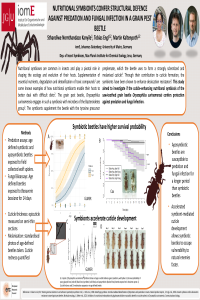
Many insects benefit from bacterial symbionts that provide essential nutrients and thereby extend the hosts’ adaptive potential and their ability to cope with challenging environments. However, the implications of nutritional symbioses for the hosts’ defence against natural enemies remain largely unstudied. Here, we investigated if the cuticle-enhancing nutritional symbiosis of the saw-toothed grain beetle Oryzaephilus surinamensis confers protection against predation and fungal infection. For this, we exposed age-defined symbiotic and symbiont-depleted (aposymbiotic) beetles to two antagonists that must actively penetrate the cuticle for a successful attack: wolf spiders (Lycosidae) and the fungal entomopathogen Beauveria bassiana. While young beetles suffered from high predation and fungal infection rates regardless of symbiont presence, symbiotic beetles were able to escape this period of vulnerability and reach high survival probabilities significantly faster than aposymbiotic beetles. To understand the mechanistic basis underlying these differences, we conducted a time-series analysis of cuticle development in symbiotic and aposymbiotic beetles by measuring cuticular melanisation and thickness. The results reveal that the symbionts accelerate their host’s cuticle formation and thereby enable it to quickly reach a cuticle quality threshold that confers structural protection against predation and fungal infection. Considering the widespread occurrence of cuticle enhancement via symbiont-mediated tyrosine supplementation in beetles and other insects, our findings demonstrate how nutritional symbioses can have important ecological implications reaching beyond the immediate nutrient provisioning benefits.
Keywords
Oryzaephilus surinamensis
sawtoothed grain beetle
Bacteroidetes
Candidatus Shikimatogenerans silvanidophilus
symbiosis
mutualism
cuticle
structural defense
Manuscript
sciforum-045654.pdf
Poster
KanyileSN_ICE_2021.pdf
Effect of Additive Series Intercropping Kidney Bean (Phaseolus vulgaris L.) with some Aromatic Plants on Tetranychus urticae Koch. (Acari: Tetranychidae) Population
Hunting Nematodes in the Pine Forests of Northern Greece: A Preliminary Overview after One Year of Surveys