Event submissions
Published

This submission belongs to the session P. Posters of the event The 1st International Electronic Conference on Entomology
Published date
01 Jul, 2021
Academic Editor
'%3e%3cpath%20d='M12.6657%2010.9104C12.4185%2010.325%2012.0599%209.79327%2011.6097%209.34482C11.1609%208.89508%2010.6293%208.5365%2010.0442%208.28888C10.0389%208.28626%2010.0337%208.28495%2010.0285%208.28233C10.8446%207.69279%2011.3752%206.73249%2011.3752%205.64904C11.3752%203.8542%209.92103%202.39999%208.1262%202.39999C6.33136%202.39999%204.87715%203.8542%204.87715%205.64904C4.87715%206.73249%205.40774%207.69279%206.22393%208.28364C6.21869%208.28626%206.21345%208.28757%206.20821%208.29019C5.62129%208.5378%205.09463%208.89284%204.64265%209.34613C4.1929%209.79493%203.83432%2010.3266%203.58671%2010.9117C3.34345%2011.4845%203.21226%2012.0987%203.20023%2012.7209C3.19988%2012.7349%203.20233%2012.7488%203.20744%2012.7619C3.21255%2012.7749%203.22022%2012.7867%203.22998%2012.7968C3.23975%2012.8068%203.25142%2012.8147%203.26431%2012.8202C3.2772%2012.8256%203.29105%2012.8284%203.30504%2012.8284H4.09109C4.14874%2012.8284%204.19459%2012.7825%204.1959%2012.7262C4.2221%2011.7148%204.62823%2010.7676%205.34617%2010.0497C6.08899%209.30683%207.0755%208.89808%208.1262%208.89808C9.17689%208.89808%2010.1634%209.30683%2010.9062%2010.0497C11.6242%2010.7676%2012.0303%2011.7148%2012.0565%2012.7262C12.0578%2012.7838%2012.1037%2012.8284%2012.1613%2012.8284H12.9474C12.9613%2012.8284%2012.9752%2012.8256%2012.9881%2012.8202C13.001%2012.8147%2013.0126%2012.8068%2013.0224%2012.7968C13.0322%2012.7867%2013.0398%2012.7749%2013.0449%2012.7619C13.0501%2012.7488%2013.0525%2012.7349%2013.0522%2012.7209C13.0391%2012.0947%2012.9094%2011.4855%2012.6657%2010.9104ZM8.1262%207.9024C7.52486%207.9024%206.9589%207.6679%206.53312%207.24211C6.10733%206.81633%205.87283%206.25037%205.87283%205.64904C5.87283%205.0477%206.10733%204.48174%206.53312%204.05596C6.9589%203.63018%207.52486%203.39567%208.1262%203.39567C8.72753%203.39567%209.29349%203.63018%209.71927%204.05596C10.1451%204.48174%2010.3796%205.0477%2010.3796%205.64904C10.3796%206.25037%2010.1451%206.81633%209.71927%207.24211C9.29349%207.6679%208.72753%207.9024%208.1262%207.9024Z'%20fill='%235D1EE1'/%3e%3c/g%3e%3c/svg%3e) Dimitrios Avtzis
Dimitrios AvtzisCitation
Natalia Kirichenko, Maria Ryazanova, Evgeny Akulov, Margarita Ponomarenko, Can Native Parasitoids Control the Invasive Lime Leaf-Miner Phyllonorycter issikii (Lepidoptera: Gracillariidae) in Western Siberia?, in Proceedings of The 1st International Electronic Conference on Entomology, 1 July–15 July 2021, MDPI: Basel, Switzerland, doi: 10.3390/IECE-10537
Share
Email
Facebook
Twitter
LinkedIn
Can Native Parasitoids Control the Invasive Lime Leaf-Miner Phyllonorycter issikii (Lepidoptera: Gracillariidae) in Western Siberia?

Natalia Kirichenko 1,2
'%3e%3cpath%20d='M12.6647%2010.9104C12.4176%2010.325%2012.0589%209.7933%2011.6088%209.34485C11.16%208.89511%2010.6283%208.53653%2010.0432%208.28891C10.038%208.28629%2010.0327%208.28498%2010.0275%208.28236C10.8437%207.69282%2011.3743%206.73252%2011.3743%205.64907C11.3743%203.85423%209.92005%202.40002%208.12522%202.40002C6.33038%202.40002%204.87618%203.85423%204.87618%205.64907C4.87618%206.73252%205.40677%207.69282%206.22296%208.28367C6.21772%208.28629%206.21248%208.2876%206.20724%208.29022C5.62031%208.53783%205.09365%208.89287%204.64167%209.34616C4.19192%209.79496%203.83334%2010.3266%203.58573%2010.9117C3.34247%2011.4846%203.21128%2012.0987%203.19925%2012.721C3.1989%2012.735%203.20135%2012.7489%203.20646%2012.7619C3.21157%2012.7749%203.21924%2012.7868%203.22901%2012.7968C3.23877%2012.8068%203.25045%2012.8148%203.26334%2012.8202C3.27623%2012.8256%203.29007%2012.8284%203.30406%2012.8284H4.09012C4.14776%2012.8284%204.19362%2012.7825%204.19493%2012.7262C4.22113%2011.7148%204.62726%2010.7676%205.34519%2010.0497C6.08802%209.30686%207.07452%208.89811%208.12522%208.89811C9.17592%208.89811%2010.1624%209.30686%2010.9052%2010.0497C11.6232%2010.7676%2012.0293%2011.7148%2012.0555%2012.7262C12.0568%2012.7839%2012.1027%2012.8284%2012.1603%2012.8284H12.9464C12.9604%2012.8284%2012.9742%2012.8256%2012.9871%2012.8202C13%2012.8148%2013.0117%2012.8068%2013.0214%2012.7968C13.0312%2012.7868%2013.0389%2012.7749%2013.044%2012.7619C13.0491%2012.7489%2013.0515%2012.735%2013.0512%2012.721C13.0381%2012.0947%2012.9084%2011.4856%2012.6647%2010.9104ZM8.12522%207.90243C7.52388%207.90243%206.95792%207.66793%206.53214%207.24215C6.10636%206.81636%205.87185%206.2504%205.87185%205.64907C5.87185%205.04773%206.10636%204.48177%206.53214%204.05599C6.95792%203.63021%207.52388%203.3957%208.12522%203.3957C8.72655%203.3957%209.29252%203.63021%209.7183%204.05599C10.1441%204.48177%2010.3786%205.04773%2010.3786%205.64907C10.3786%206.2504%2010.1441%206.81636%209.7183%207.24215C9.29252%207.66793%208.72655%207.90243%208.12522%207.90243Z'%20fill='%235D1EE1'/%3e%3c/g%3e%3c/svg%3e)
Maria Ryazanova 2
Evgeny Akulov 3
Margarita Ponomarenko 4,5
1. Sukachev Institute of Forest SB RAS, Krasnoyarsk, Russia
2. Siberian Federal University, Krasnoyarsk, Russia
3. All-Russian Plant Quarantine Center, Krasnoyarsk branch, Krasnoyarsk, Russia
4. Federal Scientific Center of the East Asia Terrestrial Biodiversity FEB RAS, Vladivostok, Russia
5. Far Eastern Federal University, Vladivostok, Russia
Abstract
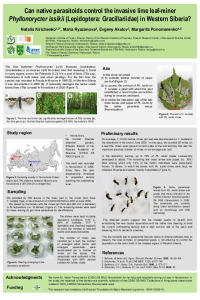
The lime leafminer Phyllonorycter issikii (Kumata) is an invasive micromoth from East Asia that nowadays is found across the most part of the Palearctic. Known as a pest of limes Tilia spp. (Malvaceae), it is able to outbreaks in both native and urban plantings. The moth was recorded in Western Siberia, in Tyumen Oblast in 2006 for the first time (Gninenko, Kozlova, 2006). Two years later, it was detected further, in Novosibirsk Oblast (Kirichenko et al., 2009), where nowadays it noticeably damages the native small-leaved lime Tilia cordata.
In the end of June 2020, we documented numerous mines of Ph. issikii on lime trees in the Central Siberian botanical garden SB RAS (Novosibirsk). Despite the pest prefers to develop on shaded leaves in the lower part of tree crown (Ermolaev, Sidorova, 2012), in the studied year in Novosibirsk the mines were found on the leaves across the whole tree crown, with the maximal density in its lower part. The mines were also detected on upper side of leaves and on bracts. In mass rearing experiment in laboratory conditions, up to 70% of pupae successfully developed to adults. The rest 30% of the late instar larvae and pupae died, among which only 7.4% of the moth’s individuals were parasitized. We will discuss the composition of native parasitoids attacking the invasive moth and their ability to control the alien pest in the occupied part of Siberia.
The study is supported by the Russian Foundation for Basic Research (No. 19-04-01029-a).
Keywords
alien gracillariid
outbreak
limes
native parasitoids
Siberia
Manuscript
sciforum-046559.pdf
Poster
Kirichenko et al supplementary_ poster.pdf
Searching for Light-Induced Genes in Hymenopteran Insect – Nasonia vitripennis: Transcription of 13% of the Genes Is Regulated by Light
Extracellular MicroRNAs in Insects