Event submissions
EventsThe 1st International Electronic Conference on Chemical Sensors and Analytical Chemistry
Published
 10.3390/CSAC2021-10559 (registering DOI)
 This submission belongs to the session O. Optical Chemical Sensors of the event The 1st International Electronic Conference on Chemical Sensors and Analytical Chemistry
Published date
01 Jul, 2021
Academic Editor
'%3e%3cpath%20d='M12.6657%2010.9104C12.4185%2010.325%2012.0599%209.79327%2011.6097%209.34482C11.1609%208.89508%2010.6293%208.5365%2010.0442%208.28888C10.0389%208.28626%2010.0337%208.28495%2010.0285%208.28233C10.8446%207.69279%2011.3752%206.73249%2011.3752%205.64904C11.3752%203.8542%209.92103%202.39999%208.1262%202.39999C6.33136%202.39999%204.87715%203.8542%204.87715%205.64904C4.87715%206.73249%205.40774%207.69279%206.22393%208.28364C6.21869%208.28626%206.21345%208.28757%206.20821%208.29019C5.62129%208.5378%205.09463%208.89284%204.64265%209.34613C4.1929%209.79493%203.83432%2010.3266%203.58671%2010.9117C3.34345%2011.4845%203.21226%2012.0987%203.20023%2012.7209C3.19988%2012.7349%203.20233%2012.7488%203.20744%2012.7619C3.21255%2012.7749%203.22022%2012.7867%203.22998%2012.7968C3.23975%2012.8068%203.25142%2012.8147%203.26431%2012.8202C3.2772%2012.8256%203.29105%2012.8284%203.30504%2012.8284H4.09109C4.14874%2012.8284%204.19459%2012.7825%204.1959%2012.7262C4.2221%2011.7148%204.62823%2010.7676%205.34617%2010.0497C6.08899%209.30683%207.0755%208.89808%208.1262%208.89808C9.17689%208.89808%2010.1634%209.30683%2010.9062%2010.0497C11.6242%2010.7676%2012.0303%2011.7148%2012.0565%2012.7262C12.0578%2012.7838%2012.1037%2012.8284%2012.1613%2012.8284H12.9474C12.9613%2012.8284%2012.9752%2012.8256%2012.9881%2012.8202C13.001%2012.8147%2013.0126%2012.8068%2013.0224%2012.7968C13.0322%2012.7867%2013.0398%2012.7749%2013.0449%2012.7619C13.0501%2012.7488%2013.0525%2012.7349%2013.0522%2012.7209C13.0391%2012.0947%2012.9094%2011.4855%2012.6657%2010.9104ZM8.1262%207.9024C7.52486%207.9024%206.9589%207.6679%206.53312%207.24211C6.10733%206.81633%205.87283%206.25037%205.87283%205.64904C5.87283%205.0477%206.10733%204.48174%206.53312%204.05596C6.9589%203.63018%207.52486%203.39567%208.1262%203.39567C8.72753%203.39567%209.29349%203.63018%209.71927%204.05596C10.1451%204.48174%2010.3796%205.0477%2010.3796%205.64904C10.3796%206.25037%2010.1451%206.81633%209.71927%207.24211C9.29349%207.6679%208.72753%207.9024%208.1262%207.9024Z'%20fill='%235D1EE1'/%3e%3c/g%3e%3c/svg%3e) Ling Zang
Ling ZangCitation
Edward B Ogugu, Ross N Gillanders, Graham A Turnbull, Thermal Desorption of Explosives Vapour from Organic Fluorescent Sensors, in Proceedings of The 1st International Electronic Conference on Chemical Sensors and Analytical Chemistry, 1 July–15 July 2021, MDPI: Basel, Switzerland, doi: 10.3390/CSAC2021-10559
Share
Email
Facebook
Twitter
LinkedIn
Thermal Desorption of Explosives Vapour from Organic Fluorescent Sensors
'%3e%3cpath%20d='M12.6647%2010.9104C12.4176%2010.325%2012.0589%209.7933%2011.6088%209.34485C11.16%208.89511%2010.6283%208.53653%2010.0432%208.28891C10.038%208.28629%2010.0327%208.28498%2010.0275%208.28236C10.8437%207.69282%2011.3743%206.73252%2011.3743%205.64907C11.3743%203.85423%209.92005%202.40002%208.12522%202.40002C6.33038%202.40002%204.87618%203.85423%204.87618%205.64907C4.87618%206.73252%205.40677%207.69282%206.22296%208.28367C6.21772%208.28629%206.21248%208.2876%206.20724%208.29022C5.62031%208.53783%205.09365%208.89287%204.64167%209.34616C4.19192%209.79496%203.83334%2010.3266%203.58573%2010.9117C3.34247%2011.4846%203.21128%2012.0987%203.19925%2012.721C3.1989%2012.735%203.20135%2012.7489%203.20646%2012.7619C3.21157%2012.7749%203.21924%2012.7868%203.22901%2012.7968C3.23877%2012.8068%203.25045%2012.8148%203.26334%2012.8202C3.27623%2012.8256%203.29007%2012.8284%203.30406%2012.8284H4.09012C4.14776%2012.8284%204.19362%2012.7825%204.19493%2012.7262C4.22113%2011.7148%204.62726%2010.7676%205.34519%2010.0497C6.08802%209.30686%207.07452%208.89811%208.12522%208.89811C9.17592%208.89811%2010.1624%209.30686%2010.9052%2010.0497C11.6232%2010.7676%2012.0293%2011.7148%2012.0555%2012.7262C12.0568%2012.7839%2012.1027%2012.8284%2012.1603%2012.8284H12.9464C12.9604%2012.8284%2012.9742%2012.8256%2012.9871%2012.8202C13%2012.8148%2013.0117%2012.8068%2013.0214%2012.7968C13.0312%2012.7868%2013.0389%2012.7749%2013.044%2012.7619C13.0491%2012.7489%2013.0515%2012.735%2013.0512%2012.721C13.0381%2012.0947%2012.9084%2011.4856%2012.6647%2010.9104ZM8.12522%207.90243C7.52388%207.90243%206.95792%207.66793%206.53214%207.24215C6.10636%206.81636%205.87185%206.2504%205.87185%205.64907C5.87185%205.04773%206.10636%204.48177%206.53214%204.05599C6.95792%203.63021%207.52388%203.3957%208.12522%203.3957C8.72655%203.3957%209.29252%203.63021%209.7183%204.05599C10.1441%204.48177%2010.3786%205.04773%2010.3786%205.64907C10.3786%206.2504%2010.1441%206.81636%209.7183%207.24215C9.29252%207.66793%208.72655%207.90243%208.12522%207.90243Z'%20fill='%235D1EE1'/%3e%3c/g%3e%3c/svg%3e)
Edward B Ogugu 1

Ross N Gillanders 1
Graham A Turnbull 1
1. Organic Semiconductor Centre, School of Physics & Astronomy, SUPA, University of St Andrews, Fife KY16 9SS, Scotland
Abstract
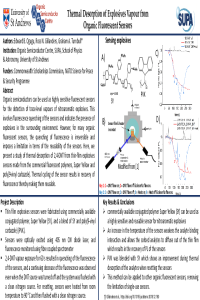
Organic semiconductors can be used as highly sensitive fluorescent sensors for the detection of nitroaromatic explosives such as TNT. When trace-level vapours of explosives encounter an organic fluorescent sensor, molecules from the vapour are absorbed into the film and modify the light-emitting properties. Specifically, an electron is transferred from a photogenerated exciton in the sensor to a sorbed nitroaromatic molecule which results in fluorescence quenching and indicates the presence of explosives in the surrounding environment. The response to ppb levels of explosives is very rapid, however for many organic fluorescent sensors, the quenching of fluorescence is irreversible which make them single use sensors, and imposes a limitation in terms of reusability of the sensors. Here, we present a study of thermal desorption of 2,4-DNT from thin film explosives sensors made from the commercial fluorescent polymer, Super Yellow. Thermal cycling of the sensor results in recovery of fluorescence thereby making them reusable, and providing a route to confirm that fluorescence quenching arises from analyte response. To optimise the sensors performance in terms of reusability, Super Yellow sensors, and blend of Super Yellow/Poly carbazole (PVK) sensors were fabricated. The sensors were exposed to 2,4-DNT vapour in a custom-made chamber while monitoring their fluorescence, and then heated to an optimum desorption temperature to desorb the DNT molecules from the sensors. Finally, the improvement of the sensors made from the polymer blend, and the effect of temperature on the sensors is discussed. This method can be applied to other organic fluorescent sensors, removing the limitation of single use sensors.
Keywords
Organic semiconductors
nitroaromatic explosives
fluorescence quenching
thermal desorption.
Manuscript
sciforum_046587_manuscript.pdf
Poster
sciforum_046587_slides_Presentation_CSAC2021_Thermal_Desorption_ebo3.pdf
A Pyridine-bridged Bispyrrole Having N-Fluoroalkyl Imino Groups That Serves as Color and Spectroscopic Indicators of Perfluorocarboxylic Acids
Unravelling plant-pathogen interactions: proximal optical sensing as an effective tool for early detect plant diseases