Event submissions
EventsThe 1st International Electronic Conference on Chemical Sensors and Analytical Chemistry
Published
 10.3390/CSAC2021-10631 (registering DOI)
 This submission belongs to the session G. General: Poster of the event The 1st International Electronic Conference on Chemical Sensors and Analytical Chemistry
Published date
07 Jul, 2021
Academic Editor
'%3e%3cpath%20d='M12.6657%2010.9104C12.4185%2010.325%2012.0599%209.79327%2011.6097%209.34482C11.1609%208.89508%2010.6293%208.5365%2010.0442%208.28888C10.0389%208.28626%2010.0337%208.28495%2010.0285%208.28233C10.8446%207.69279%2011.3752%206.73249%2011.3752%205.64904C11.3752%203.8542%209.92103%202.39999%208.1262%202.39999C6.33136%202.39999%204.87715%203.8542%204.87715%205.64904C4.87715%206.73249%205.40774%207.69279%206.22393%208.28364C6.21869%208.28626%206.21345%208.28757%206.20821%208.29019C5.62129%208.5378%205.09463%208.89284%204.64265%209.34613C4.1929%209.79493%203.83432%2010.3266%203.58671%2010.9117C3.34345%2011.4845%203.21226%2012.0987%203.20023%2012.7209C3.19988%2012.7349%203.20233%2012.7488%203.20744%2012.7619C3.21255%2012.7749%203.22022%2012.7867%203.22998%2012.7968C3.23975%2012.8068%203.25142%2012.8147%203.26431%2012.8202C3.2772%2012.8256%203.29105%2012.8284%203.30504%2012.8284H4.09109C4.14874%2012.8284%204.19459%2012.7825%204.1959%2012.7262C4.2221%2011.7148%204.62823%2010.7676%205.34617%2010.0497C6.08899%209.30683%207.0755%208.89808%208.1262%208.89808C9.17689%208.89808%2010.1634%209.30683%2010.9062%2010.0497C11.6242%2010.7676%2012.0303%2011.7148%2012.0565%2012.7262C12.0578%2012.7838%2012.1037%2012.8284%2012.1613%2012.8284H12.9474C12.9613%2012.8284%2012.9752%2012.8256%2012.9881%2012.8202C13.001%2012.8147%2013.0126%2012.8068%2013.0224%2012.7968C13.0322%2012.7867%2013.0398%2012.7749%2013.0449%2012.7619C13.0501%2012.7488%2013.0525%2012.7349%2013.0522%2012.7209C13.0391%2012.0947%2012.9094%2011.4855%2012.6657%2010.9104ZM8.1262%207.9024C7.52486%207.9024%206.9589%207.6679%206.53312%207.24211C6.10733%206.81633%205.87283%206.25037%205.87283%205.64904C5.87283%205.0477%206.10733%204.48174%206.53312%204.05596C6.9589%203.63018%207.52486%203.39567%208.1262%203.39567C8.72753%203.39567%209.29349%203.63018%209.71927%204.05596C10.1451%204.48174%2010.3796%205.0477%2010.3796%205.64904C10.3796%206.25037%2010.1451%206.81633%209.71927%207.24211C9.29349%207.6679%208.72753%207.9024%208.1262%207.9024Z'%20fill='%235D1EE1'/%3e%3c/g%3e%3c/svg%3e) Manuel Algarra
Manuel AlgarraCitation
Edward Muntean, Camelia Urda, Raluca Rezi, Luana Pacurar, Fast and non-destructive near infrared spectroscopic analysis associated with chemometrics: an efficient tool in assisting breeding programs, in Proceedings of The 1st International Electronic Conference on Chemical Sensors and Analytical Chemistry, 1 July–15 July 2021, MDPI: Basel, Switzerland, doi: 10.3390/CSAC2021-10631
Share
Email
Facebook
Twitter
LinkedIn
Fast and non-destructive near infrared spectroscopic analysis associated with chemometrics: an efficient tool in assisting breeding programs

Edward Muntean 1,2
'%3e%3cpath%20d='M12.6647%2010.9104C12.4176%2010.325%2012.0589%209.7933%2011.6088%209.34485C11.16%208.89511%2010.6283%208.53653%2010.0432%208.28891C10.038%208.28629%2010.0327%208.28498%2010.0275%208.28236C10.8437%207.69282%2011.3743%206.73252%2011.3743%205.64907C11.3743%203.85423%209.92005%202.40002%208.12522%202.40002C6.33038%202.40002%204.87618%203.85423%204.87618%205.64907C4.87618%206.73252%205.40677%207.69282%206.22296%208.28367C6.21772%208.28629%206.21248%208.2876%206.20724%208.29022C5.62031%208.53783%205.09365%208.89287%204.64167%209.34616C4.19192%209.79496%203.83334%2010.3266%203.58573%2010.9117C3.34247%2011.4846%203.21128%2012.0987%203.19925%2012.721C3.1989%2012.735%203.20135%2012.7489%203.20646%2012.7619C3.21157%2012.7749%203.21924%2012.7868%203.22901%2012.7968C3.23877%2012.8068%203.25045%2012.8148%203.26334%2012.8202C3.27623%2012.8256%203.29007%2012.8284%203.30406%2012.8284H4.09012C4.14776%2012.8284%204.19362%2012.7825%204.19493%2012.7262C4.22113%2011.7148%204.62726%2010.7676%205.34519%2010.0497C6.08802%209.30686%207.07452%208.89811%208.12522%208.89811C9.17592%208.89811%2010.1624%209.30686%2010.9052%2010.0497C11.6232%2010.7676%2012.0293%2011.7148%2012.0555%2012.7262C12.0568%2012.7839%2012.1027%2012.8284%2012.1603%2012.8284H12.9464C12.9604%2012.8284%2012.9742%2012.8256%2012.9871%2012.8202C13%2012.8148%2013.0117%2012.8068%2013.0214%2012.7968C13.0312%2012.7868%2013.0389%2012.7749%2013.044%2012.7619C13.0491%2012.7489%2013.0515%2012.735%2013.0512%2012.721C13.0381%2012.0947%2012.9084%2011.4856%2012.6647%2010.9104ZM8.12522%207.90243C7.52388%207.90243%206.95792%207.66793%206.53214%207.24215C6.10636%206.81636%205.87185%206.2504%205.87185%205.64907C5.87185%205.04773%206.10636%204.48177%206.53214%204.05599C6.95792%203.63021%207.52388%203.3957%208.12522%203.3957C8.72655%203.3957%209.29252%203.63021%209.7183%204.05599C10.1441%204.48177%2010.3786%205.04773%2010.3786%205.64907C10.3786%206.2504%2010.1441%206.81636%209.7183%207.24215C9.29252%207.66793%208.72655%207.90243%208.12522%207.90243Z'%20fill='%235D1EE1'/%3e%3c/g%3e%3c/svg%3e)
Camelia Urda 2
Raluca Rezi 2
Luana Pacurar 2
1. University of Agricultural Sciences and Veterinary Medicine Cluj Napoca, Romania
2. Research & Development Station for Agriculture, Turda, Romania
Abstract
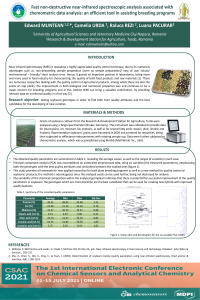
Near infrared spectroscopy (NIRS) is nowadays a highly-appreciated quality control technique, due to its numerous advantages, such as: non-demanding sample preparation (even no sample preparation)/ easy to use/ robust/ environmental – friendly/ short analysis time. Hence, it gained an important position in laboratories, being more and more used in food industry for characterizing the quality of both food products and raw materials. There are numerous researches dealing with the quality control of agricultural products, among which there are also the seeds of crop plants; the improvement in both biological and nutritional properties was and continues to be a major concern for breeding programs and in this context NIRS can bring a valuable contribution, by providing relevant data on nutritional quality in a fast way. This paper is a case study in which soybeans genotypes were tested in order to find both the quality attributes and the best candidates for the developing of new varieties. 72 soybean cultivars from the Research & Development Station for Agriculture, Turda were analyzed using a Tango spectrometer (Bruker, Germany). The instrument was calibrated to provide data for intact grains, on: moisture, fat, proteins, as well as for several fatty acids: stearic, oleic, linoleic and linolenic. Data were further subjected to chemometric analysis, which was accomplished using Matlab (MathWorks Inc., USA) ; principal component analysis was accomplished on autoscaled preprocessed data, using six variables (the measured parameters), reveling both the genotypes with the best quality attributes and similarities between the studied ones. The variability of the chemical composition within the analyzed germoplasm indicates that there is potential for successful improvement of the quality parameters in soybeans. This study can provide a framework for new applied researches for both plant breeding programs as well as a new method for quality control of soybeans’ products; the method is advantageous since the analyzed seeds can be used further, being not destroyed for analysis.
Keywords
Near infrared spectroscopy
quality
chemometry
soybeans
breeding
Manuscript
sciforum-046647 -abstract.pdf
Poster
sciforum-046647 -presentation.pdf
Voltammetric detection of mercury ions at poly(azulene-EDTA) like screen printed modified electrodes
An optical fiber sensor for Hg2+ detection based on the LSPR of silver and gold nanoparticles embedded in a polymeric matrix as an effective sensing material