Event submissions
Published

This submission belongs to the session P. Posters of the event The 1st International Electronic Conference on Entomology
Published date
14 Jul, 2021
Academic Editor
'%3e%3cpath%20d='M12.6657%2010.9104C12.4185%2010.325%2012.0599%209.79327%2011.6097%209.34482C11.1609%208.89508%2010.6293%208.5365%2010.0442%208.28888C10.0389%208.28626%2010.0337%208.28495%2010.0285%208.28233C10.8446%207.69279%2011.3752%206.73249%2011.3752%205.64904C11.3752%203.8542%209.92103%202.39999%208.1262%202.39999C6.33136%202.39999%204.87715%203.8542%204.87715%205.64904C4.87715%206.73249%205.40774%207.69279%206.22393%208.28364C6.21869%208.28626%206.21345%208.28757%206.20821%208.29019C5.62129%208.5378%205.09463%208.89284%204.64265%209.34613C4.1929%209.79493%203.83432%2010.3266%203.58671%2010.9117C3.34345%2011.4845%203.21226%2012.0987%203.20023%2012.7209C3.19988%2012.7349%203.20233%2012.7488%203.20744%2012.7619C3.21255%2012.7749%203.22022%2012.7867%203.22998%2012.7968C3.23975%2012.8068%203.25142%2012.8147%203.26431%2012.8202C3.2772%2012.8256%203.29105%2012.8284%203.30504%2012.8284H4.09109C4.14874%2012.8284%204.19459%2012.7825%204.1959%2012.7262C4.2221%2011.7148%204.62823%2010.7676%205.34617%2010.0497C6.08899%209.30683%207.0755%208.89808%208.1262%208.89808C9.17689%208.89808%2010.1634%209.30683%2010.9062%2010.0497C11.6242%2010.7676%2012.0303%2011.7148%2012.0565%2012.7262C12.0578%2012.7838%2012.1037%2012.8284%2012.1613%2012.8284H12.9474C12.9613%2012.8284%2012.9752%2012.8256%2012.9881%2012.8202C13.001%2012.8147%2013.0126%2012.8068%2013.0224%2012.7968C13.0322%2012.7867%2013.0398%2012.7749%2013.0449%2012.7619C13.0501%2012.7488%2013.0525%2012.7349%2013.0522%2012.7209C13.0391%2012.0947%2012.9094%2011.4855%2012.6657%2010.9104ZM8.1262%207.9024C7.52486%207.9024%206.9589%207.6679%206.53312%207.24211C6.10733%206.81633%205.87283%206.25037%205.87283%205.64904C5.87283%205.0477%206.10733%204.48174%206.53312%204.05596C6.9589%203.63018%207.52486%203.39567%208.1262%203.39567C8.72753%203.39567%209.29349%203.63018%209.71927%204.05596C10.1451%204.48174%2010.3796%205.0477%2010.3796%205.64904C10.3796%206.25037%2010.1451%206.81633%209.71927%207.24211C9.29349%207.6679%208.72753%207.9024%208.1262%207.9024Z'%20fill='%235D1EE1'/%3e%3c/g%3e%3c/svg%3e) Brighton Mvumi
Brighton MvumiCitation
Thais Correa Sales, Camila Oliveira Santos, José Fernando Jurca Grigolli, Thadeu Carlos de Souza, Royner Ortiz Rojas, Letícia Mari Kishimoto, Clara Maria Tossige Quaresma Soares, Matheus Souza Soares, Rodrigo José de Souza Satolo, Gisele Maria Carvalho Magalhães, Eliseu José Guedes Pereira, Neotropical Brown Stink Bug (Euschistus heros) in Soybeans: What Insecticides have Maintained Effective Field Performance?, in Proceedings of The 1st International Electronic Conference on Entomology, 1 July–15 July 2021, MDPI: Basel, Switzerland, doi: 10.3390/IECE-10649
Share
Email
Facebook
Twitter
LinkedIn
Neotropical Brown Stink Bug (Euschistus heros) in Soybeans: What Insecticides have Maintained Effective Field Performance?
'%3e%3cpath%20d='M12.6647%2010.9104C12.4176%2010.325%2012.0589%209.7933%2011.6088%209.34485C11.16%208.89511%2010.6283%208.53653%2010.0432%208.28891C10.038%208.28629%2010.0327%208.28498%2010.0275%208.28236C10.8437%207.69282%2011.3743%206.73252%2011.3743%205.64907C11.3743%203.85423%209.92005%202.40002%208.12522%202.40002C6.33038%202.40002%204.87618%203.85423%204.87618%205.64907C4.87618%206.73252%205.40677%207.69282%206.22296%208.28367C6.21772%208.28629%206.21248%208.2876%206.20724%208.29022C5.62031%208.53783%205.09365%208.89287%204.64167%209.34616C4.19192%209.79496%203.83334%2010.3266%203.58573%2010.9117C3.34247%2011.4846%203.21128%2012.0987%203.19925%2012.721C3.1989%2012.735%203.20135%2012.7489%203.20646%2012.7619C3.21157%2012.7749%203.21924%2012.7868%203.22901%2012.7968C3.23877%2012.8068%203.25045%2012.8148%203.26334%2012.8202C3.27623%2012.8256%203.29007%2012.8284%203.30406%2012.8284H4.09012C4.14776%2012.8284%204.19362%2012.7825%204.19493%2012.7262C4.22113%2011.7148%204.62726%2010.7676%205.34519%2010.0497C6.08802%209.30686%207.07452%208.89811%208.12522%208.89811C9.17592%208.89811%2010.1624%209.30686%2010.9052%2010.0497C11.6232%2010.7676%2012.0293%2011.7148%2012.0555%2012.7262C12.0568%2012.7839%2012.1027%2012.8284%2012.1603%2012.8284H12.9464C12.9604%2012.8284%2012.9742%2012.8256%2012.9871%2012.8202C13%2012.8148%2013.0117%2012.8068%2013.0214%2012.7968C13.0312%2012.7868%2013.0389%2012.7749%2013.044%2012.7619C13.0491%2012.7489%2013.0515%2012.735%2013.0512%2012.721C13.0381%2012.0947%2012.9084%2011.4856%2012.6647%2010.9104ZM8.12522%207.90243C7.52388%207.90243%206.95792%207.66793%206.53214%207.24215C6.10636%206.81636%205.87185%206.2504%205.87185%205.64907C5.87185%205.04773%206.10636%204.48177%206.53214%204.05599C6.95792%203.63021%207.52388%203.3957%208.12522%203.3957C8.72655%203.3957%209.29252%203.63021%209.7183%204.05599C10.1441%204.48177%2010.3786%205.04773%2010.3786%205.64907C10.3786%206.2504%2010.1441%206.81636%209.7183%207.24215C9.29252%207.66793%208.72655%207.90243%208.12522%207.90243Z'%20fill='%235D1EE1'/%3e%3c/g%3e%3c/svg%3e)
Thais Correa Sales 1
Camila Oliveira Santos 2
José Fernando Jurca Grigolli 3
Thadeu Carlos de Souza 2
Royner Ortiz Rojas 2
Letícia Mari Kishimoto 2
Clara Maria Tossige Quaresma Soares 2
Matheus Souza Soares 2
Rodrigo José de Souza Satolo 2
Gisele Maria Carvalho Magalhães 2

Eliseu José Guedes Pereira 2
1. Araguaia
2. Universidade Federal de Viçosa
3. Famiva Pesquisa e Soluções Agrícolas
Abstract
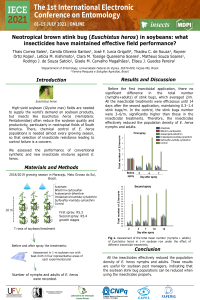
High-yield soybean (Glycine max) fields are needed to supply the world’s demand on soybean products, but insects like Euschistus heros (Hemiptera: Pentatomidae) often reduce the soybean quality and productivity, particularly in neotropical fields of South America. There, chemical control of E. heros populations is needed almost every growing season, so that selection of insecticide resistance leading to control failure is a concern. We assessed the performance of conventional synthetic and new insecticide mixtures against E. heros. In the 2018/2019 growing season, a randomized-block experiment with five replications was conducted in Maracaju, Mato Grosso do Sul, Brazil. The crop management practices were as usual expect for stink bug control. The insecticides, applied twice (in R5.3 and R5.4 growth stages), were as follows: acephate, bifentrin+carbosulfan, acetamiprid+bifenthrin, imidacloprid+lambda-cyhalothrin, sulfoxaflor+lambda-cyhalothrin. Before and after applying the treatments, the number of nymphs and adults were recorded in a 1-m soybean row using a beat cloth in four different representative areas of each experimental plot. Before the first insecticidal application, there no significant difference in the total number (nymphs+adults) of stink bugs, which averaged 2/m. All the insecticidal treatments were efficacious until 14 days after the second application, maintaining 0.3–1.4 stink bugs/m. In the control, the stink bugs number were 3–6/m, significantly higher than those in the insecticidal treatments. Therefore, the insecticides effectively reduced the population density of E. heros nymphs and adults. These results are useful for soybean pest managers, indicating that the soybean stink bug populations can be reduced when using the insecticides properly.
Keywords
Glycine max
neonicotinoid
pyrethroid
acephate
sulfoxaflor
pest management
Manuscript
sciforum-045815-layout.pdf
Poster
sciforum-046815-poster.pdf
Fumigant potential of essential oils from Laurus nobilis (Lauraceae) against the date moth Ectomyelois ceratoniae (Pyralidae)
An Updated Overview of the Genus Eumerus Meigen, 1822 (Diptera: Syrphidae) in the Iberian Peninsula