Event submissions
Published
 10.3390/IECBS2021-10651 (registering DOI)
 This submission belongs to the session 6. Behavioral Neuroscience of the event The 2nd International Electronic Conference on Brain Sciences
Published date
14 Jul, 2021
Academic Editor
'%3e%3cpath%20d='M12.6657%2010.9104C12.4185%2010.325%2012.0599%209.79327%2011.6097%209.34482C11.1609%208.89508%2010.6293%208.5365%2010.0442%208.28888C10.0389%208.28626%2010.0337%208.28495%2010.0285%208.28233C10.8446%207.69279%2011.3752%206.73249%2011.3752%205.64904C11.3752%203.8542%209.92103%202.39999%208.1262%202.39999C6.33136%202.39999%204.87715%203.8542%204.87715%205.64904C4.87715%206.73249%205.40774%207.69279%206.22393%208.28364C6.21869%208.28626%206.21345%208.28757%206.20821%208.29019C5.62129%208.5378%205.09463%208.89284%204.64265%209.34613C4.1929%209.79493%203.83432%2010.3266%203.58671%2010.9117C3.34345%2011.4845%203.21226%2012.0987%203.20023%2012.7209C3.19988%2012.7349%203.20233%2012.7488%203.20744%2012.7619C3.21255%2012.7749%203.22022%2012.7867%203.22998%2012.7968C3.23975%2012.8068%203.25142%2012.8147%203.26431%2012.8202C3.2772%2012.8256%203.29105%2012.8284%203.30504%2012.8284H4.09109C4.14874%2012.8284%204.19459%2012.7825%204.1959%2012.7262C4.2221%2011.7148%204.62823%2010.7676%205.34617%2010.0497C6.08899%209.30683%207.0755%208.89808%208.1262%208.89808C9.17689%208.89808%2010.1634%209.30683%2010.9062%2010.0497C11.6242%2010.7676%2012.0303%2011.7148%2012.0565%2012.7262C12.0578%2012.7838%2012.1037%2012.8284%2012.1613%2012.8284H12.9474C12.9613%2012.8284%2012.9752%2012.8256%2012.9881%2012.8202C13.001%2012.8147%2013.0126%2012.8068%2013.0224%2012.7968C13.0322%2012.7867%2013.0398%2012.7749%2013.0449%2012.7619C13.0501%2012.7488%2013.0525%2012.7349%2013.0522%2012.7209C13.0391%2012.0947%2012.9094%2011.4855%2012.6657%2010.9104ZM8.1262%207.9024C7.52486%207.9024%206.9589%207.6679%206.53312%207.24211C6.10733%206.81633%205.87283%206.25037%205.87283%205.64904C5.87283%205.0477%206.10733%204.48174%206.53312%204.05596C6.9589%203.63018%207.52486%203.39567%208.1262%203.39567C8.72753%203.39567%209.29349%203.63018%209.71927%204.05596C10.1451%204.48174%2010.3796%205.0477%2010.3796%205.64904C10.3796%206.25037%2010.1451%206.81633%209.71927%207.24211C9.29349%207.6679%208.72753%207.9024%208.1262%207.9024Z'%20fill='%235D1EE1'/%3e%3c/g%3e%3c/svg%3e) Stephen Meriney
Stephen MerineyCitation
James Robert Brasic, Differential of voluntary and involuntary movements, in Proceedings of The 2nd International Electronic Conference on Brain Sciences, 15 July–30 July 2021, MDPI: Basel, Switzerland, doi: 10.3390/IECBS2021-10651
Share
Email
Facebook
Twitter
LinkedIn
Differential of voluntary and involuntary movements

James Robert Brasic 1
1. Johns Hopkins University School of Medicine
Abstract
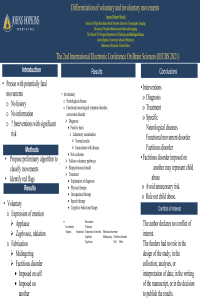
- Introduction: The differentiation of voluntary and involuntary movements represents a crucial challenge for observers, particularly providers who face the behaviors in an emergency.
- Methods: An algorithm is developed to classify movements as voluntary or involuntary are identified. Red flags to identify movements that require treatment or restraint are presented.
- Results and Discussion:
Involuntary movements include the broad class of movement disorders, including (A) movement disorders with identified pathophysiology and (B) functional movement disorders, a wide variety of movements that may or may not resemble movement disorders with identified pathophysiology.
Voluntary movements include (A) motions deliberately performed by persons to express exuberance such as applause and zaghrouta and (B) motions deliberately performed by persons to deceive others, such as (A) malingering, the fabrication of actions in order to avoid jail, work, school, and to obtain financial and other rewards, and (B) Münchausen syndrome, the fabrication of symptoms and signs to seek medical attention and treatment. Identification of functional movement disorders and fabricated voluntary movements is crucial to avoid providing inappropriate interventions, such as medications and surgeries with significant risks and no beneficial effects.
Electrophysiological and motion measurements may facilitate the identification of voluntary movements. For example, a Bereitschaftspotential, a surface-negative electrical brain potential identified on electroencephalograph (EGG), can identify self-initiated voluntary acts.
- Conclusions
Neuroscientists can benefit from the proposed algorithm to differentiate voluntary and involuntary movements particularly in emergent situations to determine when interventions are required and contraindicated.
Keywords
applause
Bereitschaftspotential
conversion disorder
functional movement disorders
involuntary
malingering
movement disorders
Münchausen syndrome
ululation
voluntary
Manuscript
sciforum-044956.pdf
Poster
Poster 210627 2102 Differentiation.pdf
Features of the psychomotor coordination in adolescents with mental disorders in remission