Event submissions
Published

This submission belongs to the session 2. Cognitive Neuroscience of the event The 2nd International Electronic Conference on Brain Sciences
Published date
14 Jul, 2021
Academic Editor
'%3e%3cpath%20d='M12.6657%2010.9104C12.4185%2010.325%2012.0599%209.79327%2011.6097%209.34482C11.1609%208.89508%2010.6293%208.5365%2010.0442%208.28888C10.0389%208.28626%2010.0337%208.28495%2010.0285%208.28233C10.8446%207.69279%2011.3752%206.73249%2011.3752%205.64904C11.3752%203.8542%209.92103%202.39999%208.1262%202.39999C6.33136%202.39999%204.87715%203.8542%204.87715%205.64904C4.87715%206.73249%205.40774%207.69279%206.22393%208.28364C6.21869%208.28626%206.21345%208.28757%206.20821%208.29019C5.62129%208.5378%205.09463%208.89284%204.64265%209.34613C4.1929%209.79493%203.83432%2010.3266%203.58671%2010.9117C3.34345%2011.4845%203.21226%2012.0987%203.20023%2012.7209C3.19988%2012.7349%203.20233%2012.7488%203.20744%2012.7619C3.21255%2012.7749%203.22022%2012.7867%203.22998%2012.7968C3.23975%2012.8068%203.25142%2012.8147%203.26431%2012.8202C3.2772%2012.8256%203.29105%2012.8284%203.30504%2012.8284H4.09109C4.14874%2012.8284%204.19459%2012.7825%204.1959%2012.7262C4.2221%2011.7148%204.62823%2010.7676%205.34617%2010.0497C6.08899%209.30683%207.0755%208.89808%208.1262%208.89808C9.17689%208.89808%2010.1634%209.30683%2010.9062%2010.0497C11.6242%2010.7676%2012.0303%2011.7148%2012.0565%2012.7262C12.0578%2012.7838%2012.1037%2012.8284%2012.1613%2012.8284H12.9474C12.9613%2012.8284%2012.9752%2012.8256%2012.9881%2012.8202C13.001%2012.8147%2013.0126%2012.8068%2013.0224%2012.7968C13.0322%2012.7867%2013.0398%2012.7749%2013.0449%2012.7619C13.0501%2012.7488%2013.0525%2012.7349%2013.0522%2012.7209C13.0391%2012.0947%2012.9094%2011.4855%2012.6657%2010.9104ZM8.1262%207.9024C7.52486%207.9024%206.9589%207.6679%206.53312%207.24211C6.10733%206.81633%205.87283%206.25037%205.87283%205.64904C5.87283%205.0477%206.10733%204.48174%206.53312%204.05596C6.9589%203.63018%207.52486%203.39567%208.1262%203.39567C8.72753%203.39567%209.29349%203.63018%209.71927%204.05596C10.1451%204.48174%2010.3796%205.0477%2010.3796%205.64904C10.3796%206.25037%2010.1451%206.81633%209.71927%207.24211C9.29349%207.6679%208.72753%207.9024%208.1262%207.9024Z'%20fill='%235D1EE1'/%3e%3c/g%3e%3c/svg%3e) Stephen Meriney
Stephen MerineyCitation
Marta Matamala-Gomez, Sara Bottiroli, Grazia Sances, Marta Allena, Roberto De Icco, Elena Guaschino, Giorgio Sandrini, Cristina Tassorelli, Positive facial expression for pain modulation in patients with chronic migraine, in Proceedings of The 2nd International Electronic Conference on Brain Sciences, 15 July–30 July 2021, MDPI: Basel, Switzerland, doi: 10.3390/IECBS2021-10658
Share
Email
Facebook
Twitter
LinkedIn
Positive facial expression for pain modulation in patients with chronic migraine
'%3e%3cpath%20d='M12.6647%2010.9104C12.4176%2010.325%2012.0589%209.7933%2011.6088%209.34485C11.16%208.89511%2010.6283%208.53653%2010.0432%208.28891C10.038%208.28629%2010.0327%208.28498%2010.0275%208.28236C10.8437%207.69282%2011.3743%206.73252%2011.3743%205.64907C11.3743%203.85423%209.92005%202.40002%208.12522%202.40002C6.33038%202.40002%204.87618%203.85423%204.87618%205.64907C4.87618%206.73252%205.40677%207.69282%206.22296%208.28367C6.21772%208.28629%206.21248%208.2876%206.20724%208.29022C5.62031%208.53783%205.09365%208.89287%204.64167%209.34616C4.19192%209.79496%203.83334%2010.3266%203.58573%2010.9117C3.34247%2011.4846%203.21128%2012.0987%203.19925%2012.721C3.1989%2012.735%203.20135%2012.7489%203.20646%2012.7619C3.21157%2012.7749%203.21924%2012.7868%203.22901%2012.7968C3.23877%2012.8068%203.25045%2012.8148%203.26334%2012.8202C3.27623%2012.8256%203.29007%2012.8284%203.30406%2012.8284H4.09012C4.14776%2012.8284%204.19362%2012.7825%204.19493%2012.7262C4.22113%2011.7148%204.62726%2010.7676%205.34519%2010.0497C6.08802%209.30686%207.07452%208.89811%208.12522%208.89811C9.17592%208.89811%2010.1624%209.30686%2010.9052%2010.0497C11.6232%2010.7676%2012.0293%2011.7148%2012.0555%2012.7262C12.0568%2012.7839%2012.1027%2012.8284%2012.1603%2012.8284H12.9464C12.9604%2012.8284%2012.9742%2012.8256%2012.9871%2012.8202C13%2012.8148%2013.0117%2012.8068%2013.0214%2012.7968C13.0312%2012.7868%2013.0389%2012.7749%2013.044%2012.7619C13.0491%2012.7489%2013.0515%2012.735%2013.0512%2012.721C13.0381%2012.0947%2012.9084%2011.4856%2012.6647%2010.9104ZM8.12522%207.90243C7.52388%207.90243%206.95792%207.66793%206.53214%207.24215C6.10636%206.81636%205.87185%206.2504%205.87185%205.64907C5.87185%205.04773%206.10636%204.48177%206.53214%204.05599C6.95792%203.63021%207.52388%203.3957%208.12522%203.3957C8.72655%203.3957%209.29252%203.63021%209.7183%204.05599C10.1441%204.48177%2010.3786%205.04773%2010.3786%205.64907C10.3786%206.2504%2010.1441%206.81636%209.7183%207.24215C9.29252%207.66793%208.72655%207.90243%208.12522%207.90243Z'%20fill='%235D1EE1'/%3e%3c/g%3e%3c/svg%3e)
Marta Matamala-Gomez 1
Sara Bottiroli 2,3
Grazia Sances 4
Marta Allena 4
Roberto De Icco 4,5
Elena Guaschino 4
Giorgio Sandrini 5,6
Cristina Tassorelli 5,7
1. Department of Human Sciences for Education “Riccardo Massa,” Center for Studies in Communication Sciences “Luigi Anolli” (CESCOM), University of Milano-Bicocca, Milan, Italy
2. Scientific Institute for Research, Hospitalization, and Healthcare (IRCCS), Mondino Foundation, Pavia, Italy
3. “Giustino Fortunato” University of Benevento, Benevento, Italy
4. Headache Science Centre, IRCCS Mondino Foundation, Pavia, Italy
5. Department of Brain and Behavioral Sciences, University of Pavia, Pavia, Italy
6. Headache Science and Neurorehabilitation Center, IRRCS Mondino Foundation, Pavia, Italy
7. Headache Science and Neurorehabilitation Center, Istituto di Ricovero e Cura a Carattere Scientifico Mondino Foundation, Pavia, Italy
Abstract
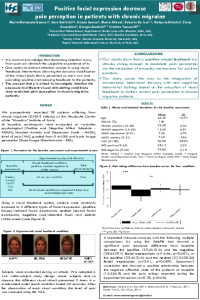
Background: Migraine is one of the most prevalent neurological disorders worldwide. A large number of studies suggest that migraines are associated with the mental state of the patients, and specially with negative emotions. One option to regulate negative emotions or the negative affective state in chronic migraine patients is by using visual feedback techniques that may induce visually induced analgesia. In fact, it is known that the observation of facial expressions effectively modulates pain perception during social interaction.
Aim: To investigate whether the exposure to different visual feedback conditions (facial expressions) may modulate pain perception assessed by the 1 to 100 cm visual analogue scale in chronic migraine patients.
Methods: To this aim 38 female chronic migraine patients were recruited at the IRCCS C. Mondino Foundation. Participants were exposed to a 1x4 within-subject study design, where they had to observe different visual stimuli (positive face, neutral face, negative face, and control (white screen)), presented 3 times in a randomized order (each condition lasted 40 seconds). After the observation of each visual condition pain ratings with a 0 to 100 VAS and identification scores in a Likert scale from -3 (not identification at all) to 3 (total identification) were assessed.
Results: The results show a significant difference in pain ratings between the positive (32.44±31) and the negative (38.61±29.74) (z=-4.46, p<0.0001), and the neutral facial expression (37.15±28.36) (z=3.41, p<0.001). Participants felt more identified with the neutral face condition compared to the negative face condition (z=3.32, p<0.05). Overall, the patients felt more identified with the three emotional face conditions than with the white screen control condition.
Conclusions: A positive emotional face feedback is a stimulus strong enough to modulate pain perception via the mediation of emotion regulation for positive emotions. This study paves the way to the integration of new cognitive-behavioural training based on the adoption of visual placebo analgesia to further control pain perception in chronic migraine patients.
Keywords
pain
chronic migraine
emotion regulation
facial expression.
Manuscript
Poster_BrainSciencesConference_ToSubmit.pdf
Poster
Poster_BrainSciencesConference_ToSubmit.pdf
Development of Parkinson's Dementia Prediction Model Using Regression with Optimal Scale
Lipid profile versus effect of rehabilitation in patients with stroke at a chronic stage of recovery – preliminary study