Event submissions
Published
 10.3390/IECBS2021-10659 (registering DOI)
 This submission belongs to the session 1. Clinical Neuroscience of the event The 2nd International Electronic Conference on Brain Sciences
Published date
14 Jul, 2021
Academic Editor
'%3e%3cpath%20d='M12.6657%2010.9104C12.4185%2010.325%2012.0599%209.79327%2011.6097%209.34482C11.1609%208.89508%2010.6293%208.5365%2010.0442%208.28888C10.0389%208.28626%2010.0337%208.28495%2010.0285%208.28233C10.8446%207.69279%2011.3752%206.73249%2011.3752%205.64904C11.3752%203.8542%209.92103%202.39999%208.1262%202.39999C6.33136%202.39999%204.87715%203.8542%204.87715%205.64904C4.87715%206.73249%205.40774%207.69279%206.22393%208.28364C6.21869%208.28626%206.21345%208.28757%206.20821%208.29019C5.62129%208.5378%205.09463%208.89284%204.64265%209.34613C4.1929%209.79493%203.83432%2010.3266%203.58671%2010.9117C3.34345%2011.4845%203.21226%2012.0987%203.20023%2012.7209C3.19988%2012.7349%203.20233%2012.7488%203.20744%2012.7619C3.21255%2012.7749%203.22022%2012.7867%203.22998%2012.7968C3.23975%2012.8068%203.25142%2012.8147%203.26431%2012.8202C3.2772%2012.8256%203.29105%2012.8284%203.30504%2012.8284H4.09109C4.14874%2012.8284%204.19459%2012.7825%204.1959%2012.7262C4.2221%2011.7148%204.62823%2010.7676%205.34617%2010.0497C6.08899%209.30683%207.0755%208.89808%208.1262%208.89808C9.17689%208.89808%2010.1634%209.30683%2010.9062%2010.0497C11.6242%2010.7676%2012.0303%2011.7148%2012.0565%2012.7262C12.0578%2012.7838%2012.1037%2012.8284%2012.1613%2012.8284H12.9474C12.9613%2012.8284%2012.9752%2012.8256%2012.9881%2012.8202C13.001%2012.8147%2013.0126%2012.8068%2013.0224%2012.7968C13.0322%2012.7867%2013.0398%2012.7749%2013.0449%2012.7619C13.0501%2012.7488%2013.0525%2012.7349%2013.0522%2012.7209C13.0391%2012.0947%2012.9094%2011.4855%2012.6657%2010.9104ZM8.1262%207.9024C7.52486%207.9024%206.9589%207.6679%206.53312%207.24211C6.10733%206.81633%205.87283%206.25037%205.87283%205.64904C5.87283%205.0477%206.10733%204.48174%206.53312%204.05596C6.9589%203.63018%207.52486%203.39567%208.1262%203.39567C8.72753%203.39567%209.29349%203.63018%209.71927%204.05596C10.1451%204.48174%2010.3796%205.0477%2010.3796%205.64904C10.3796%206.25037%2010.1451%206.81633%209.71927%207.24211C9.29349%207.6679%208.72753%207.9024%208.1262%207.9024Z'%20fill='%235D1EE1'/%3e%3c/g%3e%3c/svg%3e) Stephen Meriney
Stephen MerineyCitation
Justyna Leszczak, Bogumiła Pniak, Ewelina Czenczek-Lewandowska, Agnieszka Guzik, Lipid profile versus effect of rehabilitation in patients with stroke at a chronic stage of recovery – preliminary study, in Proceedings of The 2nd International Electronic Conference on Brain Sciences, 15 July–30 July 2021, MDPI: Basel, Switzerland, doi: 10.3390/IECBS2021-10659
Share
Email
Facebook
Twitter
LinkedIn
Lipid profile versus effect of rehabilitation in patients with stroke at a chronic stage of recovery – preliminary study

Justyna Leszczak 1
'%3e%3cpath%20d='M12.6647%2010.9104C12.4176%2010.325%2012.0589%209.7933%2011.6088%209.34485C11.16%208.89511%2010.6283%208.53653%2010.0432%208.28891C10.038%208.28629%2010.0327%208.28498%2010.0275%208.28236C10.8437%207.69282%2011.3743%206.73252%2011.3743%205.64907C11.3743%203.85423%209.92005%202.40002%208.12522%202.40002C6.33038%202.40002%204.87618%203.85423%204.87618%205.64907C4.87618%206.73252%205.40677%207.69282%206.22296%208.28367C6.21772%208.28629%206.21248%208.2876%206.20724%208.29022C5.62031%208.53783%205.09365%208.89287%204.64167%209.34616C4.19192%209.79496%203.83334%2010.3266%203.58573%2010.9117C3.34247%2011.4846%203.21128%2012.0987%203.19925%2012.721C3.1989%2012.735%203.20135%2012.7489%203.20646%2012.7619C3.21157%2012.7749%203.21924%2012.7868%203.22901%2012.7968C3.23877%2012.8068%203.25045%2012.8148%203.26334%2012.8202C3.27623%2012.8256%203.29007%2012.8284%203.30406%2012.8284H4.09012C4.14776%2012.8284%204.19362%2012.7825%204.19493%2012.7262C4.22113%2011.7148%204.62726%2010.7676%205.34519%2010.0497C6.08802%209.30686%207.07452%208.89811%208.12522%208.89811C9.17592%208.89811%2010.1624%209.30686%2010.9052%2010.0497C11.6232%2010.7676%2012.0293%2011.7148%2012.0555%2012.7262C12.0568%2012.7839%2012.1027%2012.8284%2012.1603%2012.8284H12.9464C12.9604%2012.8284%2012.9742%2012.8256%2012.9871%2012.8202C13%2012.8148%2013.0117%2012.8068%2013.0214%2012.7968C13.0312%2012.7868%2013.0389%2012.7749%2013.044%2012.7619C13.0491%2012.7489%2013.0515%2012.735%2013.0512%2012.721C13.0381%2012.0947%2012.9084%2011.4856%2012.6647%2010.9104ZM8.12522%207.90243C7.52388%207.90243%206.95792%207.66793%206.53214%207.24215C6.10636%206.81636%205.87185%206.2504%205.87185%205.64907C5.87185%205.04773%206.10636%204.48177%206.53214%204.05599C6.95792%203.63021%207.52388%203.3957%208.12522%203.3957C8.72655%203.3957%209.29252%203.63021%209.7183%204.05599C10.1441%204.48177%2010.3786%205.04773%2010.3786%205.64907C10.3786%206.2504%2010.1441%206.81636%209.7183%207.24215C9.29252%207.66793%208.72655%207.90243%208.12522%207.90243Z'%20fill='%235D1EE1'/%3e%3c/g%3e%3c/svg%3e)
Bogumiła Pniak 2
Ewelina Czenczek-Lewandowska 1

Agnieszka Guzik 1
1. Institute of Health Sciences, Medical College, University of Rzeszów, Poland
2. Excelsior Health and Rehabilitation Hospital, Iwonicz-Zdrój, Poland
Abstract
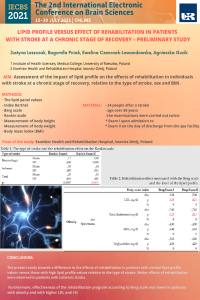
Background: Assessment of the impact of lipid profile on the effects of rehabilitation in individuals with stroke at a chronic stage of recovery, relative to the type of stroke, sex and BMI.
Methods: The study was conducted in a spa facility and involved 24 patients with chronic stroke, aged over 50 years. The patients were divided into two groups, comprising those with normal and with elevated lipid profile values. All the patients received spa therapy in course of a three-week rehabilitation program at a health resort. The examinations were carried out twice: Exam I upon admission to and Exam II on the day of discharge from the spa facility. The study assessed the lipid panel values in relation to the effectiveness of the rehabilitation program, as reflected by scores in Barthel scale, Berg scale, and Rankin scale.
Results: The present study showed a statistically significant relationship in the short-term exam with Rankin scale in patients with ischemic stroke (p=0.047). It was also observed that both the short-term and the long-term effect measured with Berg scale tended to decrease with higher LDL (rho= -0.738) and with higher total cholesterol (rho= -0.740) in patients with obesity.
Conclusions: The present study showed a difference in the effects of rehabilitation in patients with normal lipid profile values versus those with high lipid profile values relative to the type of stroke. Better effects of rehabilitation were observed in patients with ischemic stroke. Furthermore, effectiveness of the rehabilitation program according to Berg scale was lower in patients with obesity and with higher LDL and CH. However, the current findings must be treated as preliminary due to the small size of the study group. Further research should take into account a larger population of patients at a chronic stage of recovery post-stroke.
Keywords
stroke
lipid profile
spa rehabilitation
chronic stage
Manuscript
Poster.pdf
Poster
Poster.pdf
Positive facial expression for pain modulation in patients with chronic migraine
Cutaneous stimulus registration and information processing differ during constant finger force and position