Event submissions
Published
 10.3390/IECBS2021-10663 (registering DOI)
 This submission belongs to the session 1. Clinical Neuroscience of the event The 2nd International Electronic Conference on Brain Sciences
Published date
14 Jul, 2021
Academic Editor
'%3e%3cpath%20d='M12.6657%2010.9104C12.4185%2010.325%2012.0599%209.79327%2011.6097%209.34482C11.1609%208.89508%2010.6293%208.5365%2010.0442%208.28888C10.0389%208.28626%2010.0337%208.28495%2010.0285%208.28233C10.8446%207.69279%2011.3752%206.73249%2011.3752%205.64904C11.3752%203.8542%209.92103%202.39999%208.1262%202.39999C6.33136%202.39999%204.87715%203.8542%204.87715%205.64904C4.87715%206.73249%205.40774%207.69279%206.22393%208.28364C6.21869%208.28626%206.21345%208.28757%206.20821%208.29019C5.62129%208.5378%205.09463%208.89284%204.64265%209.34613C4.1929%209.79493%203.83432%2010.3266%203.58671%2010.9117C3.34345%2011.4845%203.21226%2012.0987%203.20023%2012.7209C3.19988%2012.7349%203.20233%2012.7488%203.20744%2012.7619C3.21255%2012.7749%203.22022%2012.7867%203.22998%2012.7968C3.23975%2012.8068%203.25142%2012.8147%203.26431%2012.8202C3.2772%2012.8256%203.29105%2012.8284%203.30504%2012.8284H4.09109C4.14874%2012.8284%204.19459%2012.7825%204.1959%2012.7262C4.2221%2011.7148%204.62823%2010.7676%205.34617%2010.0497C6.08899%209.30683%207.0755%208.89808%208.1262%208.89808C9.17689%208.89808%2010.1634%209.30683%2010.9062%2010.0497C11.6242%2010.7676%2012.0303%2011.7148%2012.0565%2012.7262C12.0578%2012.7838%2012.1037%2012.8284%2012.1613%2012.8284H12.9474C12.9613%2012.8284%2012.9752%2012.8256%2012.9881%2012.8202C13.001%2012.8147%2013.0126%2012.8068%2013.0224%2012.7968C13.0322%2012.7867%2013.0398%2012.7749%2013.0449%2012.7619C13.0501%2012.7488%2013.0525%2012.7349%2013.0522%2012.7209C13.0391%2012.0947%2012.9094%2011.4855%2012.6657%2010.9104ZM8.1262%207.9024C7.52486%207.9024%206.9589%207.6679%206.53312%207.24211C6.10733%206.81633%205.87283%206.25037%205.87283%205.64904C5.87283%205.0477%206.10733%204.48174%206.53312%204.05596C6.9589%203.63018%207.52486%203.39567%208.1262%203.39567C8.72753%203.39567%209.29349%203.63018%209.71927%204.05596C10.1451%204.48174%2010.3796%205.0477%2010.3796%205.64904C10.3796%206.25037%2010.1451%206.81633%209.71927%207.24211C9.29349%207.6679%208.72753%207.9024%208.1262%207.9024Z'%20fill='%235D1EE1'/%3e%3c/g%3e%3c/svg%3e) Stephen Meriney
Stephen MerineyCitation
Lydia Giménez-Llort, Juan José Martín-Gonzalez, Sara Maurel, Compassion, Physical and Mental Health in Multiple Sclerosis Patients and Their Caregivers in Times of COVID-19: The Teruel Study, in Proceedings of The 2nd International Electronic Conference on Brain Sciences, 15 July–30 July 2021, MDPI: Basel, Switzerland, doi: 10.3390/IECBS2021-10663
Share
Email
Facebook
Twitter
LinkedIn
Compassion, Physical and Mental Health in Multiple Sclerosis Patients and Their Caregivers in Times of COVID-19: The Teruel Study

Lydia Giménez-Llort 1,2
'%3e%3cpath%20d='M12.6647%2010.9104C12.4176%2010.325%2012.0589%209.7933%2011.6088%209.34485C11.16%208.89511%2010.6283%208.53653%2010.0432%208.28891C10.038%208.28629%2010.0327%208.28498%2010.0275%208.28236C10.8437%207.69282%2011.3743%206.73252%2011.3743%205.64907C11.3743%203.85423%209.92005%202.40002%208.12522%202.40002C6.33038%202.40002%204.87618%203.85423%204.87618%205.64907C4.87618%206.73252%205.40677%207.69282%206.22296%208.28367C6.21772%208.28629%206.21248%208.2876%206.20724%208.29022C5.62031%208.53783%205.09365%208.89287%204.64167%209.34616C4.19192%209.79496%203.83334%2010.3266%203.58573%2010.9117C3.34247%2011.4846%203.21128%2012.0987%203.19925%2012.721C3.1989%2012.735%203.20135%2012.7489%203.20646%2012.7619C3.21157%2012.7749%203.21924%2012.7868%203.22901%2012.7968C3.23877%2012.8068%203.25045%2012.8148%203.26334%2012.8202C3.27623%2012.8256%203.29007%2012.8284%203.30406%2012.8284H4.09012C4.14776%2012.8284%204.19362%2012.7825%204.19493%2012.7262C4.22113%2011.7148%204.62726%2010.7676%205.34519%2010.0497C6.08802%209.30686%207.07452%208.89811%208.12522%208.89811C9.17592%208.89811%2010.1624%209.30686%2010.9052%2010.0497C11.6232%2010.7676%2012.0293%2011.7148%2012.0555%2012.7262C12.0568%2012.7839%2012.1027%2012.8284%2012.1603%2012.8284H12.9464C12.9604%2012.8284%2012.9742%2012.8256%2012.9871%2012.8202C13%2012.8148%2013.0117%2012.8068%2013.0214%2012.7968C13.0312%2012.7868%2013.0389%2012.7749%2013.044%2012.7619C13.0491%2012.7489%2013.0515%2012.735%2013.0512%2012.721C13.0381%2012.0947%2012.9084%2011.4856%2012.6647%2010.9104ZM8.12522%207.90243C7.52388%207.90243%206.95792%207.66793%206.53214%207.24215C6.10636%206.81636%205.87185%206.2504%205.87185%205.64907C5.87185%205.04773%206.10636%204.48177%206.53214%204.05599C6.95792%203.63021%207.52388%203.3957%208.12522%203.3957C8.72655%203.3957%209.29252%203.63021%209.7183%204.05599C10.1441%204.48177%2010.3786%205.04773%2010.3786%205.64907C10.3786%206.2504%2010.1441%206.81636%209.7183%207.24215C9.29252%207.66793%208.72655%207.90243%208.12522%207.90243Z'%20fill='%235D1EE1'/%3e%3c/g%3e%3c/svg%3e)
Juan José Martín-Gonzalez 3
Sara Maurel 4,5
1. Institut de Neurociències, Universitat Autònoma de Barcelona, Barcelona, Spain
2. Department of Psychiatry and Forensic Medicine, School of Medicine, Universitat Autònoma de Barcelona, Barcelona, Spain
3. ATUEM (Asociación Turolense de Esclerosis Múltiple), Teruel, Spain
4. Department of Medicine, Hospital del Vall d’Hebron, Universitat Autònoma de Barcelona, Barcelona, Spain
5. Department of Neurosciences, Psychiatry, Universidad del País Vasco, Leioa, Spain
Abstract
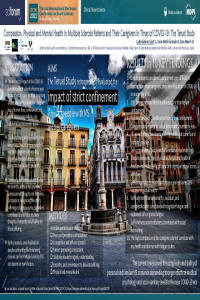
The secondary impact of the COVID-19 pandemic affects a world after one year facing adversities in a multiple mourning process due to the sudden and massive loss of human lives, confinement and physical distancing policies, and substantial socioeconomic losses. The fear of being infected, death, or the worsening of health in those already ill and their caregivers can be strong triggers of emotional distress and risk factors for mental health problems. Conversely, self-compassion skills also transcend to relationships promoting compassionate thoughts and behaviors. Compassion, recognizing the other's suffering and in response to discomfort, contributes to alleviate and create thoughts of empathy and affability for those suffering. Both constructs are in feedback in people confronting life-threatening diseases such as Multiple Sclerosis (MS) but depend on many factors. The Teruel Study retrospectively evaluated the impact of strict confinement in the 44 people with MS of a Spanish province and their caregivers on 1) fears and perceptions of lockdown; 2) compassion and self-compassion; 3) factors promoting compassion, solidarity towards tragedy, understanding, empathy, and commitment to alleviate suffering; 4) physical and mental health. Despite patients considered confinement very difficult to handle, more than caregivers, they were less afraid of COVID-19 or worsening of MS. Still, they recognized their health was worse than before confinement. Reclusion and lack of walks were the worse of confinement. Caregivers also referred to lack of leisure and uncertainty-fear. All agree the best was staying with the family, but some found ‘nothing’ positive. Self-compassion of people with MS remained moderate-high. Despite perceiving their physical and emotional health at medium-moderate levels, physical and cognitive fatigue scores were high. Self-compassion correlated with fatigue and explained 19% variance of global health. Self-judgment shared humanity, isolation, and overidentification correlated with cognitive fatigue and explained 16% of global fatigue. Self-kindness and mindfulness correlated with social functioning. The high compassion of the caregivers did not correlate with any health variable nor with fatigue scales. The current times unveil the complexity and frailty of personal and familiar MS scenarios demanding stronger efforts at medical psychology and socio-sanitary levels in the new COVID-19 era.
Keywords
Secondary impact
COVID-19
Multiple sclerosis
Caregivers
pandemic
Fears
Health
Self-compassion
Compassion
Fatigue
Manuscript
sciforum-045636-done.pdf
Poster
sciforum-045636 TheTeruel Study 2021.pdf
Repeated bout rate enhancement of finger tapping does not occur in musicians
Reversal of cognitive dysfunction and oxidative brain damage induced by chronic D-gal treatment in mice by Calcium dobesilate, a vasoactive and angioprotective drug with antioxidant properties