Event submissions
Published

This submission belongs to the session 2. Cognitive Neuroscience of the event The 2nd International Electronic Conference on Brain Sciences
Published date
14 Jul, 2021
Academic Editor
'%3e%3cpath%20d='M12.6657%2010.9104C12.4185%2010.325%2012.0599%209.79327%2011.6097%209.34482C11.1609%208.89508%2010.6293%208.5365%2010.0442%208.28888C10.0389%208.28626%2010.0337%208.28495%2010.0285%208.28233C10.8446%207.69279%2011.3752%206.73249%2011.3752%205.64904C11.3752%203.8542%209.92103%202.39999%208.1262%202.39999C6.33136%202.39999%204.87715%203.8542%204.87715%205.64904C4.87715%206.73249%205.40774%207.69279%206.22393%208.28364C6.21869%208.28626%206.21345%208.28757%206.20821%208.29019C5.62129%208.5378%205.09463%208.89284%204.64265%209.34613C4.1929%209.79493%203.83432%2010.3266%203.58671%2010.9117C3.34345%2011.4845%203.21226%2012.0987%203.20023%2012.7209C3.19988%2012.7349%203.20233%2012.7488%203.20744%2012.7619C3.21255%2012.7749%203.22022%2012.7867%203.22998%2012.7968C3.23975%2012.8068%203.25142%2012.8147%203.26431%2012.8202C3.2772%2012.8256%203.29105%2012.8284%203.30504%2012.8284H4.09109C4.14874%2012.8284%204.19459%2012.7825%204.1959%2012.7262C4.2221%2011.7148%204.62823%2010.7676%205.34617%2010.0497C6.08899%209.30683%207.0755%208.89808%208.1262%208.89808C9.17689%208.89808%2010.1634%209.30683%2010.9062%2010.0497C11.6242%2010.7676%2012.0303%2011.7148%2012.0565%2012.7262C12.0578%2012.7838%2012.1037%2012.8284%2012.1613%2012.8284H12.9474C12.9613%2012.8284%2012.9752%2012.8256%2012.9881%2012.8202C13.001%2012.8147%2013.0126%2012.8068%2013.0224%2012.7968C13.0322%2012.7867%2013.0398%2012.7749%2013.0449%2012.7619C13.0501%2012.7488%2013.0525%2012.7349%2013.0522%2012.7209C13.0391%2012.0947%2012.9094%2011.4855%2012.6657%2010.9104ZM8.1262%207.9024C7.52486%207.9024%206.9589%207.6679%206.53312%207.24211C6.10733%206.81633%205.87283%206.25037%205.87283%205.64904C5.87283%205.0477%206.10733%204.48174%206.53312%204.05596C6.9589%203.63018%207.52486%203.39567%208.1262%203.39567C8.72753%203.39567%209.29349%203.63018%209.71927%204.05596C10.1451%204.48174%2010.3796%205.0477%2010.3796%205.64904C10.3796%206.25037%2010.1451%206.81633%209.71927%207.24211C9.29349%207.6679%208.72753%207.9024%208.1262%207.9024Z'%20fill='%235D1EE1'/%3e%3c/g%3e%3c/svg%3e) Stephen Meriney
Stephen MerineyCitation
Daniel Alveal-Mellado, Lydia Giménez-Llort, Thigmotaxis helps to differentiate normal and pathological aging processes in a mice model for Alzheimer’s Disease., in Proceedings of The 2nd International Electronic Conference on Brain Sciences, 15 July–30 July 2021, MDPI: Basel, Switzerland, doi: 10.3390/IECBS2021-10669
Share
Email
Facebook
Twitter
LinkedIn
Thigmotaxis helps to differentiate normal and pathological aging processes in a mice model for Alzheimer’s Disease.
'%3e%3cpath%20d='M12.6647%2010.9104C12.4176%2010.325%2012.0589%209.7933%2011.6088%209.34485C11.16%208.89511%2010.6283%208.53653%2010.0432%208.28891C10.038%208.28629%2010.0327%208.28498%2010.0275%208.28236C10.8437%207.69282%2011.3743%206.73252%2011.3743%205.64907C11.3743%203.85423%209.92005%202.40002%208.12522%202.40002C6.33038%202.40002%204.87618%203.85423%204.87618%205.64907C4.87618%206.73252%205.40677%207.69282%206.22296%208.28367C6.21772%208.28629%206.21248%208.2876%206.20724%208.29022C5.62031%208.53783%205.09365%208.89287%204.64167%209.34616C4.19192%209.79496%203.83334%2010.3266%203.58573%2010.9117C3.34247%2011.4846%203.21128%2012.0987%203.19925%2012.721C3.1989%2012.735%203.20135%2012.7489%203.20646%2012.7619C3.21157%2012.7749%203.21924%2012.7868%203.22901%2012.7968C3.23877%2012.8068%203.25045%2012.8148%203.26334%2012.8202C3.27623%2012.8256%203.29007%2012.8284%203.30406%2012.8284H4.09012C4.14776%2012.8284%204.19362%2012.7825%204.19493%2012.7262C4.22113%2011.7148%204.62726%2010.7676%205.34519%2010.0497C6.08802%209.30686%207.07452%208.89811%208.12522%208.89811C9.17592%208.89811%2010.1624%209.30686%2010.9052%2010.0497C11.6232%2010.7676%2012.0293%2011.7148%2012.0555%2012.7262C12.0568%2012.7839%2012.1027%2012.8284%2012.1603%2012.8284H12.9464C12.9604%2012.8284%2012.9742%2012.8256%2012.9871%2012.8202C13%2012.8148%2013.0117%2012.8068%2013.0214%2012.7968C13.0312%2012.7868%2013.0389%2012.7749%2013.044%2012.7619C13.0491%2012.7489%2013.0515%2012.735%2013.0512%2012.721C13.0381%2012.0947%2012.9084%2011.4856%2012.6647%2010.9104ZM8.12522%207.90243C7.52388%207.90243%206.95792%207.66793%206.53214%207.24215C6.10636%206.81636%205.87185%206.2504%205.87185%205.64907C5.87185%205.04773%206.10636%204.48177%206.53214%204.05599C6.95792%203.63021%207.52388%203.3957%208.12522%203.3957C8.72655%203.3957%209.29252%203.63021%209.7183%204.05599C10.1441%204.48177%2010.3786%205.04773%2010.3786%205.64907C10.3786%206.2504%2010.1441%206.81636%209.7183%207.24215C9.29252%207.66793%208.72655%207.90243%208.12522%207.90243Z'%20fill='%235D1EE1'/%3e%3c/g%3e%3c/svg%3e)
Daniel Alveal-Mellado 1

Lydia Giménez-Llort 1
1. Universitat Autònoma de Barcelona
Abstract
A decline in the ability to learn and remember a spatial route often accompanies the normal aging process. Impairments in spatial orientation are also present since the early stages of disabling cognitive diseases such as Alzheimer’s Disease (AD). In the preclinical field, the detection of behavioral signs that help to differentiate both entities could promote a better understanding of AD instauration altogether with advances in novel treatments to ameliorate its impact. Here, the performance of 3xTg-AD mice of both sexes and their non-transgenic (NTg) (C57BL/6J) counterpart was evaluated at two-times point (12 and 16-months of age) in the Morris Water Maze test, using a modified 5-day protocol for the assessment of cognitive and non-cognitive symptoms of dementia, followed by a multiple swim pattern identification within a single trial in the test. Classical parameters showed that all animals learned the basic principles of the test more rapidly with age. Thereafter, mild variations in reference memory were detected along days at 12 months but not at 16 months. Surprisingly, 16-month-old 3xTg-AD male mice showed better results in short-term memory compared to all groups. However, when the swim pattern was visually analyzed, a persistence in thigmotaxis episodes, a non-hippocampus-associated search strategy was found in the pathological AD-like model but not in the NTg group, pointing out this pattern as a useful differentiating trait. Finally, the multiple strategies approach brings new evidence that mice can evolve from highly hippocampus-associated patterns since the earliest phases of the test.
Keywords
Aging
Morris Water Maze
Alzheimer's Disease
3xTg-AD mice
Manuscript
Poster_AlvealMellado_Daniel.pdf
Poster
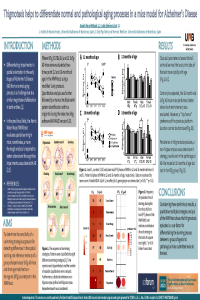
Poster_AlvealMellado_Daniel.pdf
Sex-dependent hepatomegaly, and increased hepatic oxidative stress in old male and female 3xTg-AD mice as compared to mice with physiological aging.
ADiag: Graph Theory and Deep Learning Based Diagnosis of Alzheimer's Disease