Event submissions
Published
 10.3390/IECBS2021-10671 (registering DOI)
 This submission belongs to the session 6. Behavioral Neuroscience of the event The 2nd International Electronic Conference on Brain Sciences
Published date
14 Jul, 2021
Academic Editor
'%3e%3cpath%20d='M12.6657%2010.9104C12.4185%2010.325%2012.0599%209.79327%2011.6097%209.34482C11.1609%208.89508%2010.6293%208.5365%2010.0442%208.28888C10.0389%208.28626%2010.0337%208.28495%2010.0285%208.28233C10.8446%207.69279%2011.3752%206.73249%2011.3752%205.64904C11.3752%203.8542%209.92103%202.39999%208.1262%202.39999C6.33136%202.39999%204.87715%203.8542%204.87715%205.64904C4.87715%206.73249%205.40774%207.69279%206.22393%208.28364C6.21869%208.28626%206.21345%208.28757%206.20821%208.29019C5.62129%208.5378%205.09463%208.89284%204.64265%209.34613C4.1929%209.79493%203.83432%2010.3266%203.58671%2010.9117C3.34345%2011.4845%203.21226%2012.0987%203.20023%2012.7209C3.19988%2012.7349%203.20233%2012.7488%203.20744%2012.7619C3.21255%2012.7749%203.22022%2012.7867%203.22998%2012.7968C3.23975%2012.8068%203.25142%2012.8147%203.26431%2012.8202C3.2772%2012.8256%203.29105%2012.8284%203.30504%2012.8284H4.09109C4.14874%2012.8284%204.19459%2012.7825%204.1959%2012.7262C4.2221%2011.7148%204.62823%2010.7676%205.34617%2010.0497C6.08899%209.30683%207.0755%208.89808%208.1262%208.89808C9.17689%208.89808%2010.1634%209.30683%2010.9062%2010.0497C11.6242%2010.7676%2012.0303%2011.7148%2012.0565%2012.7262C12.0578%2012.7838%2012.1037%2012.8284%2012.1613%2012.8284H12.9474C12.9613%2012.8284%2012.9752%2012.8256%2012.9881%2012.8202C13.001%2012.8147%2013.0126%2012.8068%2013.0224%2012.7968C13.0322%2012.7867%2013.0398%2012.7749%2013.0449%2012.7619C13.0501%2012.7488%2013.0525%2012.7349%2013.0522%2012.7209C13.0391%2012.0947%2012.9094%2011.4855%2012.6657%2010.9104ZM8.1262%207.9024C7.52486%207.9024%206.9589%207.6679%206.53312%207.24211C6.10733%206.81633%205.87283%206.25037%205.87283%205.64904C5.87283%205.0477%206.10733%204.48174%206.53312%204.05596C6.9589%203.63018%207.52486%203.39567%208.1262%203.39567C8.72753%203.39567%209.29349%203.63018%209.71927%204.05596C10.1451%204.48174%2010.3796%205.0477%2010.3796%205.64904C10.3796%206.25037%2010.1451%206.81633%209.71927%207.24211C9.29349%207.6679%208.72753%207.9024%208.1262%207.9024Z'%20fill='%235D1EE1'/%3e%3c/g%3e%3c/svg%3e) Stephen Meriney
Stephen MerineyCitation
Lidia Castillo Mariqueo, Lydia Giménez Llort, Bizarre behaviors limit exploratory activity and impair spontaneous gait performance in aged mice with AD pathology, in Proceedings of The 2nd International Electronic Conference on Brain Sciences, 15 July–30 July 2021, MDPI: Basel, Switzerland, doi: 10.3390/IECBS2021-10671
Share
Email
Facebook
Twitter
LinkedIn
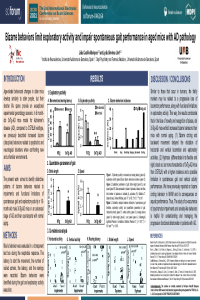
Bizarre behaviors limit exploratory activity and impair spontaneous gait performance in aged mice with AD pathology

Lidia Castillo Mariqueo 1,2

Lydia Giménez Llort 1,2
1. Institut de Neurociències, Universitat Autònoma de Barcelona, Barcelona, Spain
2. Department of Psychiatry and Forensic Medicine, School of Medicine, Universitat Autònoma de Barcelona, Barcelona, Spain
Abstract
Age-related behavioral changes in older mice develop similarly to older people, but their shorter life spans provide an exceptional experimental gerontology scenario. In the 6-month-old 3xTg-AD mice model for Alzheimer's disease (AD), compared to C57BL/6 wildtype, we previously described increased bizarre (disruptive) behaviors related to psychiatric and neurological disorders when confronting new and unfamiliar environments. We evaluated spontaneous gait and the exploratory activity at old age in the present work, using 16-month-old mice. Male sex was chosen since sex-dependent psychomotor effects of aging are stronger in C57BL/6 males than females, and at this age, male 3xTg-AD mice are close to an end-of-life status due to increased mortality rates. Mice's behavior was evaluated in a transparent test box during the neophobia response. The latency to start the movement, the number of visited corners, the latency, and the number of rearings were recorded. Bizarre behaviors (stretching, skipping, backward and bizarre circling) were identified during the gait and exploratory activity execution. The results corroborate that in the face of novelty and recognition of places, old 3xTg-AD mice exhibit increased bizarre behaviors than mice with normal aging. Bizarre circling and backward movement delayed the elicitation of horizontal and vertical locomotion and exploratory activities. Besides, kyphosis (differentiated into flexible and rigid) stood out as more characteristic of 3xTg-AD mice than C57BL/6 and a limitation in spontaneous gait and vertical activity performances. The study of co-occurrence of psychomotor impairments and anxiety-like behaviors is helpful for understanding and managing the progressive functional deterioration in patients with AD.
Keywords
Bizarre behaviors
exploratory activity
spontaneous gait
aging
alzheimer disease
Manuscript
sciforum-046164-done.pdf
Poster
Poster Lidia MPDI.pdf
ADiag: Graph Theory and Deep Learning Based Diagnosis of Alzheimer's Disease
POMEGRANATE JUICE AMELIORATES DOPAMINE RELEASE AND MOTOR AND OLFACTORY DEFICITS IN THE ROTENONE-INDUCED RAT MODEL OF PARKINSON'S DISEASE