Event submissions
Published

This submission belongs to the session 7. Environmental Neuroscience of the event The 2nd International Electronic Conference on Brain Sciences
Published date
15 Jul, 2021
Academic Editor
'%3e%3cpath%20d='M12.6657%2010.9104C12.4185%2010.325%2012.0599%209.79327%2011.6097%209.34482C11.1609%208.89508%2010.6293%208.5365%2010.0442%208.28888C10.0389%208.28626%2010.0337%208.28495%2010.0285%208.28233C10.8446%207.69279%2011.3752%206.73249%2011.3752%205.64904C11.3752%203.8542%209.92103%202.39999%208.1262%202.39999C6.33136%202.39999%204.87715%203.8542%204.87715%205.64904C4.87715%206.73249%205.40774%207.69279%206.22393%208.28364C6.21869%208.28626%206.21345%208.28757%206.20821%208.29019C5.62129%208.5378%205.09463%208.89284%204.64265%209.34613C4.1929%209.79493%203.83432%2010.3266%203.58671%2010.9117C3.34345%2011.4845%203.21226%2012.0987%203.20023%2012.7209C3.19988%2012.7349%203.20233%2012.7488%203.20744%2012.7619C3.21255%2012.7749%203.22022%2012.7867%203.22998%2012.7968C3.23975%2012.8068%203.25142%2012.8147%203.26431%2012.8202C3.2772%2012.8256%203.29105%2012.8284%203.30504%2012.8284H4.09109C4.14874%2012.8284%204.19459%2012.7825%204.1959%2012.7262C4.2221%2011.7148%204.62823%2010.7676%205.34617%2010.0497C6.08899%209.30683%207.0755%208.89808%208.1262%208.89808C9.17689%208.89808%2010.1634%209.30683%2010.9062%2010.0497C11.6242%2010.7676%2012.0303%2011.7148%2012.0565%2012.7262C12.0578%2012.7838%2012.1037%2012.8284%2012.1613%2012.8284H12.9474C12.9613%2012.8284%2012.9752%2012.8256%2012.9881%2012.8202C13.001%2012.8147%2013.0126%2012.8068%2013.0224%2012.7968C13.0322%2012.7867%2013.0398%2012.7749%2013.0449%2012.7619C13.0501%2012.7488%2013.0525%2012.7349%2013.0522%2012.7209C13.0391%2012.0947%2012.9094%2011.4855%2012.6657%2010.9104ZM8.1262%207.9024C7.52486%207.9024%206.9589%207.6679%206.53312%207.24211C6.10733%206.81633%205.87283%206.25037%205.87283%205.64904C5.87283%205.0477%206.10733%204.48174%206.53312%204.05596C6.9589%203.63018%207.52486%203.39567%208.1262%203.39567C8.72753%203.39567%209.29349%203.63018%209.71927%204.05596C10.1451%204.48174%2010.3796%205.0477%2010.3796%205.64904C10.3796%206.25037%2010.1451%206.81633%209.71927%207.24211C9.29349%207.6679%208.72753%207.9024%208.1262%207.9024Z'%20fill='%235D1EE1'/%3e%3c/g%3e%3c/svg%3e) Massimiliano Valeriani
Massimiliano ValerianiCitation
Lydia Giménez-Llort, Ana Ruiz de Molina García, Measuring Temporal Patterns of the Nest-building Process in Mice for Animal Welfare and Disease Monitoring, in Proceedings of The 2nd International Electronic Conference on Brain Sciences, 15 July–30 July 2021, MDPI: Basel, Switzerland, doi: 10.3390/IECBS2021-10685
Share
Email
Facebook
Twitter
LinkedIn
Measuring Temporal Patterns of the Nest-building Process in Mice for Animal Welfare and Disease Monitoring

Lydia Giménez-Llort 1,2
'%3e%3cpath%20d='M12.6647%2010.9104C12.4176%2010.325%2012.0589%209.7933%2011.6088%209.34485C11.16%208.89511%2010.6283%208.53653%2010.0432%208.28891C10.038%208.28629%2010.0327%208.28498%2010.0275%208.28236C10.8437%207.69282%2011.3743%206.73252%2011.3743%205.64907C11.3743%203.85423%209.92005%202.40002%208.12522%202.40002C6.33038%202.40002%204.87618%203.85423%204.87618%205.64907C4.87618%206.73252%205.40677%207.69282%206.22296%208.28367C6.21772%208.28629%206.21248%208.2876%206.20724%208.29022C5.62031%208.53783%205.09365%208.89287%204.64167%209.34616C4.19192%209.79496%203.83334%2010.3266%203.58573%2010.9117C3.34247%2011.4846%203.21128%2012.0987%203.19925%2012.721C3.1989%2012.735%203.20135%2012.7489%203.20646%2012.7619C3.21157%2012.7749%203.21924%2012.7868%203.22901%2012.7968C3.23877%2012.8068%203.25045%2012.8148%203.26334%2012.8202C3.27623%2012.8256%203.29007%2012.8284%203.30406%2012.8284H4.09012C4.14776%2012.8284%204.19362%2012.7825%204.19493%2012.7262C4.22113%2011.7148%204.62726%2010.7676%205.34519%2010.0497C6.08802%209.30686%207.07452%208.89811%208.12522%208.89811C9.17592%208.89811%2010.1624%209.30686%2010.9052%2010.0497C11.6232%2010.7676%2012.0293%2011.7148%2012.0555%2012.7262C12.0568%2012.7839%2012.1027%2012.8284%2012.1603%2012.8284H12.9464C12.9604%2012.8284%2012.9742%2012.8256%2012.9871%2012.8202C13%2012.8148%2013.0117%2012.8068%2013.0214%2012.7968C13.0312%2012.7868%2013.0389%2012.7749%2013.044%2012.7619C13.0491%2012.7489%2013.0515%2012.735%2013.0512%2012.721C13.0381%2012.0947%2012.9084%2011.4856%2012.6647%2010.9104ZM8.12522%207.90243C7.52388%207.90243%206.95792%207.66793%206.53214%207.24215C6.10636%206.81636%205.87185%206.2504%205.87185%205.64907C5.87185%205.04773%206.10636%204.48177%206.53214%204.05599C6.95792%203.63021%207.52388%203.3957%208.12522%203.3957C8.72655%203.3957%209.29252%203.63021%209.7183%204.05599C10.1441%204.48177%2010.3786%205.04773%2010.3786%205.64907C10.3786%206.2504%2010.1441%206.81636%209.7183%207.24215C9.29252%207.66793%208.72655%207.90243%208.12522%207.90243Z'%20fill='%235D1EE1'/%3e%3c/g%3e%3c/svg%3e)
Ana Ruiz de Molina García 1,2
1. Institut de Neurociències, Universitat Autònoma de Barcelona, Barcelona, Spain
2. Department of Psychiatry and Forensic Medicine, School of Medicine, Universitat Autònoma de Barcelona, Barcelona, Spain
Abstract
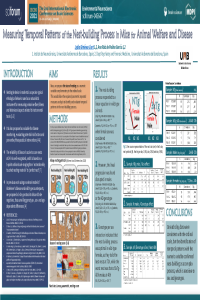
Nesting behavior in rodents is a species-typical ethological behavior used as a naturalistic instrument for measuring animal welfare/illness and behavioral aspects related to instrumental tasks. It is also proposed as valuable for disease monitoring, evaluating potential risk factors and preventive/therapeutical interventions. The reliability of Deacon’s scale to score nests at 24 h is well-recognized, and it is based on a 5-point ordinal scale ranging from 'not noticeably touched nesting material' to 'perfect nest'. In previous work using an animal model of Alzheimer's disease and wild-type counterparts, we proposed a 3-day protocol to discard false negatives, thus unveiling genotype-, sex- and age-dependent differences. Now, we propose the size of nesting as a numeric variable complementary to the ordinal scale. This would allow the required parametric repeated measures analysis to identify and evaluate temporal patterns in the nest-building process. For this purpose, nests of male and female mice with normal (C57BL/6) and AD-pathological aging were measured using paper nesting material and our 3-days protocol. The results showed that the nest-building process responded to a linear equation in wild-type animals or when female sex was considered. However, the lineal progression was found disrupted in males or the AD-genotype. Genotype per sex interaction indicated that the nest-building process was optimal in wild-type females, as they build the best nests at 72h. On each day, data were consistent with the ordinal scale, but the identification of temporal patterns with the numeric variable confirmed nest-building as a complex process, which is sensitive to sex and genotype.
Keywords
Environment
Social
Nesting
Daily life activities
Animal welfare
Disease Monitoring Aging
Manuscript
sciforum-045647.pdf
Poster
Poster Sciforum 045647 NESTING 1 Temporal patterns Gimenez-Llort submitted 30MAY 2021.pdf
High definition tDCS effect on postural control in healthy individuals: entropy analysis of a crossover clinical trial