Event submissions
EventsThe 2nd International Electronic Conference on Forests — Sustainable Forests: Ecology, Management, Products and Trade
Published

This submission belongs to the session PS. Poster Session of the event The 2nd International Electronic Conference on Forests — Sustainable Forests: Ecology, Management, Products and Trade
Published date
31 Aug, 2021
Academic Editor
'%3e%3cpath%20d='M12.6657%2010.9104C12.4185%2010.325%2012.0599%209.79327%2011.6097%209.34482C11.1609%208.89508%2010.6293%208.5365%2010.0442%208.28888C10.0389%208.28626%2010.0337%208.28495%2010.0285%208.28233C10.8446%207.69279%2011.3752%206.73249%2011.3752%205.64904C11.3752%203.8542%209.92103%202.39999%208.1262%202.39999C6.33136%202.39999%204.87715%203.8542%204.87715%205.64904C4.87715%206.73249%205.40774%207.69279%206.22393%208.28364C6.21869%208.28626%206.21345%208.28757%206.20821%208.29019C5.62129%208.5378%205.09463%208.89284%204.64265%209.34613C4.1929%209.79493%203.83432%2010.3266%203.58671%2010.9117C3.34345%2011.4845%203.21226%2012.0987%203.20023%2012.7209C3.19988%2012.7349%203.20233%2012.7488%203.20744%2012.7619C3.21255%2012.7749%203.22022%2012.7867%203.22998%2012.7968C3.23975%2012.8068%203.25142%2012.8147%203.26431%2012.8202C3.2772%2012.8256%203.29105%2012.8284%203.30504%2012.8284H4.09109C4.14874%2012.8284%204.19459%2012.7825%204.1959%2012.7262C4.2221%2011.7148%204.62823%2010.7676%205.34617%2010.0497C6.08899%209.30683%207.0755%208.89808%208.1262%208.89808C9.17689%208.89808%2010.1634%209.30683%2010.9062%2010.0497C11.6242%2010.7676%2012.0303%2011.7148%2012.0565%2012.7262C12.0578%2012.7838%2012.1037%2012.8284%2012.1613%2012.8284H12.9474C12.9613%2012.8284%2012.9752%2012.8256%2012.9881%2012.8202C13.001%2012.8147%2013.0126%2012.8068%2013.0224%2012.7968C13.0322%2012.7867%2013.0398%2012.7749%2013.0449%2012.7619C13.0501%2012.7488%2013.0525%2012.7349%2013.0522%2012.7209C13.0391%2012.0947%2012.9094%2011.4855%2012.6657%2010.9104ZM8.1262%207.9024C7.52486%207.9024%206.9589%207.6679%206.53312%207.24211C6.10733%206.81633%205.87283%206.25037%205.87283%205.64904C5.87283%205.0477%206.10733%204.48174%206.53312%204.05596C6.9589%203.63018%207.52486%203.39567%208.1262%203.39567C8.72753%203.39567%209.29349%203.63018%209.71927%204.05596C10.1451%204.48174%2010.3796%205.0477%2010.3796%205.64904C10.3796%206.25037%2010.1451%206.81633%209.71927%207.24211C9.29349%207.6679%208.72753%207.9024%208.1262%207.9024Z'%20fill='%235D1EE1'/%3e%3c/g%3e%3c/svg%3e) Lotus Guo
Lotus GuoCitation
Michele Antonelli, Davide Donelli, Valentina Maggini, Fabio Firenzuoli, Emanuela Bedeschi, Forest exposure and respiratory function: a literature review, in Proceedings of The 2nd International Electronic Conference on Forests — Sustainable Forests: Ecology, Management, Products and Trade, 1 September–15 September 2021, MDPI: Basel, Switzerland, doi: 10.3390/IECF2021-10782
Share
Email
Facebook
Twitter
LinkedIn
Forest exposure and respiratory function: a literature review

Michele Antonelli 1

Davide Donelli 2
'%3e%3cpath%20d='M12.6647%2010.9104C12.4176%2010.325%2012.0589%209.7933%2011.6088%209.34485C11.16%208.89511%2010.6283%208.53653%2010.0432%208.28891C10.038%208.28629%2010.0327%208.28498%2010.0275%208.28236C10.8437%207.69282%2011.3743%206.73252%2011.3743%205.64907C11.3743%203.85423%209.92005%202.40002%208.12522%202.40002C6.33038%202.40002%204.87618%203.85423%204.87618%205.64907C4.87618%206.73252%205.40677%207.69282%206.22296%208.28367C6.21772%208.28629%206.21248%208.2876%206.20724%208.29022C5.62031%208.53783%205.09365%208.89287%204.64167%209.34616C4.19192%209.79496%203.83334%2010.3266%203.58573%2010.9117C3.34247%2011.4846%203.21128%2012.0987%203.19925%2012.721C3.1989%2012.735%203.20135%2012.7489%203.20646%2012.7619C3.21157%2012.7749%203.21924%2012.7868%203.22901%2012.7968C3.23877%2012.8068%203.25045%2012.8148%203.26334%2012.8202C3.27623%2012.8256%203.29007%2012.8284%203.30406%2012.8284H4.09012C4.14776%2012.8284%204.19362%2012.7825%204.19493%2012.7262C4.22113%2011.7148%204.62726%2010.7676%205.34519%2010.0497C6.08802%209.30686%207.07452%208.89811%208.12522%208.89811C9.17592%208.89811%2010.1624%209.30686%2010.9052%2010.0497C11.6232%2010.7676%2012.0293%2011.7148%2012.0555%2012.7262C12.0568%2012.7839%2012.1027%2012.8284%2012.1603%2012.8284H12.9464C12.9604%2012.8284%2012.9742%2012.8256%2012.9871%2012.8202C13%2012.8148%2013.0117%2012.8068%2013.0214%2012.7968C13.0312%2012.7868%2013.0389%2012.7749%2013.044%2012.7619C13.0491%2012.7489%2013.0515%2012.735%2013.0512%2012.721C13.0381%2012.0947%2012.9084%2011.4856%2012.6647%2010.9104ZM8.12522%207.90243C7.52388%207.90243%206.95792%207.66793%206.53214%207.24215C6.10636%206.81636%205.87185%206.2504%205.87185%205.64907C5.87185%205.04773%206.10636%204.48177%206.53214%204.05599C6.95792%203.63021%207.52388%203.3957%208.12522%203.3957C8.72655%203.3957%209.29252%203.63021%209.7183%204.05599C10.1441%204.48177%2010.3786%205.04773%2010.3786%205.64907C10.3786%206.2504%2010.1441%206.81636%209.7183%207.24215C9.29252%207.66793%208.72655%207.90243%208.12522%207.90243Z'%20fill='%235D1EE1'/%3e%3c/g%3e%3c/svg%3e)
Valentina Maggini 3
Fabio Firenzuoli 3
Emanuela Bedeschi 2
1. Department of Public Health, AUSL-IRCCS of Reggio Emilia, Reggio Emilia (Italy)
2. AUSL-IRCCS Reggio Emilia (Italy)
3. CERFIT, Careggi University Hospital, Florence (Italy)
Abstract
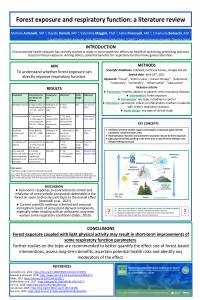
Introduction. Environmental health research has recently started to study the effects on health of well-being promoting practices based on forest exposure. This review aims to understand whether forest exposure can directly improve respiratory function.
Methods. This study was designed as a narrative literature review. PubMed, Cochrane Library and Google Scholar were searched up to April 2021 for clinical studies about changes of respiratory function induced by forest exposure and preferably measured with spirometry. Relevant evidence was summarized and critically discussed.
Results. Five studies were included in this review (three trials, an observational study and a case report). Globally, forest exposure seems to be associated with improved Forced Expiratory Volume (FEV), Peak Expiratory Flow (PEF) and Forced Vital Capacity (FVC). In most included studies, exposure time was at least 1 hour and sessions were repeated over time. Study participants were either healthy subjects or patients with respiratory diseases. Benefits were reported even in terms of inflammatory markers and were detected in children, adults and elderly individuals of both genders. The number of participants per study ranged from 1 to 65.
Discussion. Forest exposure coupled with light physical activity may result in short-term improvements of some respiratory function parameters (FEV1, FEV6, PEF, FVC). Autonomic responses to environmental stimuli and inhalation of some volatile compounds detectable in the forest air seem to directly contribute to the overall effect, which may be enhanced around waterfalls and creeks due to water nebulization. However, current scientific evidence is limited and high atmospheric levels of some plant-derived compounds, especially when reacting with air pollutants, may even worsen some respiratory conditions. Further studies on the topic are recommended to better quantify the effects size of forest-based interventions, assess long-term benefits, ascertain potential health risks and identify any moderators of the effect or confounding factors.
Keywords
Forest exposure
Shinrin-yoku
Respiratory function
Spirometry
Environmental health
Review
Manuscript
sciforum_046336_layout MODIFIED-revised.pdf
Poster
Forest exposure and respiratory health POSTER.pdf
Anatomical variability of Pinus brutia Ten. essential oils
Ayous Wood (Triplochiton scleroxylon K. Schum) physical characterisation after three different cycles of heat treatment