Event submissions
EventsThe 2nd International Electronic Conference on Forests — Sustainable Forests: Ecology, Management, Products and Trade
Published

This submission belongs to the session PS. Poster Session of the event The 2nd International Electronic Conference on Forests — Sustainable Forests: Ecology, Management, Products and Trade
Published date
31 Aug, 2021
Academic Editor
'%3e%3cpath%20d='M12.6657%2010.9104C12.4185%2010.325%2012.0599%209.79327%2011.6097%209.34482C11.1609%208.89508%2010.6293%208.5365%2010.0442%208.28888C10.0389%208.28626%2010.0337%208.28495%2010.0285%208.28233C10.8446%207.69279%2011.3752%206.73249%2011.3752%205.64904C11.3752%203.8542%209.92103%202.39999%208.1262%202.39999C6.33136%202.39999%204.87715%203.8542%204.87715%205.64904C4.87715%206.73249%205.40774%207.69279%206.22393%208.28364C6.21869%208.28626%206.21345%208.28757%206.20821%208.29019C5.62129%208.5378%205.09463%208.89284%204.64265%209.34613C4.1929%209.79493%203.83432%2010.3266%203.58671%2010.9117C3.34345%2011.4845%203.21226%2012.0987%203.20023%2012.7209C3.19988%2012.7349%203.20233%2012.7488%203.20744%2012.7619C3.21255%2012.7749%203.22022%2012.7867%203.22998%2012.7968C3.23975%2012.8068%203.25142%2012.8147%203.26431%2012.8202C3.2772%2012.8256%203.29105%2012.8284%203.30504%2012.8284H4.09109C4.14874%2012.8284%204.19459%2012.7825%204.1959%2012.7262C4.2221%2011.7148%204.62823%2010.7676%205.34617%2010.0497C6.08899%209.30683%207.0755%208.89808%208.1262%208.89808C9.17689%208.89808%2010.1634%209.30683%2010.9062%2010.0497C11.6242%2010.7676%2012.0303%2011.7148%2012.0565%2012.7262C12.0578%2012.7838%2012.1037%2012.8284%2012.1613%2012.8284H12.9474C12.9613%2012.8284%2012.9752%2012.8256%2012.9881%2012.8202C13.001%2012.8147%2013.0126%2012.8068%2013.0224%2012.7968C13.0322%2012.7867%2013.0398%2012.7749%2013.0449%2012.7619C13.0501%2012.7488%2013.0525%2012.7349%2013.0522%2012.7209C13.0391%2012.0947%2012.9094%2011.4855%2012.6657%2010.9104ZM8.1262%207.9024C7.52486%207.9024%206.9589%207.6679%206.53312%207.24211C6.10733%206.81633%205.87283%206.25037%205.87283%205.64904C5.87283%205.0477%206.10733%204.48174%206.53312%204.05596C6.9589%203.63018%207.52486%203.39567%208.1262%203.39567C8.72753%203.39567%209.29349%203.63018%209.71927%204.05596C10.1451%204.48174%2010.3796%205.0477%2010.3796%205.64904C10.3796%206.25037%2010.1451%206.81633%209.71927%207.24211C9.29349%207.6679%208.72753%207.9024%208.1262%207.9024Z'%20fill='%235D1EE1'/%3e%3c/g%3e%3c/svg%3e) Lotus Guo
Lotus GuoCitation
George T. Tziros, Ink disease of European chestnut and distribution of associated Phytophthora species in Greece, in Proceedings of The 2nd International Electronic Conference on Forests — Sustainable Forests: Ecology, Management, Products and Trade, 1 September–15 September 2021, MDPI: Basel, Switzerland, doi: 10.3390/IECF2021-10788
Share
Email
Facebook
Twitter
LinkedIn
Ink disease of European chestnut and distribution of associated Phytophthora species in Greece
'%3e%3cpath%20d='M12.6647%2010.9104C12.4176%2010.325%2012.0589%209.7933%2011.6088%209.34485C11.16%208.89511%2010.6283%208.53653%2010.0432%208.28891C10.038%208.28629%2010.0327%208.28498%2010.0275%208.28236C10.8437%207.69282%2011.3743%206.73252%2011.3743%205.64907C11.3743%203.85423%209.92005%202.40002%208.12522%202.40002C6.33038%202.40002%204.87618%203.85423%204.87618%205.64907C4.87618%206.73252%205.40677%207.69282%206.22296%208.28367C6.21772%208.28629%206.21248%208.2876%206.20724%208.29022C5.62031%208.53783%205.09365%208.89287%204.64167%209.34616C4.19192%209.79496%203.83334%2010.3266%203.58573%2010.9117C3.34247%2011.4846%203.21128%2012.0987%203.19925%2012.721C3.1989%2012.735%203.20135%2012.7489%203.20646%2012.7619C3.21157%2012.7749%203.21924%2012.7868%203.22901%2012.7968C3.23877%2012.8068%203.25045%2012.8148%203.26334%2012.8202C3.27623%2012.8256%203.29007%2012.8284%203.30406%2012.8284H4.09012C4.14776%2012.8284%204.19362%2012.7825%204.19493%2012.7262C4.22113%2011.7148%204.62726%2010.7676%205.34519%2010.0497C6.08802%209.30686%207.07452%208.89811%208.12522%208.89811C9.17592%208.89811%2010.1624%209.30686%2010.9052%2010.0497C11.6232%2010.7676%2012.0293%2011.7148%2012.0555%2012.7262C12.0568%2012.7839%2012.1027%2012.8284%2012.1603%2012.8284H12.9464C12.9604%2012.8284%2012.9742%2012.8256%2012.9871%2012.8202C13%2012.8148%2013.0117%2012.8068%2013.0214%2012.7968C13.0312%2012.7868%2013.0389%2012.7749%2013.044%2012.7619C13.0491%2012.7489%2013.0515%2012.735%2013.0512%2012.721C13.0381%2012.0947%2012.9084%2011.4856%2012.6647%2010.9104ZM8.12522%207.90243C7.52388%207.90243%206.95792%207.66793%206.53214%207.24215C6.10636%206.81636%205.87185%206.2504%205.87185%205.64907C5.87185%205.04773%206.10636%204.48177%206.53214%204.05599C6.95792%203.63021%207.52388%203.3957%208.12522%203.3957C8.72655%203.3957%209.29252%203.63021%209.7183%204.05599C10.1441%204.48177%2010.3786%205.04773%2010.3786%205.64907C10.3786%206.2504%2010.1441%206.81636%209.7183%207.24215C9.29252%207.66793%208.72655%207.90243%208.12522%207.90243Z'%20fill='%235D1EE1'/%3e%3c/g%3e%3c/svg%3e)
George T. Tziros 1
1. Aristotle University of Thessaloniki, Faculty of Agriculture, Laboratory of Plant Pathology, 54124, Thessaloniki, Greece.
Abstract
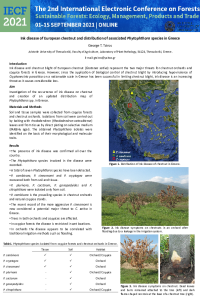
Ink disease and chestnut blight of European chestnut (Castanea sativa) represent the two major threats for chestnut orchards and coppice forests in Greece. However, since the application of biological control of chestnut blight by introducing hypovirulence of Cryphonectria parasitica on a nationwide scale in Greece has been successful in limiting chestnut blight, ink disease is an increasing threat as it causes considerable loss. For this reason, the occurrence of the disease was investigated and an updated distribution map of Phytophthora spp. in Greece has been created. In this study, the presence of ink disease was confirmed all over Greece and the Phytophthora species involved in the disease were recorded. Soil and tissue samples were collected and the obtained Phytophthora isolates were identified on the basis of their morphological and molecular traits. A total of seven species have been detected. P. cambivora, P. cinnamomi and P. cryptogea were recovered both from soil and tissue, while P. plurivora, P. cactorum and P. gonapodyides, P. citrophthora were isolated only from soil. Although P. cambivora is the prevailing species in chestnut orchards and natural coppice stands, the recent record of the more aggressive P. cinnamomi is now considered a potential major threat to C. sativa in Greece. The nationwide distribution of the disease and the severe loss of trees demand the implementation of appropriate control measures. The crucial role played by the irrigation methods used by the chestnut growers is pointed out as the major reason for the emergence of ink disease.
Keywords
Ink disease
Phytophthora spp.
Castanea sativa
Manuscript
sciforum-046839 .pdf
Poster
IECF 2021_Tziros.pdf
Spatial and temporal variation of species composition and structure of unmanaged secondary forest (abandoned satoyama) adjacent to late-successional forest
Quantification of Pinus pinea pinecone productivity using machine learning of UAV and field images