Event submissions
EventsThe 2nd International Electronic Conference on Forests — Sustainable Forests: Ecology, Management, Products and Trade
Published
 10.3390/IECF2021-10817 (registering DOI)
 This submission belongs to the session S1. Forest Ecology and Management of the event The 2nd International Electronic Conference on Forests — Sustainable Forests: Ecology, Management, Products and Trade
Published date
31 Aug, 2021
Academic Editor
'%3e%3cpath%20d='M12.6657%2010.9104C12.4185%2010.325%2012.0599%209.79327%2011.6097%209.34482C11.1609%208.89508%2010.6293%208.5365%2010.0442%208.28888C10.0389%208.28626%2010.0337%208.28495%2010.0285%208.28233C10.8446%207.69279%2011.3752%206.73249%2011.3752%205.64904C11.3752%203.8542%209.92103%202.39999%208.1262%202.39999C6.33136%202.39999%204.87715%203.8542%204.87715%205.64904C4.87715%206.73249%205.40774%207.69279%206.22393%208.28364C6.21869%208.28626%206.21345%208.28757%206.20821%208.29019C5.62129%208.5378%205.09463%208.89284%204.64265%209.34613C4.1929%209.79493%203.83432%2010.3266%203.58671%2010.9117C3.34345%2011.4845%203.21226%2012.0987%203.20023%2012.7209C3.19988%2012.7349%203.20233%2012.7488%203.20744%2012.7619C3.21255%2012.7749%203.22022%2012.7867%203.22998%2012.7968C3.23975%2012.8068%203.25142%2012.8147%203.26431%2012.8202C3.2772%2012.8256%203.29105%2012.8284%203.30504%2012.8284H4.09109C4.14874%2012.8284%204.19459%2012.7825%204.1959%2012.7262C4.2221%2011.7148%204.62823%2010.7676%205.34617%2010.0497C6.08899%209.30683%207.0755%208.89808%208.1262%208.89808C9.17689%208.89808%2010.1634%209.30683%2010.9062%2010.0497C11.6242%2010.7676%2012.0303%2011.7148%2012.0565%2012.7262C12.0578%2012.7838%2012.1037%2012.8284%2012.1613%2012.8284H12.9474C12.9613%2012.8284%2012.9752%2012.8256%2012.9881%2012.8202C13.001%2012.8147%2013.0126%2012.8068%2013.0224%2012.7968C13.0322%2012.7867%2013.0398%2012.7749%2013.0449%2012.7619C13.0501%2012.7488%2013.0525%2012.7349%2013.0522%2012.7209C13.0391%2012.0947%2012.9094%2011.4855%2012.6657%2010.9104ZM8.1262%207.9024C7.52486%207.9024%206.9589%207.6679%206.53312%207.24211C6.10733%206.81633%205.87283%206.25037%205.87283%205.64904C5.87283%205.0477%206.10733%204.48174%206.53312%204.05596C6.9589%203.63018%207.52486%203.39567%208.1262%203.39567C8.72753%203.39567%209.29349%203.63018%209.71927%204.05596C10.1451%204.48174%2010.3796%205.0477%2010.3796%205.64904C10.3796%206.25037%2010.1451%206.81633%209.71927%207.24211C9.29349%207.6679%208.72753%207.9024%208.1262%207.9024Z'%20fill='%235D1EE1'/%3e%3c/g%3e%3c/svg%3e) Lotus Guo
Lotus GuoCitation
Buddhika Madurapperuma, David Greene, Cody Leviloff, Reliable post-fire regeneration of Pinus sabiniana (gray pine), in Proceedings of The 2nd International Electronic Conference on Forests — Sustainable Forests: Ecology, Management, Products and Trade, 1 September–15 September 2021, MDPI: Basel, Switzerland, doi: 10.3390/IECF2021-10817
Share
Email
Facebook
Twitter
LinkedIn
Reliable post-fire regeneration of Pinus sabiniana (gray pine)
'%3e%3cpath%20d='M12.6647%2010.9104C12.4176%2010.325%2012.0589%209.7933%2011.6088%209.34485C11.16%208.89511%2010.6283%208.53653%2010.0432%208.28891C10.038%208.28629%2010.0327%208.28498%2010.0275%208.28236C10.8437%207.69282%2011.3743%206.73252%2011.3743%205.64907C11.3743%203.85423%209.92005%202.40002%208.12522%202.40002C6.33038%202.40002%204.87618%203.85423%204.87618%205.64907C4.87618%206.73252%205.40677%207.69282%206.22296%208.28367C6.21772%208.28629%206.21248%208.2876%206.20724%208.29022C5.62031%208.53783%205.09365%208.89287%204.64167%209.34616C4.19192%209.79496%203.83334%2010.3266%203.58573%2010.9117C3.34247%2011.4846%203.21128%2012.0987%203.19925%2012.721C3.1989%2012.735%203.20135%2012.7489%203.20646%2012.7619C3.21157%2012.7749%203.21924%2012.7868%203.22901%2012.7968C3.23877%2012.8068%203.25045%2012.8148%203.26334%2012.8202C3.27623%2012.8256%203.29007%2012.8284%203.30406%2012.8284H4.09012C4.14776%2012.8284%204.19362%2012.7825%204.19493%2012.7262C4.22113%2011.7148%204.62726%2010.7676%205.34519%2010.0497C6.08802%209.30686%207.07452%208.89811%208.12522%208.89811C9.17592%208.89811%2010.1624%209.30686%2010.9052%2010.0497C11.6232%2010.7676%2012.0293%2011.7148%2012.0555%2012.7262C12.0568%2012.7839%2012.1027%2012.8284%2012.1603%2012.8284H12.9464C12.9604%2012.8284%2012.9742%2012.8256%2012.9871%2012.8202C13%2012.8148%2013.0117%2012.8068%2013.0214%2012.7968C13.0312%2012.7868%2013.0389%2012.7749%2013.044%2012.7619C13.0491%2012.7489%2013.0515%2012.735%2013.0512%2012.721C13.0381%2012.0947%2012.9084%2011.4856%2012.6647%2010.9104ZM8.12522%207.90243C7.52388%207.90243%206.95792%207.66793%206.53214%207.24215C6.10636%206.81636%205.87185%206.2504%205.87185%205.64907C5.87185%205.04773%206.10636%204.48177%206.53214%204.05599C6.95792%203.63021%207.52388%203.3957%208.12522%203.3957C8.72655%203.3957%209.29252%203.63021%209.7183%204.05599C10.1441%204.48177%2010.3786%205.04773%2010.3786%205.64907C10.3786%206.2504%2010.1441%206.81636%209.7183%207.24215C9.29252%207.66793%208.72655%207.90243%208.12522%207.90243Z'%20fill='%235D1EE1'/%3e%3c/g%3e%3c/svg%3e)
Buddhika Madurapperuma 1
David Greene 2
Cody Leviloff 1
1. Department of Forestry & Wildland Resources, Humboldt State University
2. Department of Forestry and Wildland Resources, Humboldt State University
Abstract
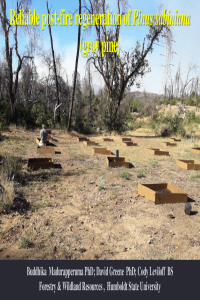
Pinus sabiniana (grey pine), an endemic tree species in California, has been little-studied because of its limited commercial value. This study seeks to understand whether grey pine is capable of behaving as a serotinous species; i.e. one that reliably has viable seeds on hand any time a fire might occur. Repeated field surveys were conducted along HWY 299 to Redding to observe the cone production and scale opening and to estimate post-fire seedling density. We found that (a) the minimum diameter for producing the first cone was about 16 cm (diameter at breast height), and that subsequently trees always initiate cones each year; (b) how by germinating seeds from burned cones in the greenhouse, the flexure is insufficient to release the bulk of their seeds; (c) lacking this protection, all but 8% of the seeds died during passage of the flaming front, as we show by germinating seeds from burned cones in the greenhouse; (d) the wind rather than rodents abscise the burned cones; (e) once on the ground, rodents cache the seeds; (f) the great majority of recruits are found within 20 m of a burnt gray pine, averaging about two regenerating stems per tree; and (g) there is little mortality for a regenerating cohort after the first post-fire summer. We conclude that gray pine reliably self-replaces following fire. While it is possible that all recruits observed in the field represent seeds cached prior to the fire, we think it more likely that the small fraction of seeds surviving the flames are the source of the regeneration.
Financial assistance by Agricultural Research Institute (grant #S4104), and HSU Loyalty Fund (A6735) are gratefully acknowledged.
Keywords
Grey pine
facultative serotiny
cone scale
post-fire
germinants
fire
dispersal
Manuscript
sciforum-047083 abstract layout.pdf
Poster
Post-fire regeneration Madurapperuma et al..pdf
Forest Certification of Non-timber forest products (NTFPs) in India: Study of NTFP harvest of Rhododendrons in Western Himalayas for its Sustainable Use
Forest cover change analysis using remote sensing and its impact on forest sustainability at Fasiakhali Wildlife Sanctuary.