Event submissions
Events1st International Electronic Conference on Molecular Sciences: Druggable Targets of Emerging Infectious Diseases
Published
 10.3390/ECMS2021-10828 (registering DOI)
 This submission belongs to the session S4. Nanoparticles, New Materials and Sustainable Chemistry in Drugs of the event 1st International Electronic Conference on Molecular Sciences: Druggable Targets of Emerging Infectious Diseases
Published date
31 Aug, 2021
Academic Editor
'%3e%3cpath%20d='M12.6657%2010.9104C12.4185%2010.325%2012.0599%209.79327%2011.6097%209.34482C11.1609%208.89508%2010.6293%208.5365%2010.0442%208.28888C10.0389%208.28626%2010.0337%208.28495%2010.0285%208.28233C10.8446%207.69279%2011.3752%206.73249%2011.3752%205.64904C11.3752%203.8542%209.92103%202.39999%208.1262%202.39999C6.33136%202.39999%204.87715%203.8542%204.87715%205.64904C4.87715%206.73249%205.40774%207.69279%206.22393%208.28364C6.21869%208.28626%206.21345%208.28757%206.20821%208.29019C5.62129%208.5378%205.09463%208.89284%204.64265%209.34613C4.1929%209.79493%203.83432%2010.3266%203.58671%2010.9117C3.34345%2011.4845%203.21226%2012.0987%203.20023%2012.7209C3.19988%2012.7349%203.20233%2012.7488%203.20744%2012.7619C3.21255%2012.7749%203.22022%2012.7867%203.22998%2012.7968C3.23975%2012.8068%203.25142%2012.8147%203.26431%2012.8202C3.2772%2012.8256%203.29105%2012.8284%203.30504%2012.8284H4.09109C4.14874%2012.8284%204.19459%2012.7825%204.1959%2012.7262C4.2221%2011.7148%204.62823%2010.7676%205.34617%2010.0497C6.08899%209.30683%207.0755%208.89808%208.1262%208.89808C9.17689%208.89808%2010.1634%209.30683%2010.9062%2010.0497C11.6242%2010.7676%2012.0303%2011.7148%2012.0565%2012.7262C12.0578%2012.7838%2012.1037%2012.8284%2012.1613%2012.8284H12.9474C12.9613%2012.8284%2012.9752%2012.8256%2012.9881%2012.8202C13.001%2012.8147%2013.0126%2012.8068%2013.0224%2012.7968C13.0322%2012.7867%2013.0398%2012.7749%2013.0449%2012.7619C13.0501%2012.7488%2013.0525%2012.7349%2013.0522%2012.7209C13.0391%2012.0947%2012.9094%2011.4855%2012.6657%2010.9104ZM8.1262%207.9024C7.52486%207.9024%206.9589%207.6679%206.53312%207.24211C6.10733%206.81633%205.87283%206.25037%205.87283%205.64904C5.87283%205.0477%206.10733%204.48174%206.53312%204.05596C6.9589%203.63018%207.52486%203.39567%208.1262%203.39567C8.72753%203.39567%209.29349%203.63018%209.71927%204.05596C10.1451%204.48174%2010.3796%205.0477%2010.3796%205.64904C10.3796%206.25037%2010.1451%206.81633%209.71927%207.24211C9.29349%207.6679%208.72753%207.9024%208.1262%207.9024Z'%20fill='%235D1EE1'/%3e%3c/g%3e%3c/svg%3e) Clemente Capasso
Clemente CapassoCitation
Marta Teixeira, Joana C. Antunes, Shafagh D. Tohidi, M. Teresa P. Amorim, Diana P. Ferreira, Helena P. Felgueiras, Antimicrobial evaluation of the synergisms of Tiger 17 and pexiganan peptides while loaded onto PVA-based electrospun mats for potential wound care applications, in Proceedings of 1st International Electronic Conference on Molecular Sciences: Druggable Targets of Emerging Infectious Diseases, 1 September–14 September 2021, MDPI: Basel, Switzerland, doi: 10.3390/ECMS2021-10828
Share
Email
Facebook
Twitter
LinkedIn
Antimicrobial evaluation of the synergisms of Tiger 17 and pexiganan peptides while loaded onto PVA-based electrospun mats for potential wound care applications
'%3e%3cpath%20d='M12.6647%2010.9104C12.4176%2010.325%2012.0589%209.7933%2011.6088%209.34485C11.16%208.89511%2010.6283%208.53653%2010.0432%208.28891C10.038%208.28629%2010.0327%208.28498%2010.0275%208.28236C10.8437%207.69282%2011.3743%206.73252%2011.3743%205.64907C11.3743%203.85423%209.92005%202.40002%208.12522%202.40002C6.33038%202.40002%204.87618%203.85423%204.87618%205.64907C4.87618%206.73252%205.40677%207.69282%206.22296%208.28367C6.21772%208.28629%206.21248%208.2876%206.20724%208.29022C5.62031%208.53783%205.09365%208.89287%204.64167%209.34616C4.19192%209.79496%203.83334%2010.3266%203.58573%2010.9117C3.34247%2011.4846%203.21128%2012.0987%203.19925%2012.721C3.1989%2012.735%203.20135%2012.7489%203.20646%2012.7619C3.21157%2012.7749%203.21924%2012.7868%203.22901%2012.7968C3.23877%2012.8068%203.25045%2012.8148%203.26334%2012.8202C3.27623%2012.8256%203.29007%2012.8284%203.30406%2012.8284H4.09012C4.14776%2012.8284%204.19362%2012.7825%204.19493%2012.7262C4.22113%2011.7148%204.62726%2010.7676%205.34519%2010.0497C6.08802%209.30686%207.07452%208.89811%208.12522%208.89811C9.17592%208.89811%2010.1624%209.30686%2010.9052%2010.0497C11.6232%2010.7676%2012.0293%2011.7148%2012.0555%2012.7262C12.0568%2012.7839%2012.1027%2012.8284%2012.1603%2012.8284H12.9464C12.9604%2012.8284%2012.9742%2012.8256%2012.9871%2012.8202C13%2012.8148%2013.0117%2012.8068%2013.0214%2012.7968C13.0312%2012.7868%2013.0389%2012.7749%2013.044%2012.7619C13.0491%2012.7489%2013.0515%2012.735%2013.0512%2012.721C13.0381%2012.0947%2012.9084%2011.4856%2012.6647%2010.9104ZM8.12522%207.90243C7.52388%207.90243%206.95792%207.66793%206.53214%207.24215C6.10636%206.81636%205.87185%206.2504%205.87185%205.64907C5.87185%205.04773%206.10636%204.48177%206.53214%204.05599C6.95792%203.63021%207.52388%203.3957%208.12522%203.3957C8.72655%203.3957%209.29252%203.63021%209.7183%204.05599C10.1441%204.48177%2010.3786%205.04773%2010.3786%205.64907C10.3786%206.2504%2010.1441%206.81636%209.7183%207.24215C9.29252%207.66793%208.72655%207.90243%208.12522%207.90243Z'%20fill='%235D1EE1'/%3e%3c/g%3e%3c/svg%3e)
Marta Teixeira 1,2

Joana C. Antunes 2
Shafagh D. Tohidi 3
M. Teresa P. Amorim 4

Diana P. Ferreira 2

Helena P. Felgueiras 2
1. University of Minho
2. Centre for Textile Science and Technology (2C2T), University of Minho, Campus ed Azurém 4800-058 Guimarães, Portugal
3. Digital transformation colab (DTX), Department of Mechanical Engineering, University of Minho, Campus of Azurém, 4800-058 Guimarães, Portugal
4. Centre for Textile Science and Technology, University of Minho
Abstract
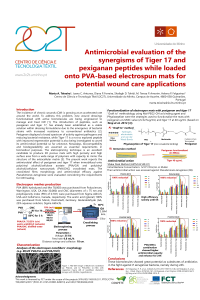
The incidence of chronic wounds (CW) is growing at an accelerated rate around the world, becoming a huge burden on healthcare and social systems. CW are characterized for failing to progress through the orderly phases of the healing process, establishing in a self-perpetuating inflammatory stage getting predisposed to infections, resulting in long-term morbidity and mortality. To address this problem, wound dressings with a new intricated nano-architecture and functionalized with active biomolecules are being developed to treat CW. The introduction of peptides with renown antimicrobial capacities, as pexiganan (or MSI-78), which display a broad spectrum of antibacterial activity and capacity to reduce bacterial resistance, has been considered a viable solution. Tiger 17, a not so explored peptide with improved regenerative potential is also being investigated to unveil its antimicrobial potential so far unknown. In this study, combinations of poly(vinyl alcohol) (PVA) and cellulosic compounds, such as cellulose acetate (CA) and cellulose nanocrystalline (CNC), were processed via electrospinning to give rise to porous, highlight intricate and flexible, biocompatible, biodegradable, and mechanically stable mats and, then, modified with combinations of pexiganan and Tiger 17. PVA/CA and PVA/CNC mats were prepared at different ratios and submitted to crosslinking process to avoid their instant solubilization in aqueous media. Antimicrobial efficacy of pexiganan and Tiger 17 was evaluated against Pseudomonas aeruginosa. The biomolecules were initially screened for their antibacterial efficacy by the determination of minimal inhibitory concentrations (MICs). Mats were modified with pexiganan at 2xMIC (60 µg/mL) and with Tiger 17 at twice the concentration required to induce regenerative effects (40 µg/mL). The Mal-PEG2-OH spacer was used as a binding agent. Data revealed the ability of the peptide-modified surfaces to fight P. aeruginosa infection above the unaltered mats, demonstrating the potential of this strategy for CW care.
Keywords
Antimicrobial peptides
infections control
biodegradable polymers
wound healing
Manuscript
sciforum-047258.pdf
Poster
ECMS Conference Poster PDF.pdf
Essential oils active against Anisakis nematode larvae
NP Navigator: a New Look at the Natural Products Chemical Space