Event submissions
Events1st International Electronic Conference on Molecular Sciences: Druggable Targets of Emerging Infectious Diseases
Published

This submission belongs to the session S3. Natural Products and Synthetic Derivatives in Anti-Infective Drug Design of the event 1st International Electronic Conference on Molecular Sciences: Druggable Targets of Emerging Infectious Diseases
Published date
31 Aug, 2021
Academic Editor
'%3e%3cpath%20d='M12.6657%2010.9104C12.4185%2010.325%2012.0599%209.79327%2011.6097%209.34482C11.1609%208.89508%2010.6293%208.5365%2010.0442%208.28888C10.0389%208.28626%2010.0337%208.28495%2010.0285%208.28233C10.8446%207.69279%2011.3752%206.73249%2011.3752%205.64904C11.3752%203.8542%209.92103%202.39999%208.1262%202.39999C6.33136%202.39999%204.87715%203.8542%204.87715%205.64904C4.87715%206.73249%205.40774%207.69279%206.22393%208.28364C6.21869%208.28626%206.21345%208.28757%206.20821%208.29019C5.62129%208.5378%205.09463%208.89284%204.64265%209.34613C4.1929%209.79493%203.83432%2010.3266%203.58671%2010.9117C3.34345%2011.4845%203.21226%2012.0987%203.20023%2012.7209C3.19988%2012.7349%203.20233%2012.7488%203.20744%2012.7619C3.21255%2012.7749%203.22022%2012.7867%203.22998%2012.7968C3.23975%2012.8068%203.25142%2012.8147%203.26431%2012.8202C3.2772%2012.8256%203.29105%2012.8284%203.30504%2012.8284H4.09109C4.14874%2012.8284%204.19459%2012.7825%204.1959%2012.7262C4.2221%2011.7148%204.62823%2010.7676%205.34617%2010.0497C6.08899%209.30683%207.0755%208.89808%208.1262%208.89808C9.17689%208.89808%2010.1634%209.30683%2010.9062%2010.0497C11.6242%2010.7676%2012.0303%2011.7148%2012.0565%2012.7262C12.0578%2012.7838%2012.1037%2012.8284%2012.1613%2012.8284H12.9474C12.9613%2012.8284%2012.9752%2012.8256%2012.9881%2012.8202C13.001%2012.8147%2013.0126%2012.8068%2013.0224%2012.7968C13.0322%2012.7867%2013.0398%2012.7749%2013.0449%2012.7619C13.0501%2012.7488%2013.0525%2012.7349%2013.0522%2012.7209C13.0391%2012.0947%2012.9094%2011.4855%2012.6657%2010.9104ZM8.1262%207.9024C7.52486%207.9024%206.9589%207.6679%206.53312%207.24211C6.10733%206.81633%205.87283%206.25037%205.87283%205.64904C5.87283%205.0477%206.10733%204.48174%206.53312%204.05596C6.9589%203.63018%207.52486%203.39567%208.1262%203.39567C8.72753%203.39567%209.29349%203.63018%209.71927%204.05596C10.1451%204.48174%2010.3796%205.0477%2010.3796%205.64904C10.3796%206.25037%2010.1451%206.81633%209.71927%207.24211C9.29349%207.6679%208.72753%207.9024%208.1262%207.9024Z'%20fill='%235D1EE1'/%3e%3c/g%3e%3c/svg%3e) Clemente Capasso
Clemente CapassoCitation
Irina V. Il'ina, Oksana Stanialavovna Patrusheva, Vladimir Viktorovich Zarubaev, Konstantin Petrovich Volcho, Nariman Faridovich Salakhutdinov, F- and OH-containing isopulegol-derived octahydro-2H-chromenes as agents against influenza A virus, in Proceedings of 1st International Electronic Conference on Molecular Sciences: Druggable Targets of Emerging Infectious Diseases, 1 September–14 September 2021, MDPI: Basel, Switzerland, doi: 10.3390/ECMS2021-10836
Share
Email
Facebook
Twitter
LinkedIn
F- and OH-containing isopulegol-derived octahydro-2H-chromenes as agents against influenza A virus
'%3e%3cpath%20d='M12.6647%2010.9104C12.4176%2010.325%2012.0589%209.7933%2011.6088%209.34485C11.16%208.89511%2010.6283%208.53653%2010.0432%208.28891C10.038%208.28629%2010.0327%208.28498%2010.0275%208.28236C10.8437%207.69282%2011.3743%206.73252%2011.3743%205.64907C11.3743%203.85423%209.92005%202.40002%208.12522%202.40002C6.33038%202.40002%204.87618%203.85423%204.87618%205.64907C4.87618%206.73252%205.40677%207.69282%206.22296%208.28367C6.21772%208.28629%206.21248%208.2876%206.20724%208.29022C5.62031%208.53783%205.09365%208.89287%204.64167%209.34616C4.19192%209.79496%203.83334%2010.3266%203.58573%2010.9117C3.34247%2011.4846%203.21128%2012.0987%203.19925%2012.721C3.1989%2012.735%203.20135%2012.7489%203.20646%2012.7619C3.21157%2012.7749%203.21924%2012.7868%203.22901%2012.7968C3.23877%2012.8068%203.25045%2012.8148%203.26334%2012.8202C3.27623%2012.8256%203.29007%2012.8284%203.30406%2012.8284H4.09012C4.14776%2012.8284%204.19362%2012.7825%204.19493%2012.7262C4.22113%2011.7148%204.62726%2010.7676%205.34519%2010.0497C6.08802%209.30686%207.07452%208.89811%208.12522%208.89811C9.17592%208.89811%2010.1624%209.30686%2010.9052%2010.0497C11.6232%2010.7676%2012.0293%2011.7148%2012.0555%2012.7262C12.0568%2012.7839%2012.1027%2012.8284%2012.1603%2012.8284H12.9464C12.9604%2012.8284%2012.9742%2012.8256%2012.9871%2012.8202C13%2012.8148%2013.0117%2012.8068%2013.0214%2012.7968C13.0312%2012.7868%2013.0389%2012.7749%2013.044%2012.7619C13.0491%2012.7489%2013.0515%2012.735%2013.0512%2012.721C13.0381%2012.0947%2012.9084%2011.4856%2012.6647%2010.9104ZM8.12522%207.90243C7.52388%207.90243%206.95792%207.66793%206.53214%207.24215C6.10636%206.81636%205.87185%206.2504%205.87185%205.64907C5.87185%205.04773%206.10636%204.48177%206.53214%204.05599C6.95792%203.63021%207.52388%203.3957%208.12522%203.3957C8.72655%203.3957%209.29252%203.63021%209.7183%204.05599C10.1441%204.48177%2010.3786%205.04773%2010.3786%205.64907C10.3786%206.2504%2010.1441%206.81636%209.7183%207.24215C9.29252%207.66793%208.72655%207.90243%208.12522%207.90243Z'%20fill='%235D1EE1'/%3e%3c/g%3e%3c/svg%3e)
Irina V. Il'ina 1
Oksana Stanialavovna Patrusheva 1
Vladimir Viktorovich Zarubaev 2

Konstantin Petrovich Volcho 1
Nariman Faridovich Salakhutdinov 1
1. Novosibirsk Institute of Organic Chemistry, Siberian Branch of the Russian Academy of Sciences, Lavrentjev av.9, 630090, Novosibirsk, Russia
2. Pasteur Institute of Epidemiology and Microbiology, 14 Mira str., 197101 St. Petersburg, Russia
Abstract
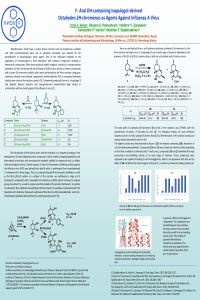
Monoterpenes, which have a unique diverse structure and are inexpensive, available and often enantiomerically pure, are an attractive renewable raw material for the development of physiologically active agents. One of the important methods to the utilization of monoterpenes is their interaction with carbonyl compounds resulting in heterocyclic compounds. Often these products exhibit analgesic, antiviral or neuroprotective properties. Earlier, we discovered anti-influenza A (H1N1) virus activity of several compounds with a hydro-2H-chromene scaffold, which were synthesized by the Prins reaction using p-menthane alcohols and carbonyl compounds; montmorillonite K10 or nanosized halloysite catalyst were used as the reaction catalysts [1]. Chromenols produced from an (–)-isopulegol and aliphatic ketones (acetone and cyclopentanone) demonstrated high activity in combination with low toxicity against the influenza virus [1].
The introduction of the fluorine atom into the molecule is an important strategy in the development of new biologically active compounds, which enables changing lipophilicity and electrostatic interactions and increasing the metabolic stability of compounds and, so affects their physiological activity. Here we synthesized fluoro- and hydroxy-containing octahydro-2H-chromenes by the Prins reaction starting from an (–)-isopulegol and a wide range of aromatic aldehydes in the presence of the BF3∙Et2O/H2O system acting as both an acid catalyst and a fluorine source. Activity of the synthesized compounds against the influenza A/Puerto Rico/8/34 (H1N1) virus was studied. The highest activity was demonstrated by fluoro- and hydroxy-containing 2,4,6-trimethoxybenzaldehyde derivatives. These compounds were supposed to be capable of binding to viral hemagglutinin, which is an agreement with data on the effect of compounds on the viral fusogenic activity as well as with molecular docking studies.
[1] N.Salakhutdinov, K.Volcho, O.Yarovaya, Pure Appl. Chem., 2017;89:1105-1117.
Keywords
Influenza
Antiviral
Fluorine
Monoterpene
Chromene
Manuscript
sciforum-047729.pdf
Poster
ECMS 2021 poster I.V. Ilyna-1.pdf
LAG-3 role in infection
Evaluation of essential oil-loaded nanofibrous mats against the Escherichia virus MS2, a mimic of SARS-CoV-2, for prospetive personal protective equipment uses