Event submissions
Published
 10.3390/ECCM-10867 (registering DOI)
 This submission belongs to the session 17. Poster of the event The 1st International Electronic Conference on Clinical Medicine
Published date
15 Sep, 2021
Academic Editor
'%3e%3cpath%20d='M12.6657%2010.9104C12.4185%2010.325%2012.0599%209.79327%2011.6097%209.34482C11.1609%208.89508%2010.6293%208.5365%2010.0442%208.28888C10.0389%208.28626%2010.0337%208.28495%2010.0285%208.28233C10.8446%207.69279%2011.3752%206.73249%2011.3752%205.64904C11.3752%203.8542%209.92103%202.39999%208.1262%202.39999C6.33136%202.39999%204.87715%203.8542%204.87715%205.64904C4.87715%206.73249%205.40774%207.69279%206.22393%208.28364C6.21869%208.28626%206.21345%208.28757%206.20821%208.29019C5.62129%208.5378%205.09463%208.89284%204.64265%209.34613C4.1929%209.79493%203.83432%2010.3266%203.58671%2010.9117C3.34345%2011.4845%203.21226%2012.0987%203.20023%2012.7209C3.19988%2012.7349%203.20233%2012.7488%203.20744%2012.7619C3.21255%2012.7749%203.22022%2012.7867%203.22998%2012.7968C3.23975%2012.8068%203.25142%2012.8147%203.26431%2012.8202C3.2772%2012.8256%203.29105%2012.8284%203.30504%2012.8284H4.09109C4.14874%2012.8284%204.19459%2012.7825%204.1959%2012.7262C4.2221%2011.7148%204.62823%2010.7676%205.34617%2010.0497C6.08899%209.30683%207.0755%208.89808%208.1262%208.89808C9.17689%208.89808%2010.1634%209.30683%2010.9062%2010.0497C11.6242%2010.7676%2012.0303%2011.7148%2012.0565%2012.7262C12.0578%2012.7838%2012.1037%2012.8284%2012.1613%2012.8284H12.9474C12.9613%2012.8284%2012.9752%2012.8256%2012.9881%2012.8202C13.001%2012.8147%2013.0126%2012.8068%2013.0224%2012.7968C13.0322%2012.7867%2013.0398%2012.7749%2013.0449%2012.7619C13.0501%2012.7488%2013.0525%2012.7349%2013.0522%2012.7209C13.0391%2012.0947%2012.9094%2011.4855%2012.6657%2010.9104ZM8.1262%207.9024C7.52486%207.9024%206.9589%207.6679%206.53312%207.24211C6.10733%206.81633%205.87283%206.25037%205.87283%205.64904C5.87283%205.0477%206.10733%204.48174%206.53312%204.05596C6.9589%203.63018%207.52486%203.39567%208.1262%203.39567C8.72753%203.39567%209.29349%203.63018%209.71927%204.05596C10.1451%204.48174%2010.3796%205.0477%2010.3796%205.64904C10.3796%206.25037%2010.1451%206.81633%209.71927%207.24211C9.29349%207.6679%208.72753%207.9024%208.1262%207.9024Z'%20fill='%235D1EE1'/%3e%3c/g%3e%3c/svg%3e) Iris Wu
Iris WuCitation
Natália Homem, Tânia D. Tavares, Catarina S. Miranda, Joana C. Antunes, M. Teresa P. Amorim, Helena P. Felgueiras, In vitro analysis of Nisin Z-loaded biodegradable wet-spun fibers: controlled release for the inhibition of Staphylococcus aureus, in Proceedings of The 1st International Electronic Conference on Clinical Medicine, 15 September–30 September 2021, MDPI: Basel, Switzerland, doi: 10.3390/ECCM-10867
Share
Email
Facebook
Twitter
LinkedIn
In vitro analysis of Nisin Z-loaded biodegradable wet-spun fibers: controlled release for the inhibition of Staphylococcus aureus

Natália Homem 1
'%3e%3cpath%20d='M12.6647%2010.9104C12.4176%2010.325%2012.0589%209.7933%2011.6088%209.34485C11.16%208.89511%2010.6283%208.53653%2010.0432%208.28891C10.038%208.28629%2010.0327%208.28498%2010.0275%208.28236C10.8437%207.69282%2011.3743%206.73252%2011.3743%205.64907C11.3743%203.85423%209.92005%202.40002%208.12522%202.40002C6.33038%202.40002%204.87618%203.85423%204.87618%205.64907C4.87618%206.73252%205.40677%207.69282%206.22296%208.28367C6.21772%208.28629%206.21248%208.2876%206.20724%208.29022C5.62031%208.53783%205.09365%208.89287%204.64167%209.34616C4.19192%209.79496%203.83334%2010.3266%203.58573%2010.9117C3.34247%2011.4846%203.21128%2012.0987%203.19925%2012.721C3.1989%2012.735%203.20135%2012.7489%203.20646%2012.7619C3.21157%2012.7749%203.21924%2012.7868%203.22901%2012.7968C3.23877%2012.8068%203.25045%2012.8148%203.26334%2012.8202C3.27623%2012.8256%203.29007%2012.8284%203.30406%2012.8284H4.09012C4.14776%2012.8284%204.19362%2012.7825%204.19493%2012.7262C4.22113%2011.7148%204.62726%2010.7676%205.34519%2010.0497C6.08802%209.30686%207.07452%208.89811%208.12522%208.89811C9.17592%208.89811%2010.1624%209.30686%2010.9052%2010.0497C11.6232%2010.7676%2012.0293%2011.7148%2012.0555%2012.7262C12.0568%2012.7839%2012.1027%2012.8284%2012.1603%2012.8284H12.9464C12.9604%2012.8284%2012.9742%2012.8256%2012.9871%2012.8202C13%2012.8148%2013.0117%2012.8068%2013.0214%2012.7968C13.0312%2012.7868%2013.0389%2012.7749%2013.044%2012.7619C13.0491%2012.7489%2013.0515%2012.735%2013.0512%2012.721C13.0381%2012.0947%2012.9084%2011.4856%2012.6647%2010.9104ZM8.12522%207.90243C7.52388%207.90243%206.95792%207.66793%206.53214%207.24215C6.10636%206.81636%205.87185%206.2504%205.87185%205.64907C5.87185%205.04773%206.10636%204.48177%206.53214%204.05599C6.95792%203.63021%207.52388%203.3957%208.12522%203.3957C8.72655%203.3957%209.29252%203.63021%209.7183%204.05599C10.1441%204.48177%2010.3786%205.04773%2010.3786%205.64907C10.3786%206.2504%2010.1441%206.81636%209.7183%207.24215C9.29252%207.66793%208.72655%207.90243%208.12522%207.90243Z'%20fill='%235D1EE1'/%3e%3c/g%3e%3c/svg%3e)
Tânia D. Tavares 1

Catarina S. Miranda 2

Joana C. Antunes 3
M. Teresa P. Amorim 1

Helena P. Felgueiras 2
1. Centre for Textile Science and Technology (2C2T), Department of Textile Engineering, University of Minho, Campus of Azurém, 4800-058 Guimarães, Portugal
2. Centre for Textile Science and Technology (2C2T), University of Minho, Campus de Azurém, 4800-058 Guimarães, Portugal
3. Centre for Textile Science and Technology (2C2T), University of Minho, Campus ed Azurém 4800-058 Guimarães, Portugal
Abstract
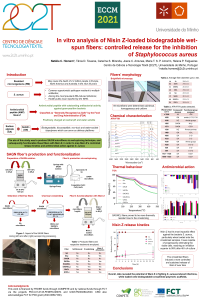
According to The Organization for Economic Cooperation and Development (OECD), 2.4 million people in Europe, North America and Australia may die in the next 30 years from infections caused by resistant microorganisms. S. aureus – a opportunistic pathogen resistant to multiple antibiotics – induced infections are among the most prevalent bacterial infections, being on the front of the line of the World Health Organization (WHO) concerns. In this study, we report the production of biodegradable microfibers composed of sodium alginate (SA) and gelatin (GN), via wet-spinning technique, and their subsequent functionalization via adsorption with Nisin Z. Nisin Z is an antimicrobial peptide which possess great antibacterial activity (mainly against Gram-positive bacteria) and low toxicity in humans, thus being a great candidate for the production of scaffolds with S. aureus eradication ability for infected wounds. SA/GN microfibers were successfully extruded at a 70/30% v/v polymer ratio, within a calcium chloride (CaCl2) 2wt% coagulation bath. SA-free fibers were obtained through chemical modification (PBS concentrated solutions and subsequently, SAGN and SA-free fibers were crosslinked with glutaraldehyde (labeled as SAGNCL and GNCL, respectively). Finally, Nisin Z was functionalized onto the fibers at an average concentration of 178µg/mL. Fibers were characterized via Fourier transform infrared spectroscopy, thermal analysis and brightfield microscopy. Nisin Z degradation/release profiles (SBF, 28 days) were assessed. Antibacterial activity against S. aureus was detected via time-kill kinetics assessments. SAGNCL and GNCL loaded microfibers were capable of inhibit the grow of S. aureus up to 99% after 48 h of culture. The SA and SAGN loaded microfibers were not as effective, losing their action after 6 h. Bacteria elimination was consistent with the release kinetics of Nisin Z from the fibers. Overall, data revealed the potential of Nisin Z in fighting S. aureus-induced infections, while loaded onto biodegradable crosslinked polymeric scaffolds.
Keywords
antibacterial activity
antimicrobial peptides
localized drug release
infection control
staphylococcus aureus.
Manuscript
Abstract_NH_ECCM final.pdf
Poster
Poster ECCM_NH.pdf
Effects of Adper™ Scotchbond™ 1 XT, Clearfil™ SE Bond 2 and Scotchbond™ Universal in odontoblastic activity
Exposure to COVID-19 among university students from six European Countries