Event submissions
EventsThe 2nd International Electronic Conference on Foods - "Future Foods and Food Technologies for a Sustainable World"
Published

This submission belongs to the session 10. Poster of the event The 2nd International Electronic Conference on Foods - "Future Foods and Food Technologies for a Sustainable World"
Published date
13 Oct, 2021
Academic Editor
'%3e%3cpath%20d='M12.6657%2010.9104C12.4185%2010.325%2012.0599%209.79327%2011.6097%209.34482C11.1609%208.89508%2010.6293%208.5365%2010.0442%208.28888C10.0389%208.28626%2010.0337%208.28495%2010.0285%208.28233C10.8446%207.69279%2011.3752%206.73249%2011.3752%205.64904C11.3752%203.8542%209.92103%202.39999%208.1262%202.39999C6.33136%202.39999%204.87715%203.8542%204.87715%205.64904C4.87715%206.73249%205.40774%207.69279%206.22393%208.28364C6.21869%208.28626%206.21345%208.28757%206.20821%208.29019C5.62129%208.5378%205.09463%208.89284%204.64265%209.34613C4.1929%209.79493%203.83432%2010.3266%203.58671%2010.9117C3.34345%2011.4845%203.21226%2012.0987%203.20023%2012.7209C3.19988%2012.7349%203.20233%2012.7488%203.20744%2012.7619C3.21255%2012.7749%203.22022%2012.7867%203.22998%2012.7968C3.23975%2012.8068%203.25142%2012.8147%203.26431%2012.8202C3.2772%2012.8256%203.29105%2012.8284%203.30504%2012.8284H4.09109C4.14874%2012.8284%204.19459%2012.7825%204.1959%2012.7262C4.2221%2011.7148%204.62823%2010.7676%205.34617%2010.0497C6.08899%209.30683%207.0755%208.89808%208.1262%208.89808C9.17689%208.89808%2010.1634%209.30683%2010.9062%2010.0497C11.6242%2010.7676%2012.0303%2011.7148%2012.0565%2012.7262C12.0578%2012.7838%2012.1037%2012.8284%2012.1613%2012.8284H12.9474C12.9613%2012.8284%2012.9752%2012.8256%2012.9881%2012.8202C13.001%2012.8147%2013.0126%2012.8068%2013.0224%2012.7968C13.0322%2012.7867%2013.0398%2012.7749%2013.0449%2012.7619C13.0501%2012.7488%2013.0525%2012.7349%2013.0522%2012.7209C13.0391%2012.0947%2012.9094%2011.4855%2012.6657%2010.9104ZM8.1262%207.9024C7.52486%207.9024%206.9589%207.6679%206.53312%207.24211C6.10733%206.81633%205.87283%206.25037%205.87283%205.64904C5.87283%205.0477%206.10733%204.48174%206.53312%204.05596C6.9589%203.63018%207.52486%203.39567%208.1262%203.39567C8.72753%203.39567%209.29349%203.63018%209.71927%204.05596C10.1451%204.48174%2010.3796%205.0477%2010.3796%205.64904C10.3796%206.25037%2010.1451%206.81633%209.71927%207.24211C9.29349%207.6679%208.72753%207.9024%208.1262%207.9024Z'%20fill='%235D1EE1'/%3e%3c/g%3e%3c/svg%3e) Christopher J. Smith
Christopher J. SmithCitation
Houari Benamar, Malika Bennaceur, Bioactive Compound Contents and Biological Activities of the Algerian Medicinal Plant Rhus Pentaphylla (Jacq.) Desf. (Anacardiaceae), in Proceedings of The 2nd International Electronic Conference on Foods - "Future Foods and Food Technologies for a Sustainable World", 15 October–30 October 2021, MDPI: Basel, Switzerland, doi: 10.3390/Foods2021-10915
Share
Email
Facebook
Twitter
LinkedIn
Bioactive Compound Contents and Biological Activities of the Algerian Medicinal Plant Rhus Pentaphylla (Jacq.) Desf. (Anacardiaceae)
'%3e%3cpath%20d='M12.6647%2010.9104C12.4176%2010.325%2012.0589%209.7933%2011.6088%209.34485C11.16%208.89511%2010.6283%208.53653%2010.0432%208.28891C10.038%208.28629%2010.0327%208.28498%2010.0275%208.28236C10.8437%207.69282%2011.3743%206.73252%2011.3743%205.64907C11.3743%203.85423%209.92005%202.40002%208.12522%202.40002C6.33038%202.40002%204.87618%203.85423%204.87618%205.64907C4.87618%206.73252%205.40677%207.69282%206.22296%208.28367C6.21772%208.28629%206.21248%208.2876%206.20724%208.29022C5.62031%208.53783%205.09365%208.89287%204.64167%209.34616C4.19192%209.79496%203.83334%2010.3266%203.58573%2010.9117C3.34247%2011.4846%203.21128%2012.0987%203.19925%2012.721C3.1989%2012.735%203.20135%2012.7489%203.20646%2012.7619C3.21157%2012.7749%203.21924%2012.7868%203.22901%2012.7968C3.23877%2012.8068%203.25045%2012.8148%203.26334%2012.8202C3.27623%2012.8256%203.29007%2012.8284%203.30406%2012.8284H4.09012C4.14776%2012.8284%204.19362%2012.7825%204.19493%2012.7262C4.22113%2011.7148%204.62726%2010.7676%205.34519%2010.0497C6.08802%209.30686%207.07452%208.89811%208.12522%208.89811C9.17592%208.89811%2010.1624%209.30686%2010.9052%2010.0497C11.6232%2010.7676%2012.0293%2011.7148%2012.0555%2012.7262C12.0568%2012.7839%2012.1027%2012.8284%2012.1603%2012.8284H12.9464C12.9604%2012.8284%2012.9742%2012.8256%2012.9871%2012.8202C13%2012.8148%2013.0117%2012.8068%2013.0214%2012.7968C13.0312%2012.7868%2013.0389%2012.7749%2013.044%2012.7619C13.0491%2012.7489%2013.0515%2012.735%2013.0512%2012.721C13.0381%2012.0947%2012.9084%2011.4856%2012.6647%2010.9104ZM8.12522%207.90243C7.52388%207.90243%206.95792%207.66793%206.53214%207.24215C6.10636%206.81636%205.87185%206.2504%205.87185%205.64907C5.87185%205.04773%206.10636%204.48177%206.53214%204.05599C6.95792%203.63021%207.52388%203.3957%208.12522%203.3957C8.72655%203.3957%209.29252%203.63021%209.7183%204.05599C10.1441%204.48177%2010.3786%205.04773%2010.3786%205.64907C10.3786%206.2504%2010.1441%206.81636%209.7183%207.24215C9.29252%207.66793%208.72655%207.90243%208.12522%207.90243Z'%20fill='%235D1EE1'/%3e%3c/g%3e%3c/svg%3e)
Houari Benamar 1,2
Malika Bennaceur 3,4
1. Department of Biology, Faculty of Natural Sciences and Life, University of Oran1, PO Box 1524, El M'Naouer, 31000 Oran, Algeria
2. Laboratory of Research in Arid Areas, Faculty of Biological Sciences, University of Science and Technology Houari Boumediene, PO Box 32, El Alia, Bab Ezzouar, 16111 Algiers, Algeria
3. Department of Biology, University of Oran1, PO Box 1524, El M'Naouer, 31000 Oran, Algeria
4. Laboratory of Research in Arid Areas, Department of Biology and Physiology of Organisms, University of Science and Technology Houari Boumediene, PO Box 32, El Alia, Bab Ezzouar, 16111 Algiers, Algeria
Abstract
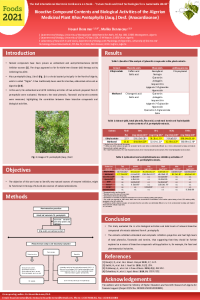
Background: Rhus pentaphylla (Jacq.) Desf. is an Algerian food and medicinal specie used to treat diarrhea, abdominal colic and employed as digestive [1-3], yet there is little information available concerning their bioactive composition.
Objectives: The aim of this study was to quantify bioactive compounds and to investigate antioxidant and acetylcholinesterase inhibitory activities of extracts obtained from leaves of R. pentaphylla, in order to prove its possible use as potential natural source for human health.
Methods: The bioactive compounds were quantified by colorimetric methods. The phytochemical analysis was carried out by chromatographic techniques. The antioxidant activity was assayed by using several test systems, namely total antioxidant capacity, DPPH, ABTS and OH radicals scavenging activity, ferric reducing power assay, ferrous ion chelating capacity and β-carotene bleaching assay. The acetylcholinesterase inhibitory activity was determined by bioautographic and spectrophotometric methods.
Results: The results showed that the extracts of R. pentaphylla are an excellent source of phenolic compounds especially regarding its high flavonoid and hydrolysable tannin contents (36.26 ± 1.77 mg CE/g DE and 898.64 ± 26.56 mg TAE/g DE, respectively) promoting high antioxidant activity. The phytochemical analysis led to the identification of several phenolic compounds that were dominated by flavonoids and phenolic acids. The extracts showed a potential antioxidant activity by the different tests. This could be attributed to their polyphenol, tannin and flavonoid contents. The extracts of R. pentaphylla also exhibited anti-acetylcholinesterase activity.
Conclusion: Owing to its phenolic profile and biological activities, R. pentaphylla could be considered as potential functional-ingredient for pharmaceutical applications.
Keywords
Antioxidant activity
acetylcholinesterase inhibitory activity
Rhus pentaphylla
medicinal plant
phenolic compounds
chromatographic techniques
Manuscript
Abstract_Houari Benamar_Foods2021.pdf
Poster
Poster_Houari Benamar_Foods2021.pdf
Berry-based products classification by FIA−HRMS fingerprinting and chemometric analysis