Event submissions
EventsThe 2nd International Electronic Conference on Foods - "Future Foods and Food Technologies for a Sustainable World"
Published

This submission belongs to the session 10. Poster of the event The 2nd International Electronic Conference on Foods - "Future Foods and Food Technologies for a Sustainable World"
Published date
14 Oct, 2021
Academic Editor
'%3e%3cpath%20d='M12.6657%2010.9104C12.4185%2010.325%2012.0599%209.79327%2011.6097%209.34482C11.1609%208.89508%2010.6293%208.5365%2010.0442%208.28888C10.0389%208.28626%2010.0337%208.28495%2010.0285%208.28233C10.8446%207.69279%2011.3752%206.73249%2011.3752%205.64904C11.3752%203.8542%209.92103%202.39999%208.1262%202.39999C6.33136%202.39999%204.87715%203.8542%204.87715%205.64904C4.87715%206.73249%205.40774%207.69279%206.22393%208.28364C6.21869%208.28626%206.21345%208.28757%206.20821%208.29019C5.62129%208.5378%205.09463%208.89284%204.64265%209.34613C4.1929%209.79493%203.83432%2010.3266%203.58671%2010.9117C3.34345%2011.4845%203.21226%2012.0987%203.20023%2012.7209C3.19988%2012.7349%203.20233%2012.7488%203.20744%2012.7619C3.21255%2012.7749%203.22022%2012.7867%203.22998%2012.7968C3.23975%2012.8068%203.25142%2012.8147%203.26431%2012.8202C3.2772%2012.8256%203.29105%2012.8284%203.30504%2012.8284H4.09109C4.14874%2012.8284%204.19459%2012.7825%204.1959%2012.7262C4.2221%2011.7148%204.62823%2010.7676%205.34617%2010.0497C6.08899%209.30683%207.0755%208.89808%208.1262%208.89808C9.17689%208.89808%2010.1634%209.30683%2010.9062%2010.0497C11.6242%2010.7676%2012.0303%2011.7148%2012.0565%2012.7262C12.0578%2012.7838%2012.1037%2012.8284%2012.1613%2012.8284H12.9474C12.9613%2012.8284%2012.9752%2012.8256%2012.9881%2012.8202C13.001%2012.8147%2013.0126%2012.8068%2013.0224%2012.7968C13.0322%2012.7867%2013.0398%2012.7749%2013.0449%2012.7619C13.0501%2012.7488%2013.0525%2012.7349%2013.0522%2012.7209C13.0391%2012.0947%2012.9094%2011.4855%2012.6657%2010.9104ZM8.1262%207.9024C7.52486%207.9024%206.9589%207.6679%206.53312%207.24211C6.10733%206.81633%205.87283%206.25037%205.87283%205.64904C5.87283%205.0477%206.10733%204.48174%206.53312%204.05596C6.9589%203.63018%207.52486%203.39567%208.1262%203.39567C8.72753%203.39567%209.29349%203.63018%209.71927%204.05596C10.1451%204.48174%2010.3796%205.0477%2010.3796%205.64904C10.3796%206.25037%2010.1451%206.81633%209.71927%207.24211C9.29349%207.6679%208.72753%207.9024%208.1262%207.9024Z'%20fill='%235D1EE1'/%3e%3c/g%3e%3c/svg%3e) Christopher J. Smith
Christopher J. SmithCitation
Francesco Bigi, Enrico Maurizzi, Heinz Wilhelm Siesler, andrea pulvirenti, hossein haghighi, Characterization of active chitosan/hydroxypropyl methylcellulose/orange cellulose nanocrystals films enriched with LAE for food packaging applications, in Proceedings of The 2nd International Electronic Conference on Foods - "Future Foods and Food Technologies for a Sustainable World", 15 October–30 October 2021, MDPI: Basel, Switzerland, doi: 10.3390/Foods2021-10933
Share
Email
Facebook
Twitter
LinkedIn
Characterization of active chitosan/hydroxypropyl methylcellulose/orange cellulose nanocrystals films enriched with LAE for food packaging applications
'%3e%3cpath%20d='M12.6647%2010.9104C12.4176%2010.325%2012.0589%209.7933%2011.6088%209.34485C11.16%208.89511%2010.6283%208.53653%2010.0432%208.28891C10.038%208.28629%2010.0327%208.28498%2010.0275%208.28236C10.8437%207.69282%2011.3743%206.73252%2011.3743%205.64907C11.3743%203.85423%209.92005%202.40002%208.12522%202.40002C6.33038%202.40002%204.87618%203.85423%204.87618%205.64907C4.87618%206.73252%205.40677%207.69282%206.22296%208.28367C6.21772%208.28629%206.21248%208.2876%206.20724%208.29022C5.62031%208.53783%205.09365%208.89287%204.64167%209.34616C4.19192%209.79496%203.83334%2010.3266%203.58573%2010.9117C3.34247%2011.4846%203.21128%2012.0987%203.19925%2012.721C3.1989%2012.735%203.20135%2012.7489%203.20646%2012.7619C3.21157%2012.7749%203.21924%2012.7868%203.22901%2012.7968C3.23877%2012.8068%203.25045%2012.8148%203.26334%2012.8202C3.27623%2012.8256%203.29007%2012.8284%203.30406%2012.8284H4.09012C4.14776%2012.8284%204.19362%2012.7825%204.19493%2012.7262C4.22113%2011.7148%204.62726%2010.7676%205.34519%2010.0497C6.08802%209.30686%207.07452%208.89811%208.12522%208.89811C9.17592%208.89811%2010.1624%209.30686%2010.9052%2010.0497C11.6232%2010.7676%2012.0293%2011.7148%2012.0555%2012.7262C12.0568%2012.7839%2012.1027%2012.8284%2012.1603%2012.8284H12.9464C12.9604%2012.8284%2012.9742%2012.8256%2012.9871%2012.8202C13%2012.8148%2013.0117%2012.8068%2013.0214%2012.7968C13.0312%2012.7868%2013.0389%2012.7749%2013.044%2012.7619C13.0491%2012.7489%2013.0515%2012.735%2013.0512%2012.721C13.0381%2012.0947%2012.9084%2011.4856%2012.6647%2010.9104ZM8.12522%207.90243C7.52388%207.90243%206.95792%207.66793%206.53214%207.24215C6.10636%206.81636%205.87185%206.2504%205.87185%205.64907C5.87185%205.04773%206.10636%204.48177%206.53214%204.05599C6.95792%203.63021%207.52388%203.3957%208.12522%203.3957C8.72655%203.3957%209.29252%203.63021%209.7183%204.05599C10.1441%204.48177%2010.3786%205.04773%2010.3786%205.64907C10.3786%206.2504%2010.1441%206.81636%209.7183%207.24215C9.29252%207.66793%208.72655%207.90243%208.12522%207.90243Z'%20fill='%235D1EE1'/%3e%3c/g%3e%3c/svg%3e)
Francesco Bigi 1
Enrico Maurizzi 1
Heinz Wilhelm Siesler 2

andrea pulvirenti 1,3
hossein haghighi 1
1. Department of Life Sciences, University of Modena and Reggio Emilia, Reggio Emilia, Italy
2. Department of Physical Chemistry, University of Duisburg Essen, Essen, Germany
3. Interdepartmental Research Centre for the Improvement of Agro-Food Biological Resources (BIOGEST-SITEIA), University of Modena and Reggio Emilia, Reggio Emilia, Italy
Abstract
Cellulose nanocrystals (CNCs) were extracted from orange peels using an alkaline/H2O2 bleaching pre-treatment followed by sulfuric acid hydrolysis. Extracted CNCs were added as reinforcing agent into films based on chitosan/hydroxypropyl methylcellulose blend (CS/HPMC) enriched with lauroyl arginate ethyl (LAE) to produce bio nanocomposite active films. The size and morphology of CNCs were characterized by transmission electron microscopy. In addition, the effect of CNCs (10% w/w of biopolymer) and LAE (5% w/w of biopolymer) on microstructural, optical, mechanical, water barrier, and antimicrobial properties of the CS/HPMC films were analyzed. CNCs displayed needle-like shapes morphology with an average length of 500 nm, an average width of 40 nm. Scanning electron microscopy illustrated structural integrity and compatibility between CS/HPMC/CNCs and incorporated LAE. The successful incorporation of CNCs and LAE was confirmed by fourier transform infrared spectroscopy mainly due to the formation of hydrogen linkages between film matrix and incorporated CNCs and LAE. This nanocomposite active film showed improvement in UV-Vis light barrier properties (p<0.05). The addition of CNCs to CS/HPMC caused a reduction in water vapor permeability, while tensile strength was improved due to the homogeneous distribution of the nanoparticles within the polymer matrix. On contrary, LAE incorporation into CS/HPMC improved the elasticity and also caused antimicrobial activity against S. enterica subsp. Thyphimurium and L. monocytogenes. Overall, nanocomposite films based on CS/HPMC/CNCs enriched with LAE could represent a suitable green approach for a partial replacement of synthetic plastics for packaging foods sensitive to microbiological decay and spread of foodborne pathogens.
Keywords
Antimicrobial activity
Cellulose nano crystals
Chitosan/hydroxypropyl methylcellulose blend film
Food packaging
Mechanical properties
Scanning electron microscopy
Fourier transform infrared spectroscopy
Manuscript
Poster_Bigi et al. (2021).pdf
Poster
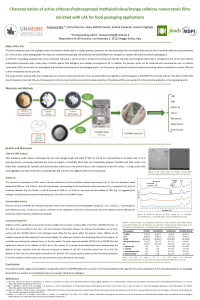
Poster_Bigi et al. (2021).pdf
INFOGEST 2.0 digestion method: Characterization of the sterol content in the digestion reagents
Characterization of polyphenolic composition of extracts form winery wastes by HPLC-UV-MS/MS