Event submissions
EventsThe 2nd International Electronic Conference on Foods - "Future Foods and Food Technologies for a Sustainable World"
Published

This submission belongs to the session 10. Poster of the event The 2nd International Electronic Conference on Foods - "Future Foods and Food Technologies for a Sustainable World"
Published date
13 Oct, 2021
Academic Editor
'%3e%3cpath%20d='M12.6657%2010.9104C12.4185%2010.325%2012.0599%209.79327%2011.6097%209.34482C11.1609%208.89508%2010.6293%208.5365%2010.0442%208.28888C10.0389%208.28626%2010.0337%208.28495%2010.0285%208.28233C10.8446%207.69279%2011.3752%206.73249%2011.3752%205.64904C11.3752%203.8542%209.92103%202.39999%208.1262%202.39999C6.33136%202.39999%204.87715%203.8542%204.87715%205.64904C4.87715%206.73249%205.40774%207.69279%206.22393%208.28364C6.21869%208.28626%206.21345%208.28757%206.20821%208.29019C5.62129%208.5378%205.09463%208.89284%204.64265%209.34613C4.1929%209.79493%203.83432%2010.3266%203.58671%2010.9117C3.34345%2011.4845%203.21226%2012.0987%203.20023%2012.7209C3.19988%2012.7349%203.20233%2012.7488%203.20744%2012.7619C3.21255%2012.7749%203.22022%2012.7867%203.22998%2012.7968C3.23975%2012.8068%203.25142%2012.8147%203.26431%2012.8202C3.2772%2012.8256%203.29105%2012.8284%203.30504%2012.8284H4.09109C4.14874%2012.8284%204.19459%2012.7825%204.1959%2012.7262C4.2221%2011.7148%204.62823%2010.7676%205.34617%2010.0497C6.08899%209.30683%207.0755%208.89808%208.1262%208.89808C9.17689%208.89808%2010.1634%209.30683%2010.9062%2010.0497C11.6242%2010.7676%2012.0303%2011.7148%2012.0565%2012.7262C12.0578%2012.7838%2012.1037%2012.8284%2012.1613%2012.8284H12.9474C12.9613%2012.8284%2012.9752%2012.8256%2012.9881%2012.8202C13.001%2012.8147%2013.0126%2012.8068%2013.0224%2012.7968C13.0322%2012.7867%2013.0398%2012.7749%2013.0449%2012.7619C13.0501%2012.7488%2013.0525%2012.7349%2013.0522%2012.7209C13.0391%2012.0947%2012.9094%2011.4855%2012.6657%2010.9104ZM8.1262%207.9024C7.52486%207.9024%206.9589%207.6679%206.53312%207.24211C6.10733%206.81633%205.87283%206.25037%205.87283%205.64904C5.87283%205.0477%206.10733%204.48174%206.53312%204.05596C6.9589%203.63018%207.52486%203.39567%208.1262%203.39567C8.72753%203.39567%209.29349%203.63018%209.71927%204.05596C10.1451%204.48174%2010.3796%205.0477%2010.3796%205.64904C10.3796%206.25037%2010.1451%206.81633%209.71927%207.24211C9.29349%207.6679%208.72753%207.9024%208.1262%207.9024Z'%20fill='%235D1EE1'/%3e%3c/g%3e%3c/svg%3e) Christopher J. Smith
Christopher J. SmithCitation
Maria Celeiro, Lua Vazquez, Daniel Armada, Thierry Dagnac, Maria Llompart, ASSESSING THE content OF PHYTOCHEMICALS IN HONEY SAMPLES: POLYPHENOLS AS BIO-indicatorS OF THEIR BOTANICAL ORIGIN, in Proceedings of The 2nd International Electronic Conference on Foods - "Future Foods and Food Technologies for a Sustainable World", 15 October–30 October 2021, MDPI: Basel, Switzerland, doi: 10.3390/Foods2021-10936
Share
Email
Facebook
Twitter
LinkedIn
ASSESSING THE content OF PHYTOCHEMICALS IN HONEY SAMPLES: POLYPHENOLS AS BIO-indicatorS OF THEIR BOTANICAL ORIGIN

Maria Celeiro 1
'%3e%3cpath%20d='M12.6647%2010.9104C12.4176%2010.325%2012.0589%209.7933%2011.6088%209.34485C11.16%208.89511%2010.6283%208.53653%2010.0432%208.28891C10.038%208.28629%2010.0327%208.28498%2010.0275%208.28236C10.8437%207.69282%2011.3743%206.73252%2011.3743%205.64907C11.3743%203.85423%209.92005%202.40002%208.12522%202.40002C6.33038%202.40002%204.87618%203.85423%204.87618%205.64907C4.87618%206.73252%205.40677%207.69282%206.22296%208.28367C6.21772%208.28629%206.21248%208.2876%206.20724%208.29022C5.62031%208.53783%205.09365%208.89287%204.64167%209.34616C4.19192%209.79496%203.83334%2010.3266%203.58573%2010.9117C3.34247%2011.4846%203.21128%2012.0987%203.19925%2012.721C3.1989%2012.735%203.20135%2012.7489%203.20646%2012.7619C3.21157%2012.7749%203.21924%2012.7868%203.22901%2012.7968C3.23877%2012.8068%203.25045%2012.8148%203.26334%2012.8202C3.27623%2012.8256%203.29007%2012.8284%203.30406%2012.8284H4.09012C4.14776%2012.8284%204.19362%2012.7825%204.19493%2012.7262C4.22113%2011.7148%204.62726%2010.7676%205.34519%2010.0497C6.08802%209.30686%207.07452%208.89811%208.12522%208.89811C9.17592%208.89811%2010.1624%209.30686%2010.9052%2010.0497C11.6232%2010.7676%2012.0293%2011.7148%2012.0555%2012.7262C12.0568%2012.7839%2012.1027%2012.8284%2012.1603%2012.8284H12.9464C12.9604%2012.8284%2012.9742%2012.8256%2012.9871%2012.8202C13%2012.8148%2013.0117%2012.8068%2013.0214%2012.7968C13.0312%2012.7868%2013.0389%2012.7749%2013.044%2012.7619C13.0491%2012.7489%2013.0515%2012.735%2013.0512%2012.721C13.0381%2012.0947%2012.9084%2011.4856%2012.6647%2010.9104ZM8.12522%207.90243C7.52388%207.90243%206.95792%207.66793%206.53214%207.24215C6.10636%206.81636%205.87185%206.2504%205.87185%205.64907C5.87185%205.04773%206.10636%204.48177%206.53214%204.05599C6.95792%203.63021%207.52388%203.3957%208.12522%203.3957C8.72655%203.3957%209.29252%203.63021%209.7183%204.05599C10.1441%204.48177%2010.3786%205.04773%2010.3786%205.64907C10.3786%206.2504%2010.1441%206.81636%209.7183%207.24215C9.29252%207.66793%208.72655%207.90243%208.12522%207.90243Z'%20fill='%235D1EE1'/%3e%3c/g%3e%3c/svg%3e)
Lua Vazquez 2
Daniel Armada 2
Thierry Dagnac 3
Maria Llompart 2
1. CRETUS, Department of Analytical Chemistry, Nutrition and Food Science, University of Santiago de Compostela, Santiago de Compostela, 15782, Spain
2. University of Santiago de Compostela
3. Galician Agency for Food Quality, Xunta de Galicia
Abstract
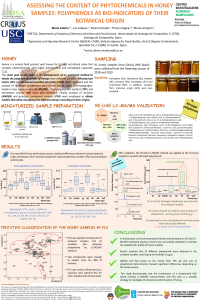
Honey is a natural food product well known for its high nutritional value. Apart from sugars, it contains phytochemicals, including polyphenols and flavonoids that are compounds with highly demonstrated antimicrobial and antioxidant capacities.
The main goal of this work is the development of an analytical methodology to obtain the polyphenolic profile of honeys from different varieties and pollen sources. To isolate the target compounds from the samples, miniaturized vortex (VE) and ultrasound assisted extraction (UAE) employing aqueous solvent followed by liquid chromatography-tandem mass spectrometry (LC-MS/MS) were employed. Results revealed that more than 20 different polyphenols of the 40 target were detected in the analyzed samples, reaching total concentrations up to hundreds of µg g-1. Other indexes such as the total polyphenolic content (TPC) and antioxidant activity (AA) were also evaluated by spectrophotometric techniques.
ANOVA and PCA based on the results from TPC, AA and individual polyphenols concentration showed that significant differences appeared depending on the honey variety, being several of the identified polyphenols, especially hydroxycinnamic acids, responsible of the main differentiation. PCA revealed that two components were enough to explain more than 90% of variance and honey classification in 6 different groups, attending to the presence of individual polyphenols, was successfully obtained showing that the combination of chromatographic analysis, mass spectrometry detection and PCA are suitable tools to investigate the botanical authentication of honey.
Acknowledgement. This research was supported by project GO FEADER 2018/054B (Xunta de Galicia). The authors belong to the National Network for the Innovation in miniaturized sample preparation techniques, RED2018-102522-T (Ministry of Science, Innovation and Universities, Spain), and to the Galician Competitive Research Groups IN607B 2019/13 and ED431 2020/06 (Xunta de Galicia). This study is based upon work from the Sample Preparation Study Group and Network, supported by the Division of Analytical Chemistry of the European Chemical Society. All these programmes are co-funded by FEDER (EU). Authors would like to acknowledge the Regulator Council of Galician Honey (IXP, Mel de Galicia) for collecting and supplying the samples.
Keywords
honey
polyphenols
total polyphenolic content
antioxidant activity
liquid chromatography
tandem mass spectrometry
principal components analysis
Manuscript
Abstract_honey.pdf
Poster
Poster_honey_v3pdf.pdf
Assessment of the polyphenolic composition of orange wastes from agri-food industries by HPLC-UV-MS/MS
Evaluation of analytical methods to determine regulatory compliance of coffee leaf tea